







Question: NEED HELP ASAP PLZ!!!Also here is some helpful tips from my teacher:Question 01, part a:For this part, consider three different cases based on the agent's
NEED HELP ASAP PLZ!!!Also here is some helpful tips from my teacher:Question 01, part a:For this part, consider three different cases based on the agent's working hours. Specifically, analyze scenarios where the agent works more than 8 hours, exactly 8 hours, or fewer than 8 hours. Each case might occur depending on parameter values. If your calculations suggest L*>16, then ensure that this is consistent with your findings. Any inconsistency here should lead you to discard this case.Question 01, part b:Here, you should examine two scenarios. In the first, consider the agent working less than 8 hours, and in the second, the agent working more than 8 hours. Apply the appropriate optimality conditions for each case and then substitute these into the corresponding budget constraints. Remove any scenarios that yield inconsistencies.Question 01, part c:You have two alternative approaches for this part. One way is to solve for the optimal L* and C* under the standard budget constraint and then sketch indifference curves that align with this solution. This can help you identify a possible corner solution. Alternatively, you could compare the Marginal Rate of Substitution for leisure (MRSL) with the Opportunity Cost of leisure to decide if the agent would prefer as much or as little leisure as possible within the constraints.Question 01, part d: To work or not to work. That is the question. For this part, consider the decision of whether to work or not. In other words, examine the case where the agent does not work and evaluate how the lump-sum amount B affects L* and C*. Since you have a jump at L=24, you need to compare the utility of working with the utility of not working to pin down L* and C*.
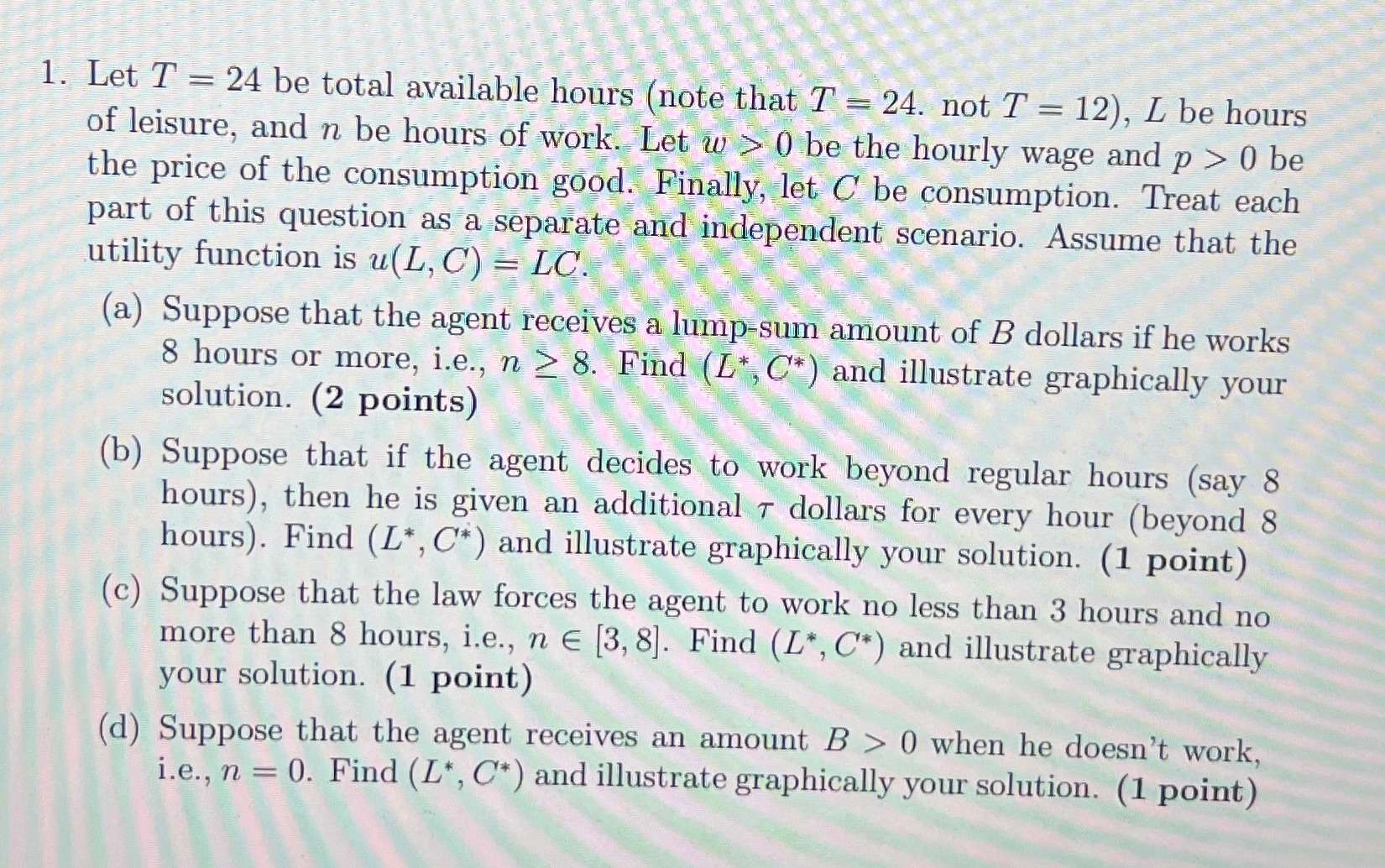
1. Let T = 24 be total available hours (note that T = 24. not T = 12), L be hours of leisure, and n be hours of work. Let w > 0 be the hourly wage and p > 0 be the price of the consumption good. Finally, let C be consumption. Treat each part of this question as a separate and independent scenario. Assume that the utility function is u(L, C) = LC. (a) Suppose that the agent receives a lump-sum amount of B dollars if he works 8 hours or more, i.e., n 2 8. Find (L*, C*) and illustrate graphically your solution. (2 points) (b) Suppose that if the agent decides to work beyond regular hours (say 8 hours), then he is given an additional 7 dollars for every hour (beyond 8 hours). Find (L*, C*) and illustrate graphically your solution. (1 point) (c) Suppose that the law forces the agent to work no less than 3 hours and no more than 8 hours, i.e., n E [3, 8]. Find (L*, C*) and illustrate graphically your solution. (1 point) (d) Suppose that the agent receives an amount B > 0 when he doesn't work, i.e., n = 0. Find (L*, C*) and illustrate graphically your solution. (1 point)
Step by Step Solution
There are 3 Steps involved in it

Get step-by-step solutions from verified subject matter experts
 Study Help