Question: Need help by 1 PM (EST) Nov 18! Q1 Write a short answer based on customers' negative attitudes towards smart kitchen appliances to each bullet
Need help by 1 PM (EST) Nov 18!
Q1 Write a short answer based on customers' negative attitudes towards smart kitchen appliances to each bullet point question listed below with research objectives & questions, SWOT analysis, qualitative analysis, etc.
- Project Objective
- Research Questions from GE Appliances Research Proposal (and highlight which one you are addressing with your recommendation)
- Findings from your research that answer the research question you have chosen. Make sure you use at least one data point from each source. You may conduct additional research for this assignment
- Recommendation based on your research. Include any projected tangible benefits for GE Appliances
- Conclusion with a call to action.
(This is for a marketing class)
Research Objectives & Questions Understand the competitive landscape and pace of growth for smart cooking accessories, other cooking accessories, and paid digital upgrades especially ones done by GE appliances competitors and by small kitchen appliances. -What are competitors doing around traditional accessories, smart accessories, software upgrades, and 3rd party software/service partnerships? (background research) -What are smaller more innovative companies doing in this space that we should learn from? (e.g., start-ups, smaller companies, international companies) (background research) -What accessories, smart capabilities, services, partnerships would consumers be interested in? (primary research) Identify unmet consumer needs and preferences in cooking and competitive products, and based on the competitive analysis, explore additional products that would be a good fit. (primary research)
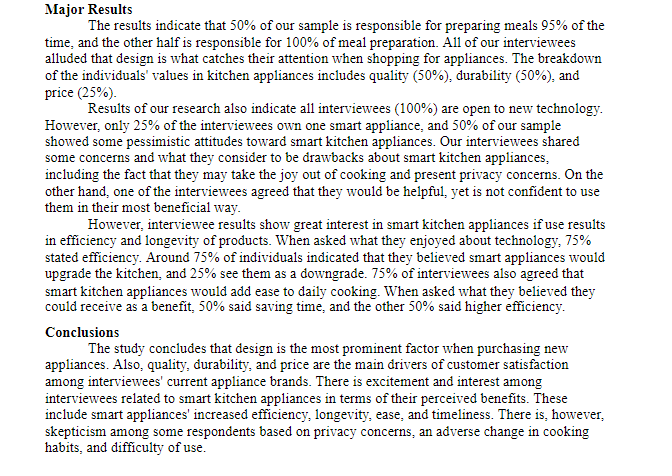
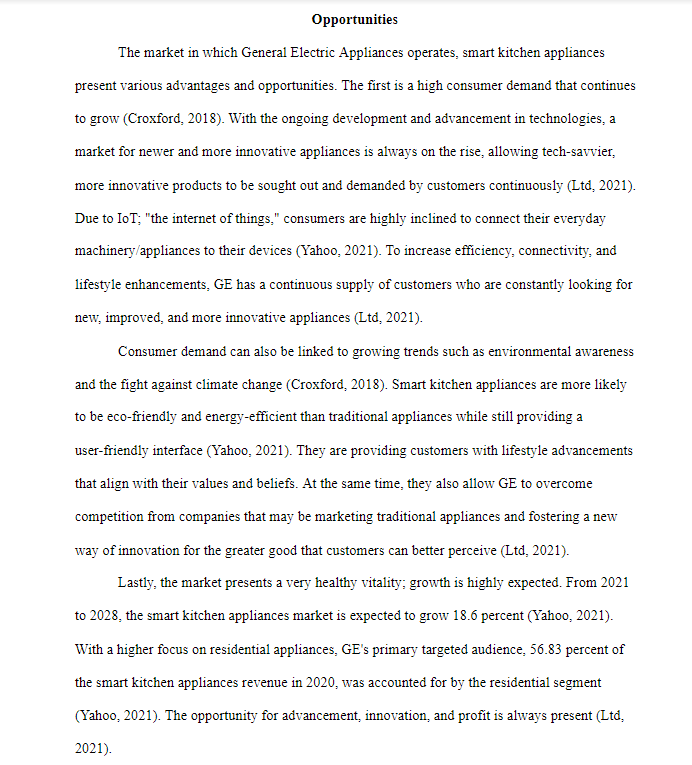
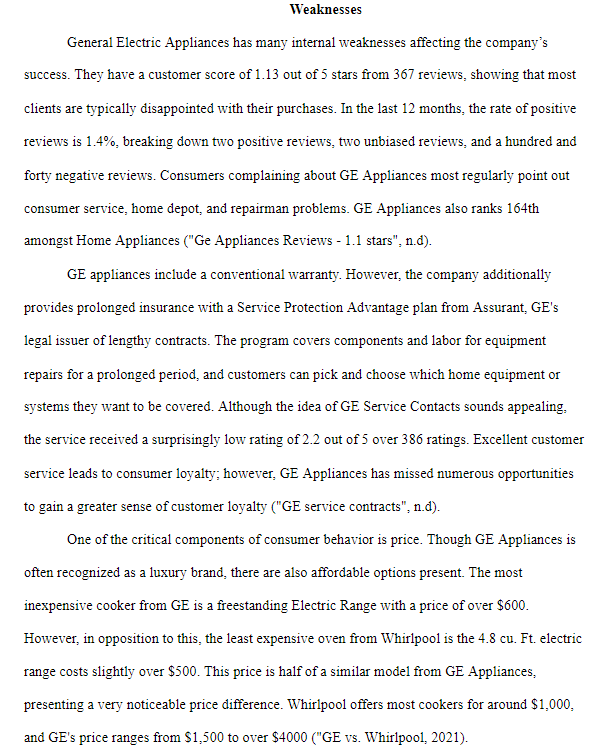
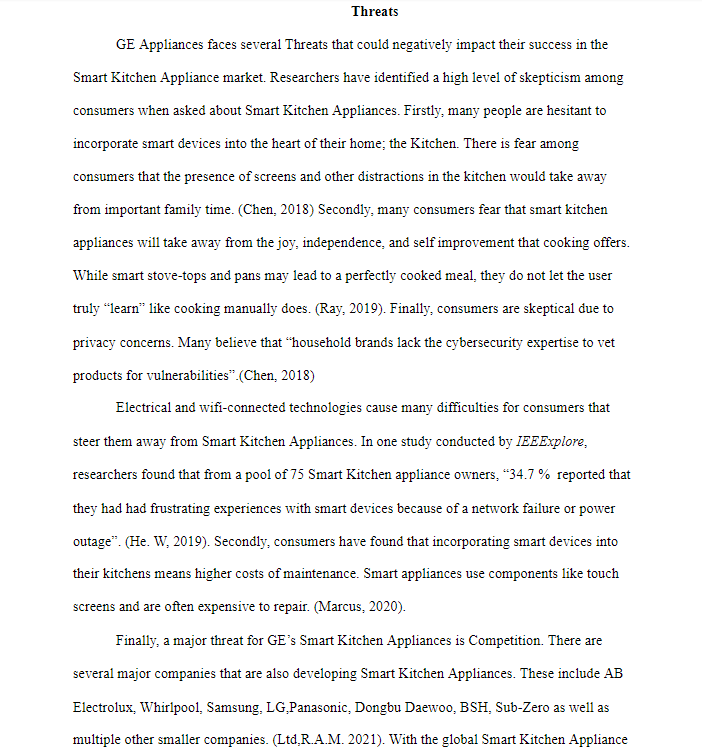
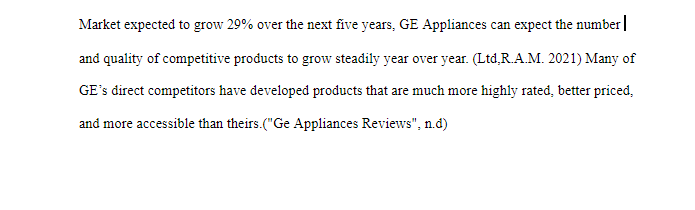
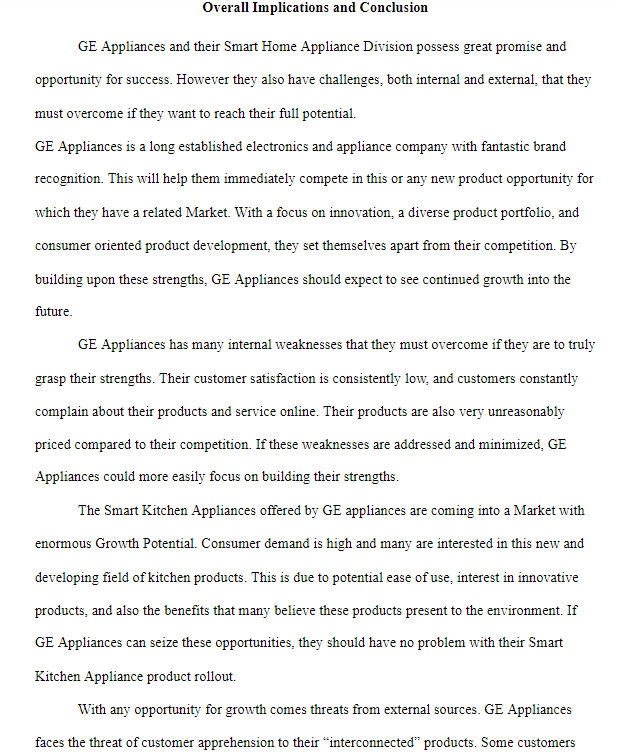
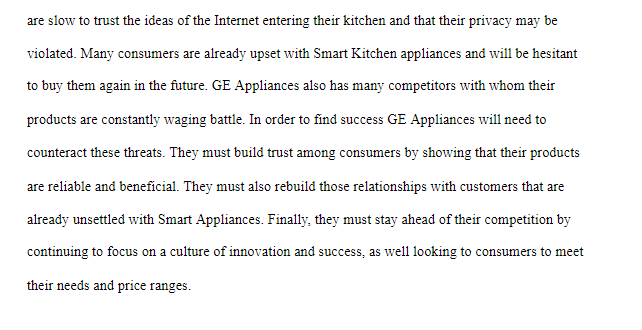
Major Results The results indicate that 50% of our sample is responsible for preparing meals 95% of the time, and the other half is responsible for 100% of meal preparation. All of our interviewees alluded that design is what catches their attention when shopping for appliances. The breakdown of the individuals' values in kitchen appliances includes quality (50%), durability (50%), and price (25%). Results of our research also indicate all interviewees (100%) are open to new technology. However, only 25% of the interviewees own one smart appliance, and 50% of our sample showed some pessimistic attitudes toward smart kitchen appliances. Our interviewees shared some concerns and what they consider to be drawbacks about smart kitchen appliances, including the fact that they may take the joy out of cooking and present privacy concerns. On the other hand, one of the interviewees agreed that they would be helpful, yet is not confident to use them in their most beneficial way. However, interviewee results show great interest in smart kitchen appliances if use results in efficiency and longevity of products. When asked what they enjoyed about technology, 75% stated efficiency. Around 75% of individuals indicated that they believed smart appliances would upgrade the kitchen and 25% see them as a downgrade. 75% of interviewees also agreed that smart kitchen appliances would add ease to daily cooking. When asked what they believed they could receive as a benefit. 50% said saving time, and the other 50% said higher efficiency. Conclusions The study concludes that design is the most prominent factor when purchasing new appliances. Also, quality, durability, and price are the main drivers of customer satisfaction among interviewees' current appliance brands. There is excitement and interest among interviewees related to smart kitchen appliances in terms of their perceived benefits. These include smart appliances' increased efficiency, longevity, ease, and timeliness. There is, however, skepticism among some respondents based on privacy concerns, an adverse change in cooking habits, and difficulty of use. Opportunities The market in which General Electric Appliances operates, smart kitchen appliances present various advantages and opportunities. The first is a high consumer demand that continues to grow (Croxford, 2018). With the ongoing development and advancement in technologies, a market for newer and more innovative appliances is always on the rise, allowing tech-savvier, more innovative products to be sought out and demanded by customers continuously (Ltd, 2021). Due to IoT: "the internet of things." consumers are highly inclined to connect their everyday machinery/appliances to their devices (Yahoo, 2021). To increase efficiency, connectivity, and lifestyle enhancements, GE has a continuous supply of customers who are constantly looking for new, improved, and more innovative appliances (Ltd, 2021). Consumer demand can also be linked to growing trends such as environmental awareness and the fight against climate change (Croxford, 2018). Smart kitchen appliances are more likely to be eco-friendly and energy-efficient than traditional appliances while still providing a user-friendly interface (Yahoo, 2021). They are providing customers with lifestyle advancements that align with their values and beliefs. At the same time, they also allow GE to overcome competition from companies that may be marketing traditional appliances and fostering a new way of innovation for the greater good that customers can better perceive (Ltd, 2021). Lastly, the market presents a very healthy vitality, growth is highly expected. From 2021 to 2028, the smart kitchen appliances market is expected to grow 18.6 percent (Yahoo, 2021). With a higher focus on residential appliances, GE's primary targeted audience, 56.83 percent of the smart kitchen appliances revenue in 2020, was accounted for by the residential segment (Yahoo, 2021). The opportunity for advancement, innovation, and profit is always present (Ltd, 2021). Weaknesses General Electric Appliances has many internal weaknesses affecting the company's success. They have a customer score of 1.13 out of 5 stars from 367 reviews, showing that most clients are typically disappointed with their purchases. In the last 12 months, the rate of positive reviews is 1.4%, breaking down two positive reviews, two unbiased reviews, and a hundred and forty negative reviews. Consumers complaining about GE Appliances most regularly point out consumer service, home depot, and repairman problems. GE Appliances also ranks 164th amongst Home Appliances ("Ge Appliances Reviews - 1.1 stars", n.d). GE appliances include a conventional warranty. However, the company additionally provides prolonged insurance with a Service Protection Advantage plan from Assurant, GE's legal issuer of lengthy contracts. The program covers components and labor for equipment repairs for a prolonged period, and customers can pick and choose which home equipment or systems they want to be covered. Although the idea of GE Service Contacts sounds appealing. the service received a surprisingly low rating of 2.2 out of 5 over 386 ratings. Excellent customer service leads to consumer loyalty; however, GE Appliances has missed numerous opportunities to gain a greater sense of customer loyalty ("GE service contracts", n.d). One of the critical components of consumer behavior is price. Though GE Appliances is often recognized as a luxury brand, there are also affordable options present. The most inexpensive cooker from GE is a freestanding Electric Range with a price of over $600. However, in opposition to this, the least expensive oven from Whirlpool is the 4.8 cu. Ft. electric range costs slightly over $500. This price is half of a similar model from GE Appliances, presenting a very noticeable price difference. Whirlpool offers most cookers for around $1,000, and GE's price ranges from $1,500 to over $4000 ("GE vs. Whirlpool, 2021). Threats GE Appliances faces several Threats that could negatively impact their success in the Smart Kitchen Appliance market. Researchers have identified a high level of skepticism among consumers when asked about Smart Kitchen Appliances. Firstly, many people are hesitant to incorporate smart devices into the heart of their home; the Kitchen. There is fear among consumers that the presence of screens and other distractions in the kitchen would take away from important family time. (Chen, 2018) Secondly, many consumers fear that smart kitchen appliances will take away from the joy, independence, and self improvement that cooking offers. While smart stove-tops and pans may lead to a perfectly cooked meal, they do not let the user truly "learn" like cooking manually does. (Ray, 2019). Finally, consumers are skeptical due to privacy concerns. Many believe that household brands lack the cybersecurity expertise to vet products for vulnerabilities. (Chen, 2018) Electrical and wifi-connected technologies cause many difficulties for consumers that steer them away from Smart Kitchen Appliances. In one study conducted by IEEExplore, researchers found that from a pool of 75 Smart Kitchen appliance owners, 34.7% reported that they had had frustrating experiences with smart devices because of a network failure or power outage. (He. W, 2019). Secondly, consumers have found that incorporating smart devices into their kitchens means higher costs of maintenance. Smart appliances use components like touch screens and are often expensive to repair. (Marcus, 2020). Finally, a major threat for GE's Smart Kitchen Appliances is Competition. There are several major companies that are also developing Smart Kitchen Appliances. These include AB Electrolux, Whirlpool, Samsung, LG Panasonic, Dongbu Daewoo, BSH, Sub-Zero as well as multiple other smaller companies. (Ltd.R.A.M. 2021). With the global Smart Kitchen Appliance Market expected to grow 29% over the next five years, GE Appliances can expect the number| and quality of competitive products to grow steadily year over year. (Ltd.R.A.M. 2021) Many of GE's direct competitors have developed products that are much more highly rated, better priced, and more accessible than theirs. ("Ge Appliances Reviews", n.d) Overall Implications and Conclusion GE Appliances and their Smart Home Appliance Division possess great promise and opportunity for success. However they also have challenges, both internal and external, that they must overcome if they want to reach their full potential. GE Appliances is a long established electronics and appliance company with fantastic brand recognition. This will help them immediately compete in this or any new product opportunity for which they have a related Market. With a focus on innovation, a diverse product portfolio, and consumer oriented product development, they set themselves apart from their competition. By building upon these strengths, GE Appliances should expect to see continued growth into the future. GE Appliances has many internal weaknesses that they must overcome if they are to truly grasp their strengths. Their customer satisfaction is consistently low, and customers constantly complain about their products and service online. Their products are also very unreasonably priced compared to their competition. If these weaknesses are addressed and minimized. GE Appliances could more easily focus on building their strengths. The Smart Kitchen Appliances offered by GE appliances are coming into a Market with enormous Growth Potential. Consumer demand is high and many are interested in this new and developing field of kitchen products. This is due to potential ease of use, interest in innovative products, and also the benefits that many believe these products present to the environment. If GE Appliances can seize these opportunities, they should have no problem with their Smart Kitchen Appliance product rollout. With any opportunity for growth comes threats from external sources. GE Appliances faces the threat of customer apprehension to their "interconnected" products. Some customers are slow to trust the ideas of the Internet entering their kitchen and that their privacy may be violated. Many consumers are already upset with Smart Kitchen appliances and will be hesitant to buy them again in the future. GE Appliances also has many competitors with whom their products are constantly waging battle. In order to find success GE Appliances will need to counteract these threats. They must build trust among consumers by showing that their products are reliable and beneficial. They must also rebuild those relationships with customers that are already unsettled with Smart Appliances. Finally, they must stay ahead of their competition by continuing to focus on a culture of innovation and success, as well looking to consumers to meet their needs and price ranges









 Study Help