







Question: need help capital budget we can do it not in excel sheet Question Seven: Capital Budgeting Read the hypothetical case below and answer the questions
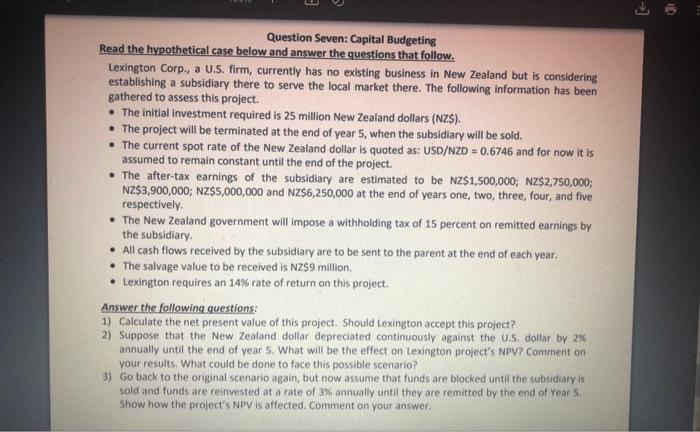
Question Seven: Capital Budgeting Read the hypothetical case below and answer the questions that follow. Lexington Corp., a U.S. firm, currently has no existing business in New Zealand but is considering establishing a subsidiary there to serve the local market there. The following information has been gathered to assess this project. - The initial investment required is 25 million New Zealand dollars (NZ\$). - The project will be terminated at the end of year 5 , when the subsidiary will be sold. - The current spot rate of the New Zealand dollar is quoted as: USD/NZD =0.6746 and for now it is assumed to remain constant until the end of the project. - The after-tax earnings of the subsidiary are estimated to be NZ\$1,500,000; NZ\$2,750,000; NZ\$3,900,000; NZ\$5,000,000 and NZS6,250,000 at the end of years one, two, three, four, and five respectively. - The New Zealand government will impose a withholding tax of 15 percent on remitted earnings by the subsidiary. - All cash flows received by the subsidiary are to be sent to the parent at the end of each year. - The salvage value to be received is NZZ9 million. - Lexington requires an 14% rate of return on this project. Answer the followinq questions: 1) Calculate the net present value of this project. Should Lexington accept this project? 2) Suppose that the New Zealand dollar depreciated continuously against the U.S. dollar by 2% annually until the end of year 5 . What will be the effect on Lexington project's NPV? Comment on your results. What could be done to face this possible scenario? 3) Go back to the original scenario again, but now assume that funds are blocked until the subsidiary is sold and funds are reinvested at a rate of 3% annually until they are remitted by the end of Year 5 . Show how the project's NPV is affected. Comment on your answer. Question Seven: Capital Budgeting Read the hypothetical case below and answer the questions that follow. Lexington Corp., a U.S. firm, currently has no existing business in New Zealand but is considering establishing a subsidiary there to serve the local market there. The following information has been gathered to assess this project. - The initial investment required is 25 million New Zealand dollars (NZ\$). - The project will be terminated at the end of year 5 , when the subsidiary will be sold. - The current spot rate of the New Zealand dollar is quoted as: USD/NZD =0.6746 and for now it is assumed to remain constant until the end of the project. - The after-tax earnings of the subsidiary are estimated to be NZ\$1,500,000; NZ\$2,750,000; NZ\$3,900,000; NZ\$5,000,000 and NZS6,250,000 at the end of years one, two, three, four, and five respectively. - The New Zealand government will impose a withholding tax of 15 percent on remitted earnings by the subsidiary. - All cash flows received by the subsidiary are to be sent to the parent at the end of each year. - The salvage value to be received is NZZ9 million. - Lexington requires an 14% rate of return on this project. Answer the followinq questions: 1) Calculate the net present value of this project. Should Lexington accept this project? 2) Suppose that the New Zealand dollar depreciated continuously against the U.S. dollar by 2% annually until the end of year 5 . What will be the effect on Lexington project's NPV? Comment on your results. What could be done to face this possible scenario? 3) Go back to the original scenario again, but now assume that funds are blocked until the subsidiary is sold and funds are reinvested at a rate of 3% annually until they are remitted by the end of Year 5 . Show how the project's NPV is affected. Comment on your
Step by Step Solution
There are 3 Steps involved in it

Get step-by-step solutions from verified subject matter experts
 Study Help