







Question: Need help for above question. Please provide the unique idea Thank you Part #1 - Generate an Idea (Ideation) You must come up with an
Need help for above question. Please provide the unique idea
Thank you
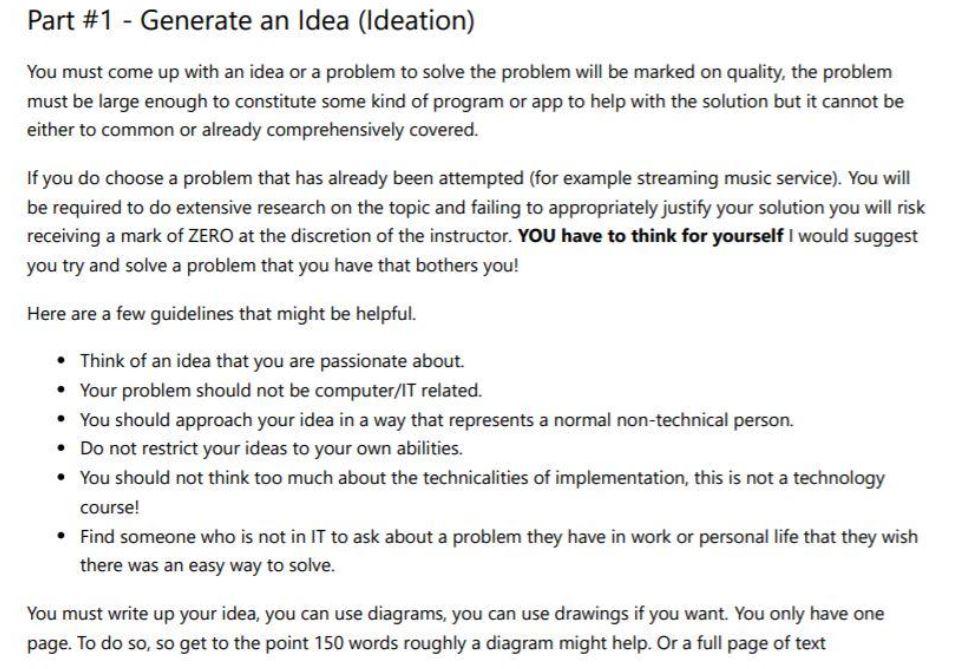
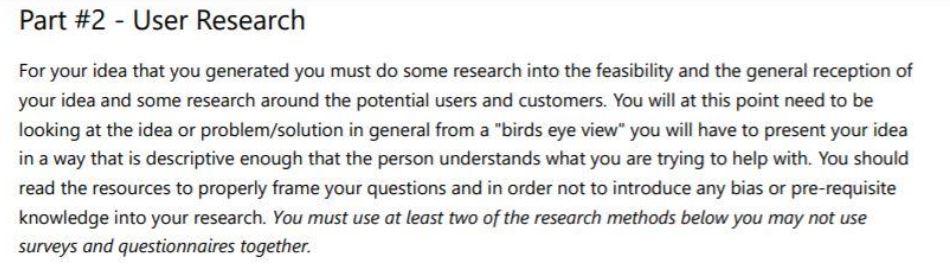
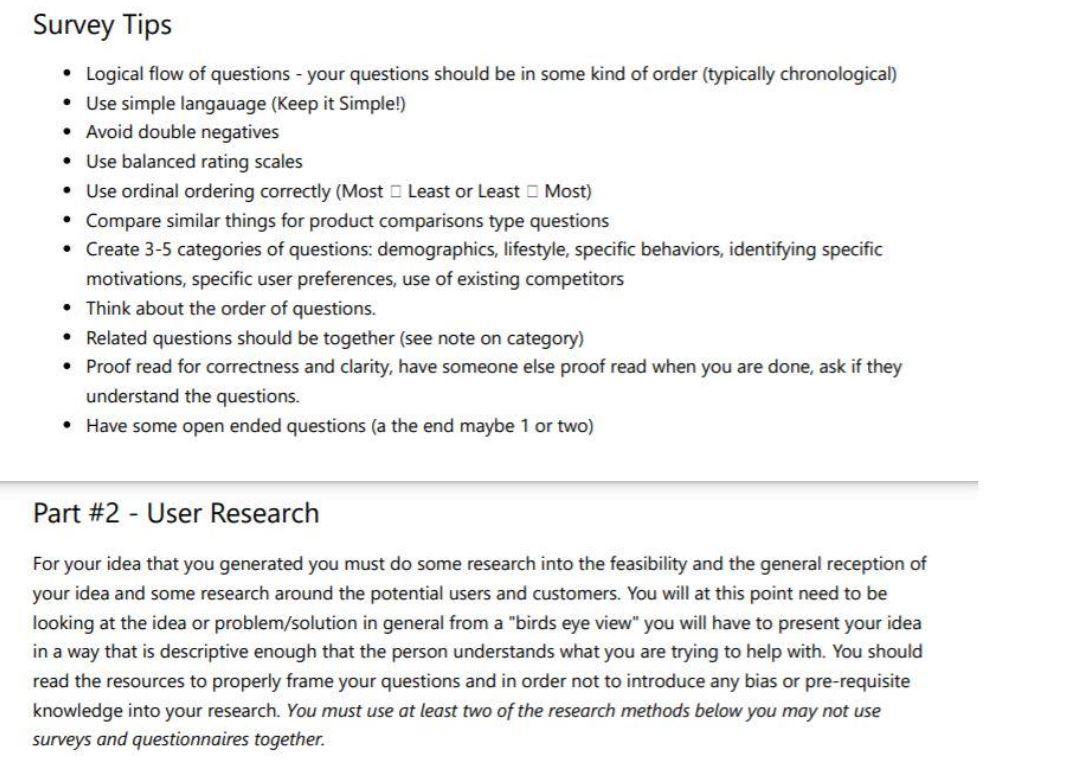
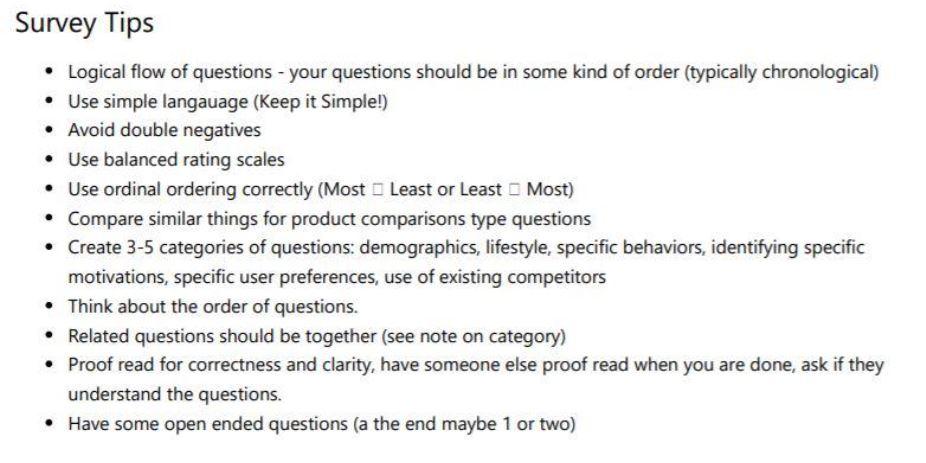
Part #1 - Generate an Idea (Ideation) You must come up with an idea or a problem to solve the problem will be marked on quality, the problem must be large enough to constitute some kind of program or app to help with the solution but it cannot be either to common or already comprehensively covered. If you do choose a problem that has already been attempted (for example streaming music service). You will be required to do extensive research on the topic and failing to appropriately justify your solution you will risk receiving a mark of ZERO at the discretion of the instructor. YOU have to think for yourself I would suggest you try and solve a problem that you have that bothers you! Here are a few guidelines that might be helpful. Think of an idea that you are passionate about Your problem should not be computer/IT related. You should approach your idea in a way that represents a normal non-technical person. Do not restrict your ideas to your own abilities. You should not think too much about the technicalities of implementation, this is not a technology course! Find someone who is not in IT to ask about a problem they have in work or personal life that they wish there was an easy way to solve. You must write up your idea, you can use diagrams, you can use drawings if you want. You only have one page. To do so, so get to the point 150 words roughly a diagram might help. Or a full page of text Part #2 - User Research For your idea that you generated you must do some research into the feasibility and the general reception of your idea and some research around the potential users and customers. You will at this point need to be looking at the idea or problem/solution in general from a "birds eye view" you will have to present your idea in a way that is descriptive enough that the person understands what you are trying to help with. You should read the resources to properly frame your questions and in order not to introduce any bias or pre-requisite knowledge into your research. You must use at least two of the research methods below you may not use surveys and questionnaires together. Survey Tips Logical flow of questions - your questions should be in some kind of order (typically chronological) Use simple langauage (Keep it Simple!) Avoid double negatives Use balanced rating scales Use ordinal ordering correctly (Most Least or Least Most) Compare similar things for product comparisons type questions Create 3-5 categories of questions: demographics, lifestyle, specific behaviors, identifying specific motivations, specific user preferences, use of existing competitors Think about the order of questions. Related questions should be together (see note on category) Proof read for correctness and clarity, have someone else proof read when you are done, ask if they understand the questions. Have some open ended questions (a the end maybe 1 or two) Part #2 - User Research For your idea that you generated you must do some research into the feasibility and the general reception of your idea and some research around the potential users and customers. You will at this point need to be looking at the idea or problem/solution in general from a "birds eye view" you will have to present your idea in a way that is descriptive enough that the person understands what you are trying to help with. You should read the resources to properly frame your questions and in order not to introduce any bias or pre-requisite knowledge into your research. You must use at least two of the research methods below you may not use surveys and questionnaires together. Survey Tips Logical flow of questions - your questions should be in some kind of order (typically chronological) Use simple langauage (Keep it Simple!) Avoid double negatives Use balanced rating scales Use ordinal ordering correctly (Most Least or Least Most) Compare similar things for product comparisons type questions Create 3-5 categories of questions: demographics, lifestyle, specific behaviors, identifying specific motivations, specific user preferences, use of existing competitors Think about the order of questions. Related questions should be together (see note on category) Proof read for correctness and clarity, have someone else proof read when you are done, ask if they understand the questions. Have some open ended questions (a the end maybe 1 or two) Part #1 - Generate an Idea (Ideation) You must come up with an idea or a problem to solve the problem will be marked on quality, the problem must be large enough to constitute some kind of program or app to help with the solution but it cannot be either to common or already comprehensively covered. If you do choose a problem that has already been attempted (for example streaming music service). You will be required to do extensive research on the topic and failing to appropriately justify your solution you will risk receiving a mark of ZERO at the discretion of the instructor. YOU have to think for yourself I would suggest you try and solve a problem that you have that bothers you! Here are a few guidelines that might be helpful. Think of an idea that you are passionate about Your problem should not be computer/IT related. You should approach your idea in a way that represents a normal non-technical person. Do not restrict your ideas to your own abilities. You should not think too much about the technicalities of implementation, this is not a technology course! Find someone who is not in IT to ask about a problem they have in work or personal life that they wish there was an easy way to solve. You must write up your idea, you can use diagrams, you can use drawings if you want. You only have one page. To do so, so get to the point 150 words roughly a diagram might help. Or a full page of text Part #2 - User Research For your idea that you generated you must do some research into the feasibility and the general reception of your idea and some research around the potential users and customers. You will at this point need to be looking at the idea or problem/solution in general from a "birds eye view" you will have to present your idea in a way that is descriptive enough that the person understands what you are trying to help with. You should read the resources to properly frame your questions and in order not to introduce any bias or pre-requisite knowledge into your research. You must use at least two of the research methods below you may not use surveys and questionnaires together. Survey Tips Logical flow of questions - your questions should be in some kind of order (typically chronological) Use simple langauage (Keep it Simple!) Avoid double negatives Use balanced rating scales Use ordinal ordering correctly (Most Least or Least Most) Compare similar things for product comparisons type questions Create 3-5 categories of questions: demographics, lifestyle, specific behaviors, identifying specific motivations, specific user preferences, use of existing competitors Think about the order of questions. Related questions should be together (see note on category) Proof read for correctness and clarity, have someone else proof read when you are done, ask if they understand the questions. Have some open ended questions (a the end maybe 1 or two) Part #2 - User Research For your idea that you generated you must do some research into the feasibility and the general reception of your idea and some research around the potential users and customers. You will at this point need to be looking at the idea or problem/solution in general from a "birds eye view" you will have to present your idea in a way that is descriptive enough that the person understands what you are trying to help with. You should read the resources to properly frame your questions and in order not to introduce any bias or pre-requisite knowledge into your research. You must use at least two of the research methods below you may not use surveys and questionnaires together. Survey Tips Logical flow of questions - your questions should be in some kind of order (typically chronological) Use simple langauage (Keep it Simple!) Avoid double negatives Use balanced rating scales Use ordinal ordering correctly (Most Least or Least Most) Compare similar things for product comparisons type questions Create 3-5 categories of questions: demographics, lifestyle, specific behaviors, identifying specific motivations, specific user preferences, use of existing competitors Think about the order of questions. Related questions should be together (see note on category) Proof read for correctness and clarity, have someone else proof read when you are done, ask if they understand the questions. Have some open ended questions (a the end maybe 1 or two)
Step by Step Solution
There are 3 Steps involved in it

Get step-by-step solutions from verified subject matter experts
 Study Help