Question: Need help for answering the above 3 questions. CASE STUDY - LOCAL GOVERNMENT PROCUREMENT CONSORTIUM (LGP) Local Government Procurement (LGP) is a new initiative, which
 Need help for answering the above 3 questions.
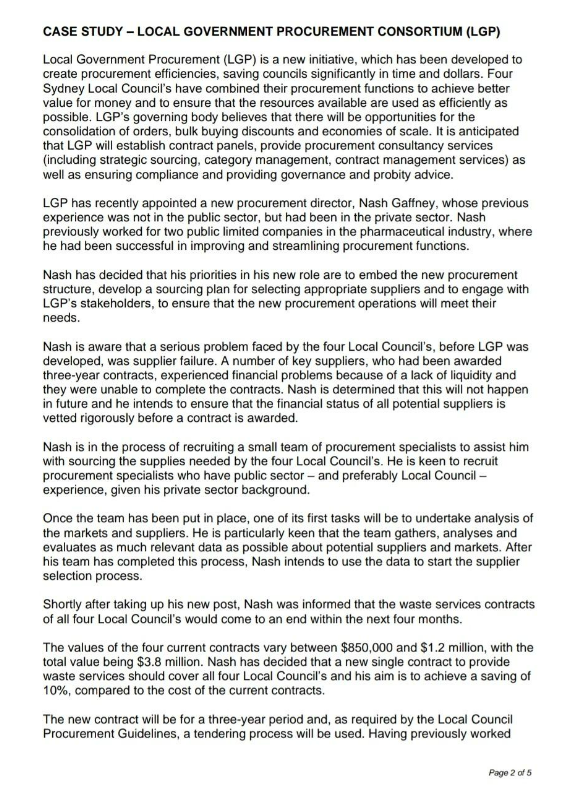
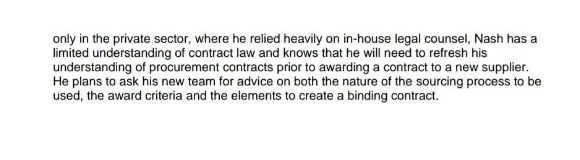
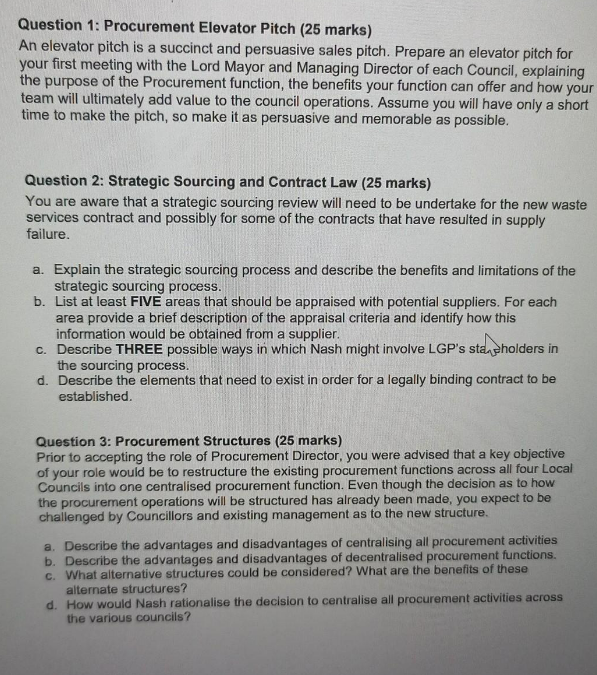
CASE STUDY - LOCAL GOVERNMENT PROCUREMENT CONSORTIUM (LGP) Local Government Procurement (LGP) is a new initiative, which has been developed to create procurement efficiencies, saving councils significantly in time and dollars. Four Sydney Local Council's have combined their procurement functions to achieve better value for money and to ensure that the resources available are used as efficiently as possible. LGP's governing body believes that there will be opportunities for the consolidation of orders, bulk buying discounts and economies of scale. It is anticipated that LGP will establish contract panels, provide procurement consultancy services (including strategic sourcing, category management, contract management services) as well as ensuring compliance and providing governance and probity advice. LGP has recently appointed a new procurement director, Nash Gaffney, whose previous experience was not in the public sector, but had been in the private sector. Nash previously worked for two public limited companies in the pharmaceutical industry, where he had been successful in improving and streamlining procurement functions. Nash has decided that his priorities in his new role are to embed the new procurement structure, develop a sourcing plan for selecting appropriate suppliers and to engage with LGP's stakeholders, to ensure that the new procurement operations will meet their needs. Nash is aware that a serious problem faced by the four Local Council's, before LGP was developed, was supplier failure. A number of key suppliers, who had been awarded three-year contracts, experienced financial problems because of a lack of liquidity and they were unable to complete the contracts. Nash is determined that this will not happen in future and he intends to ensure that the financial status of all potential suppliers is vetted rigorously before a contract is awarded. Nash is in the process of recruiting a small team of procurement specialists to assist him with sourcing the supplies needed by the four Local Council's. He is keen to recruit procurement specialists who have public sector - and preferably Local Council experience, given his private sector background. Once the team has been put in place, one of its first tasks will be to undertake analysis of the markets and suppliers. He is particularly keen that the team gathers, analyses and evaluates as much relevant data as possible about potential suppliers and markets. After his team has completed this process, Nash intends to use the data to start the supplier selection process. Shortly after taking up his new post, Nash was informed that the waste services contracts of all four Local Council's would come to an end within the next four months. The values of the four current contracts vary between $850,000 and $1.2 million, with the total value being $3.8 million. Nash has decided that a new single contract to provide waste services should cover all four Local Council's and his aim is to achieve a saving of 10%, compared to the cost of the current contracts. The new contract will be for a three-year period and, as required by the Local Council Procurement Guidelines, a tendering process will be used. Having previously worked Page 2 of 5 only in the private sector, where he relied heavily on in-house legal counsel, Nash has a limited understanding of contract law and knows that he will need to refresh his understanding of procurement contracts prior to awarding a contract to a new supplier. He plans to ask his new team for advice on both the nature of the sourcing process to be used, the award criteria and the elements to create a binding contract. Question 1: Procurement Elevator Pitch (25 marks) An elevator pitch is a succinct and persuasive sales pitch. Prepare an elevator pitch for your first meeting with the Lord Mayor and Managing Director of each Council, explaining the purpose of the Procurement function, the benefits your function can offer and how your team will ultimately add value to the council operations. Assume you will have only a short time to make the pitch, so make it as persuasive and memorable as possible. Question 2: Strategic Sourcing and Contract Law (25 marks) You are aware that a strategic sourcing review will need to be undertake for the new waste services contract and possibly for some of the contracts that have resulted in supply failure. a. Explain the strategic sourcing process and describe the benefits and limitations of the strategic sourcing process. b. List at least FIVE areas that should be appraised with potential suppliers. For each area provide a brief description of the appraisal criteria and identify how this information would be obtained from a supplier. c. Describe THREE possible ways in which Nash might involve LGP's stantholders in the sourcing process. d. Describe the elements that need to exist in order for a legally binding contract to be established. Question 3: Procurement Structures (25 marks) Prior to accepting the role of Procurement Director, you were advised that a key objective of your role would be to restructure the existing procurement functions across all four Local Councils into one centralised procurement function. Even though the decision as to how the procurement operations will be structured has already been made, you expect to be challenged by Councillors and existing management as to the new structure. a. Describe the advantages and disadvantages of centralising all procurement activities b. Describe the advantages and disadvantages of decentralised procurement functions. c. What alternative structures could be considered? What are the benefits of these alternate structures? d. How would Nash rationalise the decision to centralise all procurement activities across the various councils









 Study Help