







Question: Need help knowing how to approach the problem, any help would be appreciated: thank you! Demand for X-Ray machines is: D = 10,000 -= .
Need help knowing how to approach the problem, any help would be appreciated: thank you!
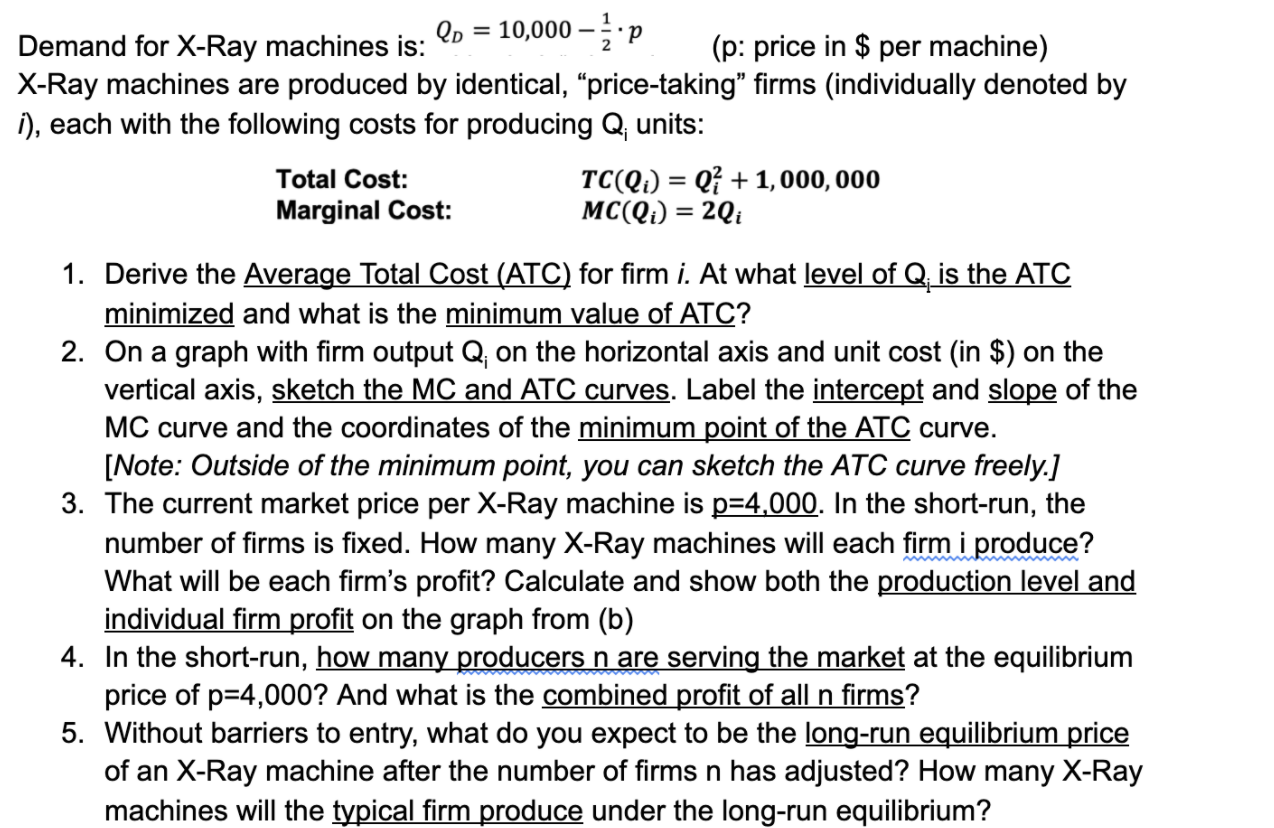
Demand for X-Ray machines is: D = 10,000 -= . p (p: price in $ per machine) X-Ray machines are produced by identical, "price-taking" firms (individually denoted by i), each with the following costs for producing Q; units: Total Cost: TC(Qi) = Q2 + 1, 000, 000 Marginal Cost: MC(Qi) = 2Qi 1. Derive the Average Total Cost (ATC) for firm i. At what level of Q, is the ATC minimized and what is the minimum value of ATC? 2. On a graph with firm output Q; on the horizontal axis and unit cost (in $) on the vertical axis, sketch the MC and ATC curves. Label the intercept and slope of the MC curve and the coordinates of the minimum point of the ATC curve. [ Note: Outside of the minimum point, you can sketch the ATC curve freely.] 3. The current market price per X-Ray machine is p=4,000. In the short-run, the number of firms is fixed. How many X-Ray machines will each firm i produce? What will be each firm's profit? Calculate and show both the production level and individual firm profit on the graph from (b) 4. In the short-run, how many producers n are serving the market at the equilibrium price of p=4,000? And what is the combined profit of all n firms? 5. Without barriers to entry, what do you expect to be the long-run equilibrium price of an X-Ray machine after the number of firms n has adjusted? How many X-Ray machines will the typical firm produce under the long-run equilibrium
Step by Step Solution
There are 3 Steps involved in it

Get step-by-step solutions from verified subject matter experts
 Study Help