







Question: Need help making my functions sort quicker. Topics: Vectors and sorting. I was given the header and main files while changes should only be made
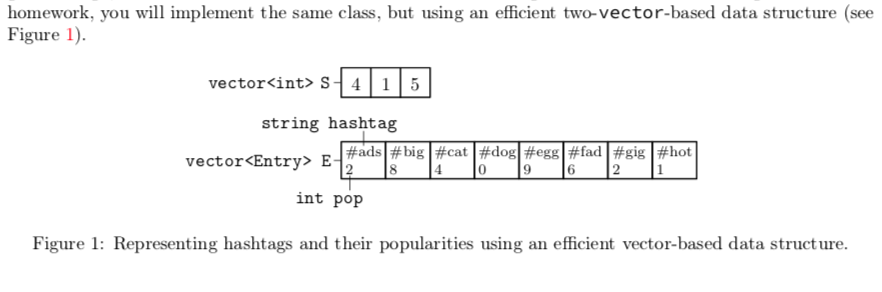
Need help making my functions sort quicker. Topics: Vectors and sorting. I was given the header and main files while changes should only be made in the trendtracker.cpp file. Only thing is my sorting algorithm seems to fail.. I wanted to do a binary search but wasn't able to. Perferably use this algorithm and use comments to see what steps I needed to take. The following files are below, thanks! //************************* main.cpp *****************************/
#include
#include
#include
#include
#include
#include "trendtracker.h"
using namespace std;
inline void _test(const char* expression, const char* file, int line)
{
cerr
cerr
abort();
}
#define test(EXPRESSION) ((EXPRESSION) ? (void)0 : _test(#EXPRESSION, __FILE__, __LINE__))
int main()
{
// Setup
vector R;
string s, line;
// Test constructor, size(), popularity(), tweeted()
Trendtracker T1("small.txt");
test(T1.size() == 4);
test(T1.popularity("#algorithms") == 0);
test(T1.popularity("#cs4all") == 0);
test(T1.popularity("#datastructures") == -1);
test(T1.popularity("#programming") == 0);
test(T1.popularity("#C++") == 0);
T1.tweeted("#programming");
test(T1.popularity("#algorithms") == 0);
test(T1.popularity("#cs4all") == 0);
test(T1.popularity("#datastructures") == -1);
test(T1.popularity("#programming") == 1);
test(T1.popularity("#C++") == 0);
T1.tweeted("#programming");
test(T1.popularity("#algorithms") == 0);
test(T1.popularity("#cs4all") == 0);
test(T1.popularity("#datastructures") == -1);
test(T1.popularity("#programming") == 2);
test(T1.popularity("#C++") == 0);
T1.tweeted("#programming");
test(T1.popularity("#algorithms") == 0);
test(T1.popularity("#cs4all") == 0);
test(T1.popularity("#datastructures") == -1);
test(T1.popularity("#programming") == 3);
test(T1.popularity("#C++") == 0);
T1.tweeted("#cs4all");
test(T1.popularity("#algorithms") == 0);
test(T1.popularity("#cs4all") == 1);
test(T1.popularity("#programming") == 3);
test(T1.popularity("#C++") == 0);
T1.tweeted("#algorithms");
test(T1.popularity("#algorithms") == 1);
test(T1.popularity("#cs4all") == 1);
test(T1.popularity("#datastructures") == -1);
test(T1.popularity("#programming") == 3);
test(T1.popularity("#C++") == 0);
T1.tweeted("#cs4all");
test(T1.popularity("#algorithms") == 1);
test(T1.popularity("#cs4all") == 2);
test(T1.popularity("#datastructures") == -1);
test(T1.popularity("#programming") == 3);
test(T1.popularity("#C++") == 0);
T1.tweeted("#datastructures");
test(T1.popularity("#algorithms") == 1);
test(T1.popularity("#cs4all") == 2);
test(T1.popularity("#datastructures") == -1);
test(T1.popularity("#programming") == 3);
test(T1.popularity("#C++") == 0);
Trendtracker T2("small.txt");
T2.tweeted("#programming");
T2.tweeted("#programming");
T2.tweeted("#programming");
T2.tweeted("#programming");
T2.tweeted("#programming");
T2.tweeted("#C++");
T2.tweeted("#C++");
T2.tweeted("#C++");
T2.tweeted("#C++");
T2.tweeted("#cs4all");
T2.tweeted("#cs4all");
T2.tweeted("#cs4all");
T2.tweeted("#algorithms");
T2.tweeted("#algorithms");
test(T2.popularity("#algorithms") == 2);
test(T2.popularity("#cs4all") == 3);
test(T2.popularity("#programming") == 5);
test(T2.popularity("#C++") == 4);
// Enforce no usage of global variables
test(T1.popularity("#algorithms") == 1);
test(T1.popularity("#cs4all") == 2);
test(T1.popularity("#programming") == 3);
test(T1.popularity("#C++") == 0);
// Test top_trend(), top_three_trends()
Trendtracker T3("small.txt");
T3.top_three_trends(R);
test(R.size() == 3);
T3.tweeted("#programming");
test(T3.top_trend() == "#programming");
T3.top_three_trends(R);
test(R.size() == 3);
test(R[0] == "#programming");
T3.tweeted("#C++");
T3.tweeted("#C++");
test(T3.top_trend() == "#C++");
T3.top_three_trends(R);
test(R.size() == 3);
test(R[0] == "#C++");
test(R[1] == "#programming");
T3.tweeted("#algorithms");
T3.tweeted("#algorithms");
T3.tweeted("#algorithms");
test(T3.top_trend() == "#algorithms");
T3.top_three_trends(R);
test(R.size() == 3);
test(R[0] == "#algorithms");
test(R[1] == "#C++");
test(R[2] == "#programming");
T3.tweeted("#cs4all");
T3.tweeted("#cs4all");
T3.tweeted("#cs4all");
T3.tweeted("#cs4all");
test(T3.top_trend() == "#cs4all");
T3.top_three_trends(R);
test(R.size() == 3);
test(R[0] == "#cs4all");
test(R[1] == "#algorithms");
test(R[2] == "#C++");
// At this point:
// cs4all: 4
// algorithms: 3
// C++: 2
// programming: 1
T3.tweeted("#programming");
T3.tweeted("#programming");
T3.tweeted("#programming");
T3.tweeted("#programming");
test(T3.top_trend() == "#programming");
T3.top_three_trends(R);
test(R.size() == 3);
test(R[0] == "#programming");
test(R[1] == "#cs4all");
test(R[2] == "#algorithms");
// At this point:
// programming: 5
// cs4all: 4
// algorithms: 3
// C++: 2
T3.tweeted("#cs4all");
T3.tweeted("#cs4all");
T3.tweeted("#algorithms");
test(T3.top_trend() == "#cs4all");
T3.top_three_trends(R);
test(R.size() == 3);
test(R[0] == "#cs4all");
test(R[1] == "#programming");
test(R[2] == "#algorithms");
// At this point:
// cs4all: 6
// programming: 5
// algorithms: 4
// C++: 2
for (int i = 0; i
T3.tweeted("#C++");
test(T3.top_trend() == "#C++");
T3.top_three_trends(R);
test(R.size() == 3);
test(R[0] == "#C++");
test(R[1] == "#cs4all");
test(R[2] == "#programming");
Trendtracker T4("hashtags.txt");
test(T4.size() == 300000);
ifstream f;
f.open("tweeted.txt");
assert(f.is_open()); // If this fails, you're missing tweeted.txt
while (getline(f, line))
T4.tweeted(line);
f.close();
test(T4.popularity("#programming") == 10);
test(T4.popularity("#computer") == 9);
test(T4.popularity("#is") == 8);
test(T4.popularity("#very") == 7);
test(T4.popularity("#fun") == 6);
test(T4.popularity("#but") == 5);
test(T4.popularity("#sometimes") == 5);
test(T4.popularity("#can") == 5);
test(T4.popularity("#be") == 5);
test(T4.popularity("#challenging") == 5);
test(T4.top_trend() == "#programming");
T4.top_three_trends(R);
test(R[0] == "#programming");
test(R[1] == "#computer");
test(R[2] == "#is");
// Test a Trendtracker with a single hashtag
Trendtracker T5("tiny.txt");
test(T5.size() == 1);
test(T5.popularity("#solo") == 0);
test(T5.popularity("#duo") == -1);
T5.tweeted("#solo");
test(T5.popularity("#solo") == 1);
test(T5.popularity("#duo") == -1);
test(T5.top_trend() == "#solo");
T5.top_three_trends(R);
test(R.size() == 1);
test(R[0] == "#solo");
cout
} //************************************ trendtracker.h *****************************//
#ifndef TRENDTRACKER_H
#define TRENDTRACKER_H
#include
#include
#include
#include
using namespace std;
class Trendtracker
{
// For the mandatory running times below:
// n is the number of hashtags in the Trendtracker.
public:
// Creates a Trendtracker containing hashtags
// found in the provided file.
// The file is promised to have the following format:
//
// string1
// string2
// ...
// stringN
//
// where string1
//
// Must run in O(n) time.
Trendtracker(string filename);
// Return the number of hashtags in the Trendtracker.
//
// Must run in O(1) time.
int size();
// Adds 1 to the total number times a hashtag has been tweeted.
// If the hashtag does not exist in TrendTracker, does nothing.
//
// Must run in O(log(n)) time.
void tweeted(string ht);
// Returns the number of times a hashtag has been tweeted.
// If the hashtag does not exist in Trendtracker, returns -1.
//
// Must run in O(log(n)) time.
int popularity(string name);
// Returns a most-tweeted hashtag.
// If the Trendtracker has no hashtags, returns "".
//
// Must run in O(1) time.
string top_trend();
// Fills the provided vector with the 3 most-tweeted hashtags,
// in order from most-tweeted to least-tweeted.
//
// If there are fewer than 3 hashtags, then the vector is filled
// with all hashtags (in most-tweeted to least-tweeted order).
//
// Must run in O(1) time.
void top_three_trends(vector &T);
private:
// A simple class representing a hashtag and
// the number of times it has been tweeted.
class Entry
{
public:
string hashtag;
int pop;
};
// Optional helper method.
// Returns the index of E containing an Entry with hashtag ht.
// If no such hashtag is found, returns -1.
//
// Should run in O(log(n)).
int search(string ht);
// Entries sorted (lexicographically) by hashtag.
vector E;
// Stores indices of the (up to) three most-tweeted
// entries in E.
vector S;
};
#endif
//********************************* trendtracker.cpp ********************************//
#include "trendtracker.h"
#include
using namespace std;
/*************************************************************/
// Creates a Trendtracker containing hashtags
// found in the provided file.
// The file is promised to have the following format:
//
// string1
// string2
// ...
// stringN
//
// where string1
//
// Must run in O(n) time.
Trendtracker::Trendtracker(string filename)
{
}
/*************************************************************/
// Return the number of hashtags in the Trendtracker.
//
// Must run in O(1) time.
int Trendtracker::size()
{
return E.size();
}
/*************************************************************/
// Adds 1 to the total number times a hashtag has been tweeted.
// If the hashtag does not exist in TrendTracker, does nothing.
//
// Must run in O(log(n)) time.
void Trendtracker::tweeted(string ht)
{
}
/*************************************************************/
// Returns the number of times a hashtag has been tweeted.
// If the hashtag does not exist in Trendtracker, returns -1.
//
// Must run in O(log(n)) time.
int Trendtracker::popularity(string name)
{
}
/*************************************************************/
// Returns a most-tweeted hashtag.
// If the Trendtracker has no hashtags, returns "".
//
// Must run in O(1) time.
string Trendtracker::top_trend()
{
}
/*************************************************************/
// Fills the provided vector with the 3 most-tweeted hashtags,
// in order from most-tweeted to least-tweeted.
//
// If there are fewer than 3 hashtags, then the vector is filled
// with all hashtags (in most-tweeted to least-tweeted order).
//
// Must run in O(1) time.
void Trendtracker::top_three_trends(vector& T)
{
} //********************************* small.txt ********************************//
#C++
#algorithms
#cs4all
#programming //********************************* tiny.txt ********************************//
#solo
//Other text files too large for chegg
homework, you wil implement the same class, but using an efficient two-vector-based data structure (see Figure 1). vector
Step by Step Solution
There are 3 Steps involved in it

Get step-by-step solutions from verified subject matter experts
 Study Help