







Question: need help on all including graph thanks 5. Risk-adjusted discount rate approach The risk-adjusted discount rate (RADR) approach recognizes that different investment projects exhibit different
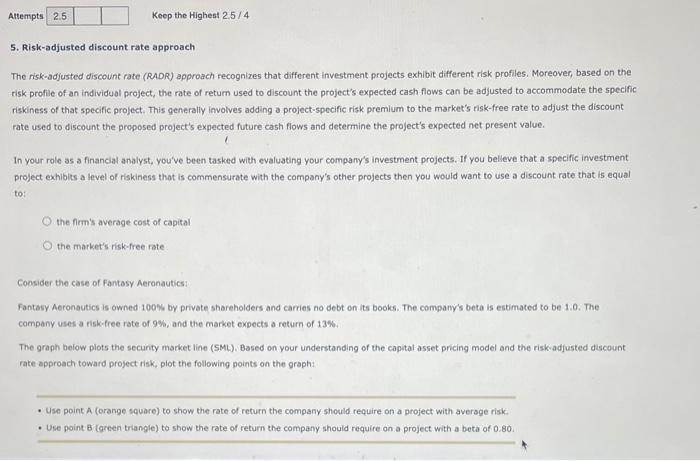
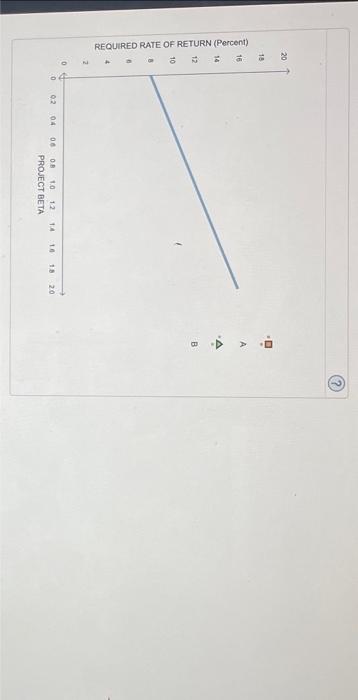
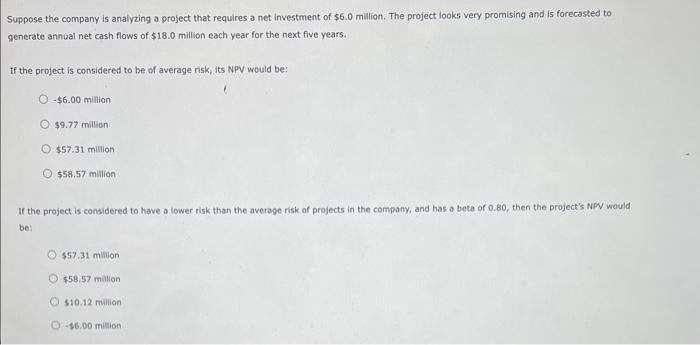
5. Risk-adjusted discount rate approach The risk-adjusted discount rate (RADR) approach recognizes that different investment projects exhibit different risk profiles. Moreover, based on the risk profile of an individual project, the rate of retum used to discount the project's expected cash flows can be adjusted to accommodate the specific riskiness of that specific project. This generally involves adding a project-specific risk premium to the market's risk-free rate to adjust the discount rate used to discount the proposed project's expected future cash flows and determine the project's expected net present value. In your role as a financlal analyst, you've been tasked with evaluating your company's investment projects. If you believe that a specific investment project exhibits a level of riskiness that is commensurate with the company's other projects then you would want to use a discount rate that is equal to: the firm's average cost of capital the market's risk-free rate Coosider the case of Fantasy Aeronautics? Fantasy Aeronautics is owned 100% by private shareholders and carries no debt on its books. The company's beta is estimated to be 1.0. The company uses a fisk:free rate of 9%, and the market expects a return of 13%, The graph beiow piots the security market line (SML). Based on your understanding of the capital asset pricing model and the risk-adjusted discount rate approach toward project risk, plot the following points on the graph: - Use point A (orange square) to show the rate of return the company should require on a profect with average risk. - Use point B (green triangle) to show the rate of return the company should require on a project with a beta of 0.80. Suppose the company is analyzing a project that requires a net investment of $6.0 million. The project looks very promising and is forecasted to generate annual net cash flows of $18.0 million each year for the next five years. If the project is considered to be of average risk, its NPV would be: $6.00 million $9.77 million $57.31 million $58.57million If the project is considered to have o lower risk than the average risk of projects in the company, and has o beta of 0.80, then the project's NpV would be: \$57.31 milition $58.57 milion 510.12 million 16.00 million
Step by Step Solution
There are 3 Steps involved in it

Get step-by-step solutions from verified subject matter experts
 Study Help