







Question: need help on basic accounting homework problem THE CORN AND HOGS CASE (PART 1) Growing corn Paul Plowright was delighted to be able to leave
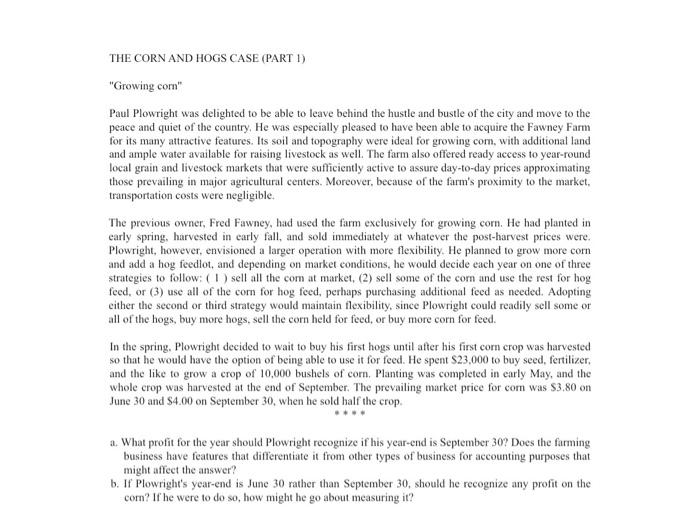
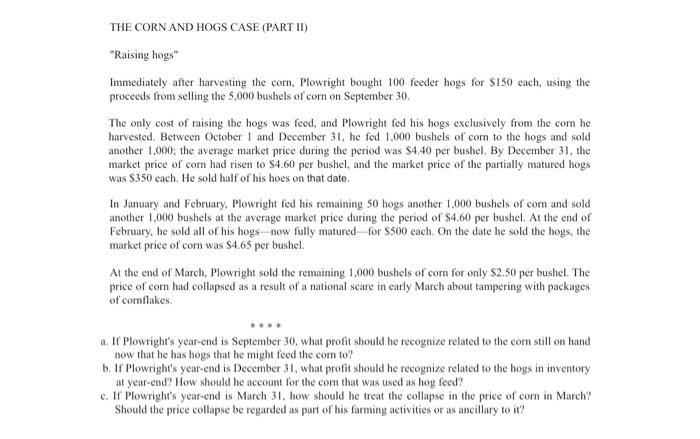
THE CORN AND HOGS CASE (PART 1) "Growing corn" Paul Plowright was delighted to be able to leave behind the hustle and bustle of the city and move to the peace and quiet of the country. He was especially pleased to have been able to acquire the Fawney Farm for its many attractive features. Its soil and topography were ideal for growing com, with additional land and ample water available for raising livestock as well. The farm also offered ready access to year-round local grain and livestock markets that were sufficiently active to assure day-to-day prices approximating those prevailing in major agricultural centers. Moreover, because of the farm's proximity to the market. transportation costs were negligible. The previous owner, Fred Fawney, had used the farm exclusively for growing corn. He had planted in carly spring, harvested in early fall, and sold immediately at whatever the post-harvest prices were Plowright, however, envisioned a larger operation with more flexibility. He planned to grow more corn and add a hog feedlot, and depending on market conditions, he would decide each year on one of three strategies to follow: ( 1 ) sell all the com at market, (2) sell some of the com and use the rest for hog feed, or (3) use all of the com for hog feed, perhaps purchasing additional feed as needed. Adopting either the second or third strategy would maintain flexibility, since Plowright could readily sell some or all of the hogs, buy more hogs, sell the corn held for feed, or buy more corn for feed. In the spring, Plowright decided to wait to buy his first hogs until after his first corn crop was harvested so that he would have the option of being able to use it for feed. He spent $23,000 to buy seed, fertilizer, and the like to grow a crop of 10,000 bushels of corn. Planting was completed in early May, and the whole crop was harvested at the end of September. The prevailing market price for com was $3.80 on June 30 and $4.00 on September 30, when he sold half the crop a. What profit for the year should Plowright recognize if his year-end is September 307 Does the farming business have features that differentiate it from other types of business for accounting purposes that might affect the answer? b. If Plowright's year-end is June 30 rather than September 30, should he recognize any profit on the corn? If he were to do so, how might he go about measuring it? THE CORN AND HOGS CASE (PART II) "Raising hogs" Immediately after harvesting the corn, Plowright bought 100 feeder hogs for $150 each, using the proceeds from selling the 5,000 bushels of corn on September 30. The only cost of raising the hogs was feed, and Plowright fed his hogs exclusively from the corn he harvested. Between October 1 and December 31, he fed 1,000 bushels of corn to the hogs and sold another 1,000; the average market price during the period was $4.40 per bushel. By December 31, the market price of corn had risen to $4.60 per bushel, and the market price of the partially matured hogs was $350 each. He sold half of his hoes on that date. In January and February, Plowright fed his remaining 50 hogs another 1,000 bushels of com and sold another 1,000 bushels at the average market price during the period of $4.60 per bushel. At the end of February, he sold all of his hogs-now fully matured for $500 cach. On the date he sold the hogs, the market price of corn was $4.65 per bushel. At the end of March, Plowright sold the remaining 1,000 bushels of corn for only $2.50 per bushel. The price of corn had collapsed as a result of a national scare in early March about tampering with packages of comflakes. af Plowright's year-end is September 30, what profit should he recognize related to the corn still on hand now that he has hogs that he might feed the com to? b. If Plowright's year-end is December 31, what profit should he recognize related to the hogs in inventory at year-end? How should he account for the com that was used as hog feed? c. If Plowright's year-end is March 31, how should he treat the collapse in the price of corn in March? Should the price collapse be regarded as part of his farming activities or as ancillary to it? THE CORN AND HOGS CASE (PART 1) "Growing corn" Paul Plowright was delighted to be able to leave behind the hustle and bustle of the city and move to the peace and quiet of the country. He was especially pleased to have been able to acquire the Fawney Farm for its many attractive features. Its soil and topography were ideal for growing com, with additional land and ample water available for raising livestock as well. The farm also offered ready access to year-round local grain and livestock markets that were sufficiently active to assure day-to-day prices approximating those prevailing in major agricultural centers. Moreover, because of the farm's proximity to the market. transportation costs were negligible. The previous owner, Fred Fawney, had used the farm exclusively for growing corn. He had planted in carly spring, harvested in early fall, and sold immediately at whatever the post-harvest prices were Plowright, however, envisioned a larger operation with more flexibility. He planned to grow more corn and add a hog feedlot, and depending on market conditions, he would decide each year on one of three strategies to follow: ( 1 ) sell all the com at market, (2) sell some of the com and use the rest for hog feed, or (3) use all of the com for hog feed, perhaps purchasing additional feed as needed. Adopting either the second or third strategy would maintain flexibility, since Plowright could readily sell some or all of the hogs, buy more hogs, sell the corn held for feed, or buy more corn for feed. In the spring, Plowright decided to wait to buy his first hogs until after his first corn crop was harvested so that he would have the option of being able to use it for feed. He spent $23,000 to buy seed, fertilizer, and the like to grow a crop of 10,000 bushels of corn. Planting was completed in early May, and the whole crop was harvested at the end of September. The prevailing market price for com was $3.80 on June 30 and $4.00 on September 30, when he sold half the crop a. What profit for the year should Plowright recognize if his year-end is September 307 Does the farming business have features that differentiate it from other types of business for accounting purposes that might affect the answer? b. If Plowright's year-end is June 30 rather than September 30, should he recognize any profit on the corn? If he were to do so, how might he go about measuring it? THE CORN AND HOGS CASE (PART II) "Raising hogs" Immediately after harvesting the corn, Plowright bought 100 feeder hogs for $150 each, using the proceeds from selling the 5,000 bushels of corn on September 30. The only cost of raising the hogs was feed, and Plowright fed his hogs exclusively from the corn he harvested. Between October 1 and December 31, he fed 1,000 bushels of corn to the hogs and sold another 1,000; the average market price during the period was $4.40 per bushel. By December 31, the market price of corn had risen to $4.60 per bushel, and the market price of the partially matured hogs was $350 each. He sold half of his hoes on that date. In January and February, Plowright fed his remaining 50 hogs another 1,000 bushels of com and sold another 1,000 bushels at the average market price during the period of $4.60 per bushel. At the end of February, he sold all of his hogs-now fully matured for $500 cach. On the date he sold the hogs, the market price of corn was $4.65 per bushel. At the end of March, Plowright sold the remaining 1,000 bushels of corn for only $2.50 per bushel. The price of corn had collapsed as a result of a national scare in early March about tampering with packages of comflakes. af Plowright's year-end is September 30, what profit should he recognize related to the corn still on hand now that he has hogs that he might feed the com to? b. If Plowright's year-end is December 31, what profit should he recognize related to the hogs in inventory at year-end? How should he account for the com that was used as hog feed? c. If Plowright's year-end is March 31, how should he treat the collapse in the price of corn in March? Should the price collapse be regarded as part of his farming activities or as ancillary to it
Step by Step Solution
There are 3 Steps involved in it

Get step-by-step solutions from verified subject matter experts
 Study Help