







Question: Need help on doing data analysis on Real Estate, it can be of any city. Must be done on Excel. Help Please. For the first
Need help on doing data analysis on Real Estate, it can be of any city. Must be done on Excel.
Help Please.
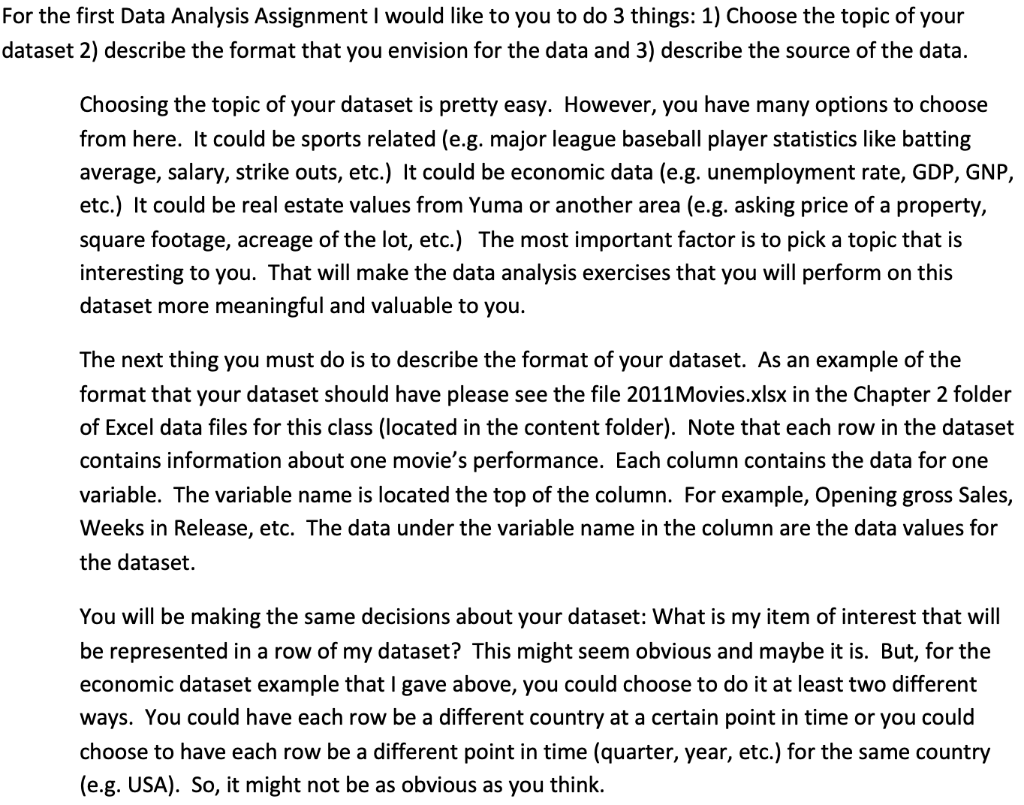
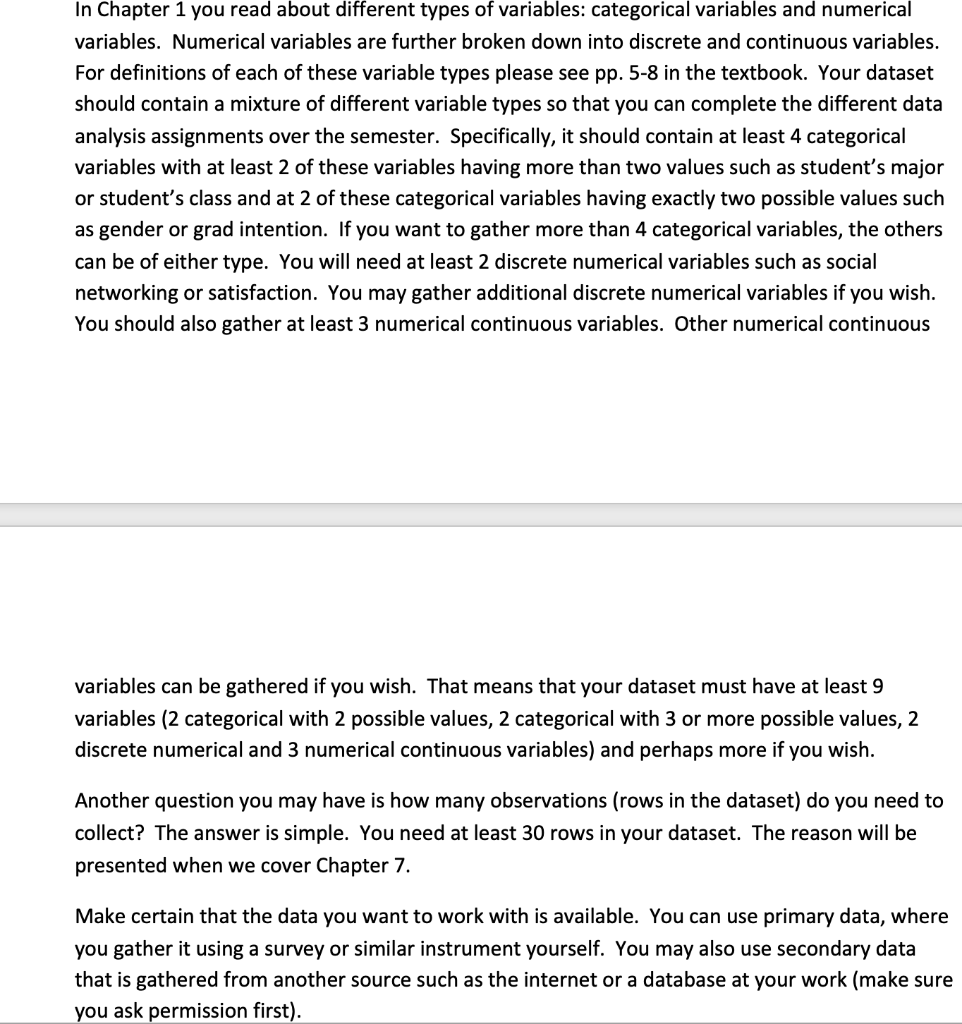
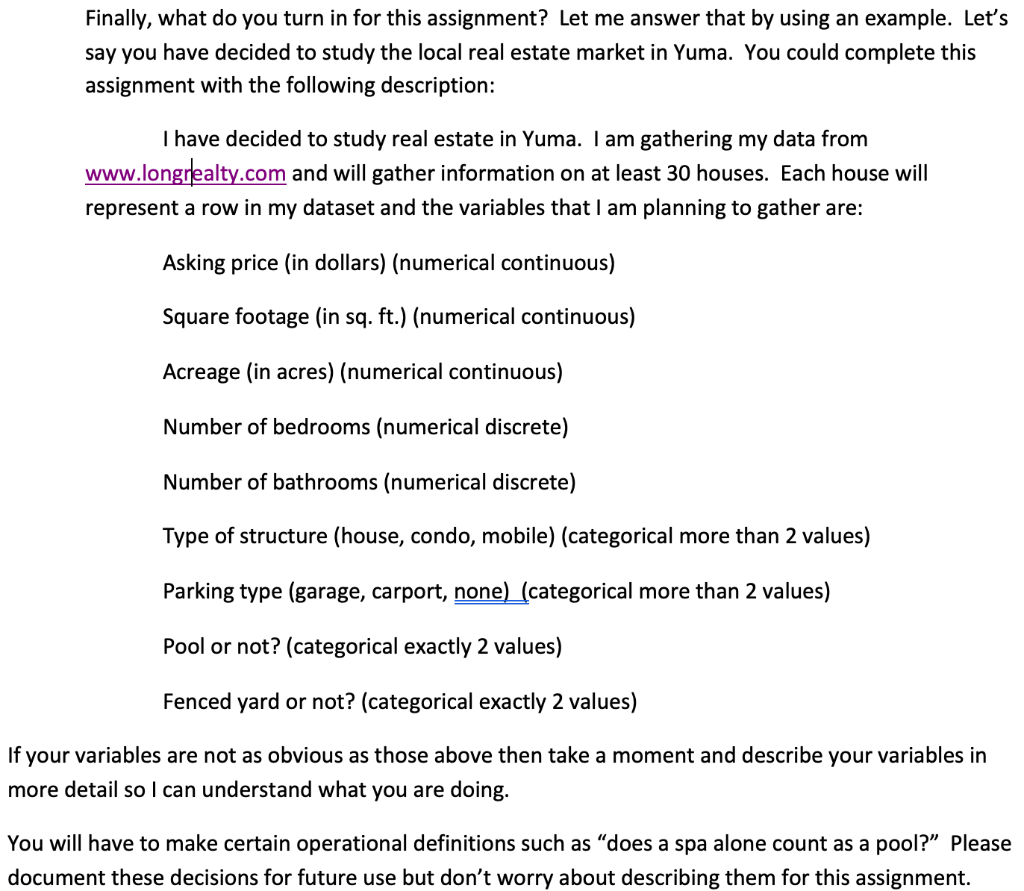
For the first Data Analysis Assignment I would like to you to do 3 things: 1) Choose the topic of your dataset 2) describe the format that you envision for the data and 3) describe the source of the data. Choosing the topic of your dataset is pretty easy. However, you have many options to choose from here. It could be sports related (e.g. major league baseball player statistics like batting average, salary, strike outs, etc.) It could be economic data (e.g. unemployment rate, GDP, GNP, etc.) It could be real estate values from Yuma or another area (e.g. asking price of a property, square footage, acreage of the lot, etc.) The most important factor is to pick a topic that is interesting to you. That will make the data analysis exercises that you will perform on this dataset more meaningful and valuable to you. The next thing you must do is to describe the format of your dataset. As an example of the format that your dataset should have please see the file 2011 Movies.xlsx in the Chapter 2 folder of Excel data files for this class (located in the content folder). Note that each row in the dataset contains information about one movie's performance. Each column contains the data for one variable. The variable name is located the top of the column. For example, Opening gross Sales, Weeks in Release, etc. The data under the variable name in the column are the data values for the dataset. You will be making the same decisions about your dataset: What is my item of interest that will be represented in a row of my dataset? This might seem obvious and maybe it is. But, for the economic dataset example that I gave above, you could choose to do it at least two different ways. You could have each row be a different country at a certain point in time or you could choose to have each row be a different point in time (quarter, year, etc.) for the same country (e.g. USA). So, it might not be as obvious as you think. In Chapter 1 you read about different types of variables: categorical variables and numerical variables. Numerical variables are further broken down into discrete and continuous variables. For definitions of each of these variable types please see pp. 5-8 in the textbook. Your dataset should contain a mixture of different variable types so that you can complete the different data analysis assignments over the semester. Specifically, it should contain at least 4 categorical variables with at least 2 of these variables having more than two values such as student's major or student's class and at 2 of these categorical variables having exactly two possible values such as gender or grad intention. If you want to gather more than 4 categorical variables, the others can be of either type. You will need at least 2 discrete numerical variables such as social networking or satisfaction. You may gather additional discrete numerical variables if you wish. You should also gather at least 3 numerical continuous variables. Other numerical continuous variables can be gathered if you wish. That means that your dataset must have at least 9 variables (2 categorical with 2 possible values, 2 categorical with 3 or more possible values, 2 discrete numerical and 3 numerical continuous variables) and perhaps more if you wish. Another question you may have is how many observations (rows in the dataset) do you need to collect? The answer is simple. You need at least 30 rows in your dataset. The reason will be presented when we cover Chapter 7. Make certain that the data you want to work with is available. You can use primary data, where you gather it using a survey or similar instrument yourself. You may also use secondary data that is gathered from another source such as the internet or a database at your work (make sure you ask permission first). Finally, what do you turn in for this assignment? Let me answer that by using an example. Let's say you have decided to study the local real estate market in Yuma. You could complete this assignment with the following description: I have decided to study real estate in Yuma. I am gathering my data from www.longrealty.com and will gather information on at least 30 houses. Each house will represent a row in my dataset and the variables that I am planning to gather are: Asking price (in dollars) (numerical continuous) Square footage (in sq. ft.) (numerical continuous) Acreage (in acres) (numerical continuous) Number of bedrooms (numerical discrete) Number of bathrooms (numerical discrete) Type of structure (house, condo, mobile) (categorical more than 2 values) Parking type (garage, carport, none) (categorical more than 2 values) Pool or not? (categorical exactly 2 values) Fenced yard or not? (categorical exactly 2 values) If your variables are not as obvious as those above then take a moment and describe your variables in more detail so I can understand what you are doing. You will have to make certain operational definitions such as "does a spa alone count as a pool?" Please document these decisions for future use but don't worry about describing them for this assignment. For the first Data Analysis Assignment I would like to you to do 3 things: 1) Choose the topic of your dataset 2) describe the format that you envision for the data and 3) describe the source of the data. Choosing the topic of your dataset is pretty easy. However, you have many options to choose from here. It could be sports related (e.g. major league baseball player statistics like batting average, salary, strike outs, etc.) It could be economic data (e.g. unemployment rate, GDP, GNP, etc.) It could be real estate values from Yuma or another area (e.g. asking price of a property, square footage, acreage of the lot, etc.) The most important factor is to pick a topic that is interesting to you. That will make the data analysis exercises that you will perform on this dataset more meaningful and valuable to you. The next thing you must do is to describe the format of your dataset. As an example of the format that your dataset should have please see the file 2011 Movies.xlsx in the Chapter 2 folder of Excel data files for this class (located in the content folder). Note that each row in the dataset contains information about one movie's performance. Each column contains the data for one variable. The variable name is located the top of the column. For example, Opening gross Sales, Weeks in Release, etc. The data under the variable name in the column are the data values for the dataset. You will be making the same decisions about your dataset: What is my item of interest that will be represented in a row of my dataset? This might seem obvious and maybe it is. But, for the economic dataset example that I gave above, you could choose to do it at least two different ways. You could have each row be a different country at a certain point in time or you could choose to have each row be a different point in time (quarter, year, etc.) for the same country (e.g. USA). So, it might not be as obvious as you think. In Chapter 1 you read about different types of variables: categorical variables and numerical variables. Numerical variables are further broken down into discrete and continuous variables. For definitions of each of these variable types please see pp. 5-8 in the textbook. Your dataset should contain a mixture of different variable types so that you can complete the different data analysis assignments over the semester. Specifically, it should contain at least 4 categorical variables with at least 2 of these variables having more than two values such as student's major or student's class and at 2 of these categorical variables having exactly two possible values such as gender or grad intention. If you want to gather more than 4 categorical variables, the others can be of either type. You will need at least 2 discrete numerical variables such as social networking or satisfaction. You may gather additional discrete numerical variables if you wish. You should also gather at least 3 numerical continuous variables. Other numerical continuous variables can be gathered if you wish. That means that your dataset must have at least 9 variables (2 categorical with 2 possible values, 2 categorical with 3 or more possible values, 2 discrete numerical and 3 numerical continuous variables) and perhaps more if you wish. Another question you may have is how many observations (rows in the dataset) do you need to collect? The answer is simple. You need at least 30 rows in your dataset. The reason will be presented when we cover Chapter 7. Make certain that the data you want to work with is available. You can use primary data, where you gather it using a survey or similar instrument yourself. You may also use secondary data that is gathered from another source such as the internet or a database at your work (make sure you ask permission first). Finally, what do you turn in for this assignment? Let me answer that by using an example. Let's say you have decided to study the local real estate market in Yuma. You could complete this assignment with the following description: I have decided to study real estate in Yuma. I am gathering my data from www.longrealty.com and will gather information on at least 30 houses. Each house will represent a row in my dataset and the variables that I am planning to gather are: Asking price (in dollars) (numerical continuous) Square footage (in sq. ft.) (numerical continuous) Acreage (in acres) (numerical continuous) Number of bedrooms (numerical discrete) Number of bathrooms (numerical discrete) Type of structure (house, condo, mobile) (categorical more than 2 values) Parking type (garage, carport, none) (categorical more than 2 values) Pool or not? (categorical exactly 2 values) Fenced yard or not? (categorical exactly 2 values) If your variables are not as obvious as those above then take a moment and describe your variables in more detail so I can understand what you are doing. You will have to make certain operational definitions such as "does a spa alone count as a pool?" Please document these decisions for future use but don't worry about describing them for this assignment
Step by Step Solution
There are 3 Steps involved in it

Get step-by-step solutions from verified subject matter experts
 Study Help