







Question: need help on question how does your expeimental factor comapre to the standard conversion.. on all 3 thank you. C. Equalities and Conversion Factors 1.
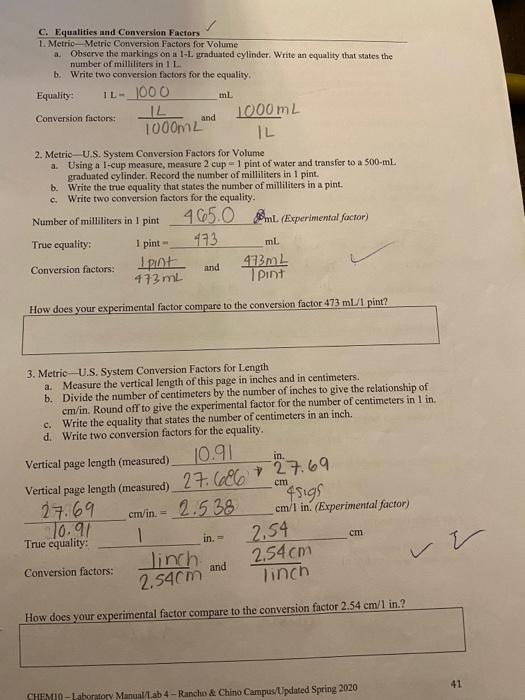
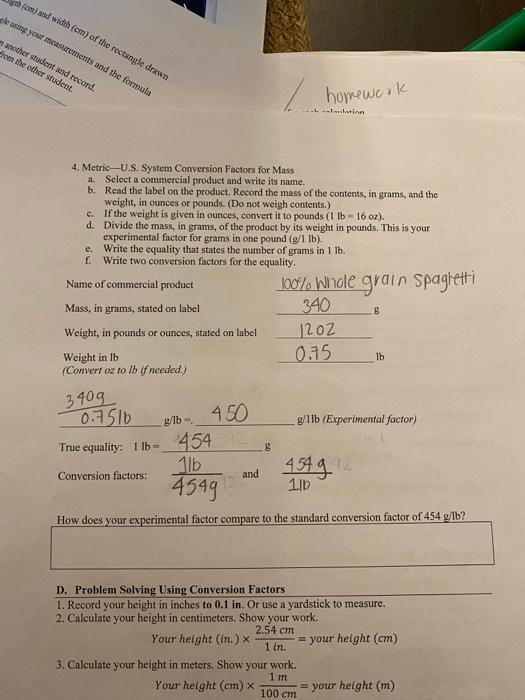
C. Equalities and Conversion Factors 1. Metric-Metric Conversion Factors for Volume a. Observe the markings on a I-L graduated cylinder. Write an equality that states the number of milliliters in 1 L b. Write two conversion factors for the equality Equality IL- 1000 ml IL Conversion factors: 1000 m2 and 1000m2 IL 2. Metrio U.S. System Conversion Factors for Volume a. Using a 1-cup measure, measure 2 cup - 1 pint of water and transfer to a 500-ml graduated cylinder. Record the number of milliliters in 1 pint. b. Write the true equality that states the number of milliliters in a pint. c. Write two conversion factors for the equality. Number of milliliters in 1 pint AmL (Experimental factor) True equality: 1 pint- 473 ml Conversion factors: Ipot 4322 and 473 ml Pint 465.0 How does your experimental factor compare to the conversion factor 473 ml/1 pint? 3. Metric U.S. System Conversion Factors for Length a. Measure the vertical length of this page in inches and in centimeters. b. Divide the number of centimeters by the number of inches to give the relationship of cm/in. Round off to give the experimental factor for the number of centimeters in 1 in. c. Write the equality that states the number of centimeters in an inch. d. Write two conversion factors for the equality. Vertical page length (measured) 10.91 in. Vertical page length (measured) 27. (celo 27.69 cm/in. 2.5 38 cm/1 in. (Experimental factor) 10.91 True equality: 1 in. = 2,54 linch Conversion factors: and 27.69 sigs cm cm 2.54cm linch 2.54cm How does your experimental factor compare to the conversion factor 2.54 cm/l in.? 41 CHEMIO- Laboratory Manual Lab 4 - Rancho & Chino Campus/Updated Spring 2020 th(cm) and width (cm) of the rectangle drawn ale using your measurements and the formula another student and record, from the other student homework -slation 4. Metric-U.S. System Conversion Factors for Mass a. Select a commercial product and write its name. b. Read the label on the product. Record the mass of the contents, in grams, and the weight, in ounces or pounds. (Do not weigh contents.) c. If the weight is given in ounces, convert it to pounds (1 lb - 16 oz). d. Divide the mass, in grams of the product by its weight in pounds. This is your experimental factor for grams in one pound (g/1 lb). e. Write the equality that states the number of grams in 1 lb. f. Write two conversion factors for the equality, Name of commercial product B 100% Whole grain spaghetti 340 1202 0.75 lb Mass, in grams, stated on label Weight, in pounds or ounces, stated on label Weight in lb (Convert oz to lb if needed.) 340g 0.3516 g/lb 450 True equality: 11b =_4542 8 11b Conversion factors: and g/llb (Experimental factor) 454 92 4549 1.10 How does your experimental factor compare to the standard conversion factor of 454 g/lb? D. Problem Solving Using Conversion Factors 1. Record your height in inches to 0.1 in. Or use a yardstick to measure. 2. Calculate your height in centimeters. Show your work. 2.54 cm Your height (in.) = your height (cm) 1 in. 3. Calculate your height in meters. Show your work. 1 m Your height (cm) 100 cm = your height (m)
Step by Step Solution
There are 3 Steps involved in it

Get step-by-step solutions from verified subject matter experts
 Study Help