







Question: need help on these questions docs.google.com C ab 8 Repeated Measures Assignment - PSY200: Quantitative Methods in PSY_L01_SPR22 X Untitled document - Google Docs Untitled
need help on these questions
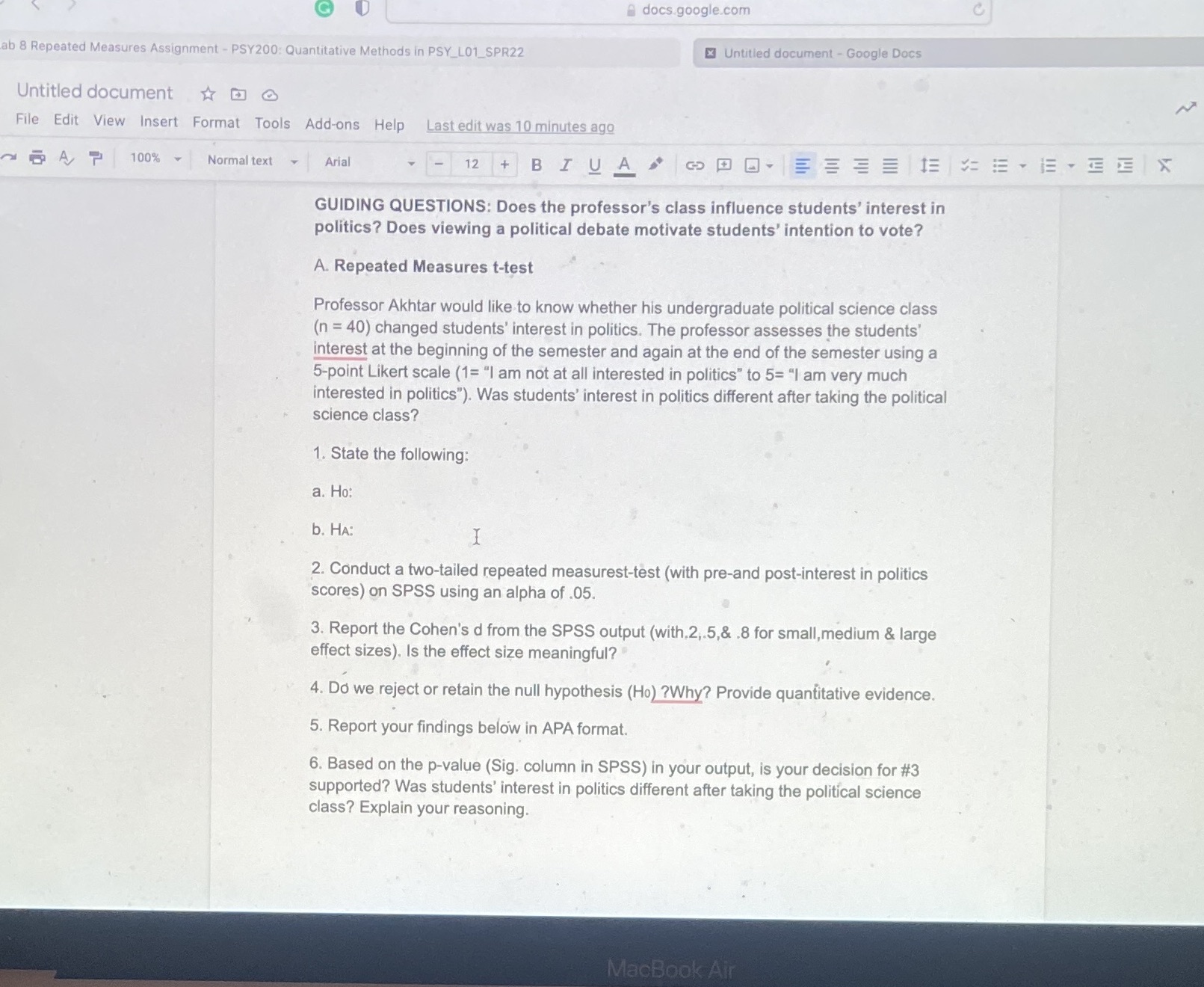
docs.google.com C ab 8 Repeated Measures Assignment - PSY200: Quantitative Methods in PSY_L01_SPR22 X Untitled document - Google Docs Untitled document * File Edit View Insert Format Tools Add-ons Help Last edit was 10 minutes ago 100% - Normal text Arial - 12 + B I U A . CO P O . = = = = 1= S B . B . FEX GUIDING QUESTIONS: Does the professor's class influence students' interest in politics? Does viewing a political debate motivate students' intention to vote? A. Repeated Measures t-test Professor Akhtar would like to know whether his undergraduate political science class (n = 40) changed students' interest in politics. The professor assesses the students interest at the beginning of the semester and again at the end of the semester using a 5-point Likert scale (1= "I am not at all interested in politics" to 5= "I am very much interested in politics"). Was students' interest in politics different after taking the political science class? 1. State the following: a. Ho: b. HA: 2. Conduct a two-tailed repeated measurest-test (with pre-and post-interest in politics scores) on SPSS using an alpha of .05. 3. Report the Cohen's d from the SPSS output (with,2,.5,& .8 for small, medium & large effect sizes). Is the effect size meaningful? 4. Do we reject or retain the null hypothesis (Ho) ?Why? Provide quantitative evidence. 5. Report your findings below in APA format. 6. Based on the p-value (Sig. column in SPSS) in your output, is your decision for #3 supported? Was students' interest in politics different after taking the political science class? Explain your reasoning. MacBook Air
Step by Step Solution
There are 3 Steps involved in it

Get step-by-step solutions from verified subject matter experts
 Study Help