







Question: Need help on this homework problem #3!! Must use #2 to solve for #3! Please show complete work! Thank you! Only need help with #3,
Need help on this homework problem #3!! Must use #2 to solve for #3! Please show complete work! Thank you!
Only need help with #3, so you DO NOT have to do #2!!
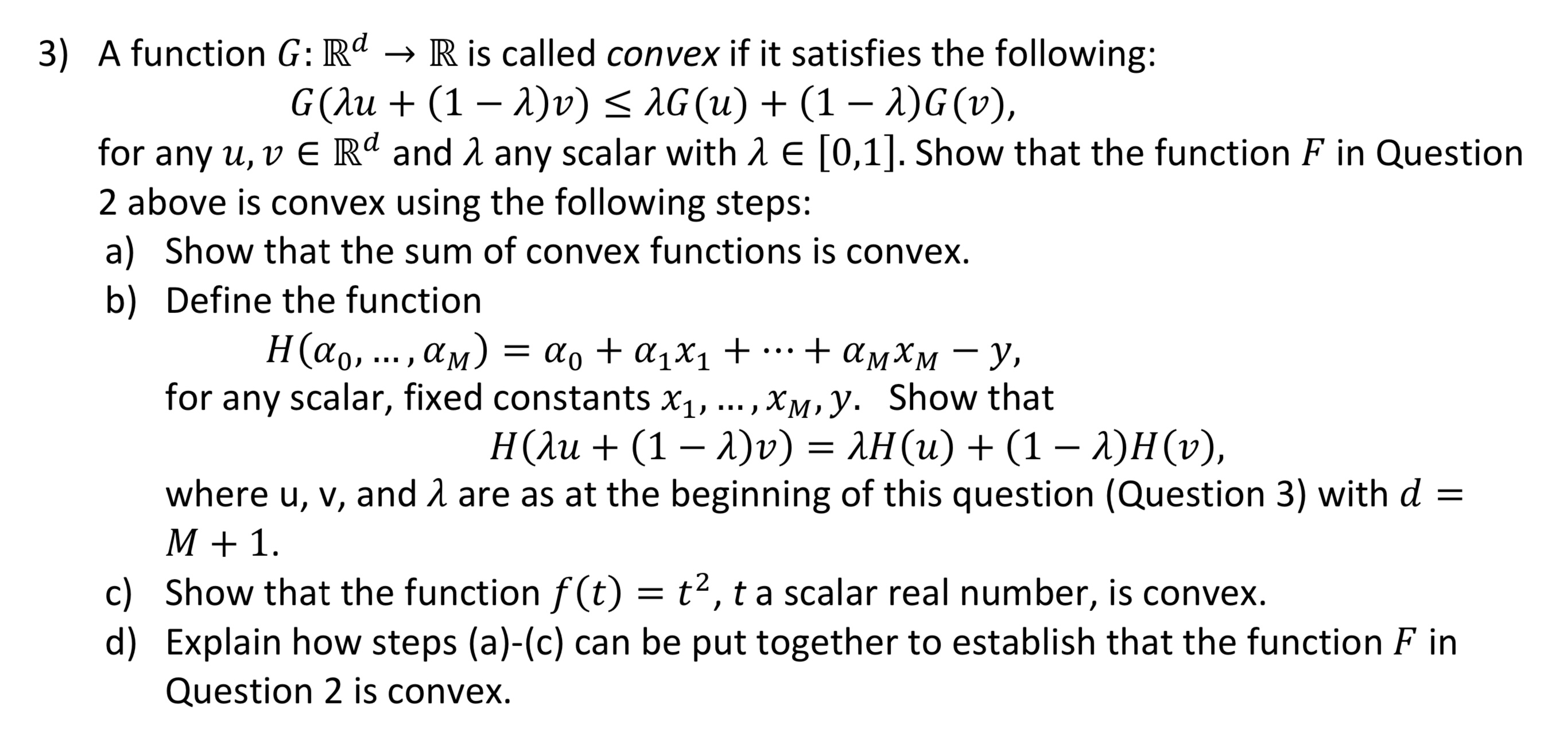
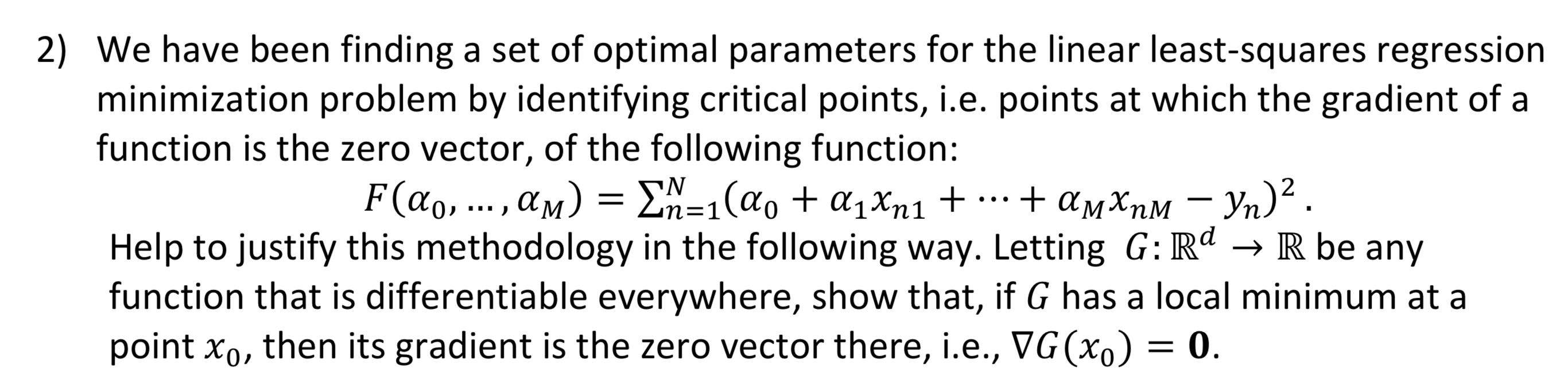
3) A function G: Rd > 1R is called convex if it satisfies the following: G(/1u + (1 x017) S 1601) + (1 x1)G(v), for any u, v E Rd and /1 any scalar with A E [0,1]. Show that the function F in Question 2 above is convex using the following steps: a) Show that the sum of convex functions is convex. b) Define the function H(a0, ...,aM) = 0:0 + alxl + + aMxM y, for any scalar, fixed constants x1, , xM, y. Show that H(/1u + (1 Mu) = 11H(u) + (1 11)H(v), where u, v, and /l are as at the beginning of this question (Question 3) with d = M + 1. c) Show that the function f(t) = t2, t a scalar real number, is convex. d) Explain how steps (a)-(c) can be put together to establish that the function F in Question 2 is convex. 2) We have been finding a set of optimal parameters for the linear leastsquares regression minimization problem by identifying critical points, i.e. points at which the gradient of a function is the zero vector, of the following function: 1:010 ---05M) = Zleo + 05195111 + + \"Mng 3902- Help to justify this methodology in the following way. Letting G: Rd > R be any function that is differentiable everywhere, show that, if G has a local minimum at a point x0, then its gradient is the zero vector there, i.e., VGOCO) = 0
Step by Step Solution
There are 3 Steps involved in it

Get step-by-step solutions from verified subject matter experts
 Study Help