







Question: need help on this question please 6. Consider a simple, representative agent RBC model in which output, y, is produced via a standard Cobb-Douglas production
need help on this question please
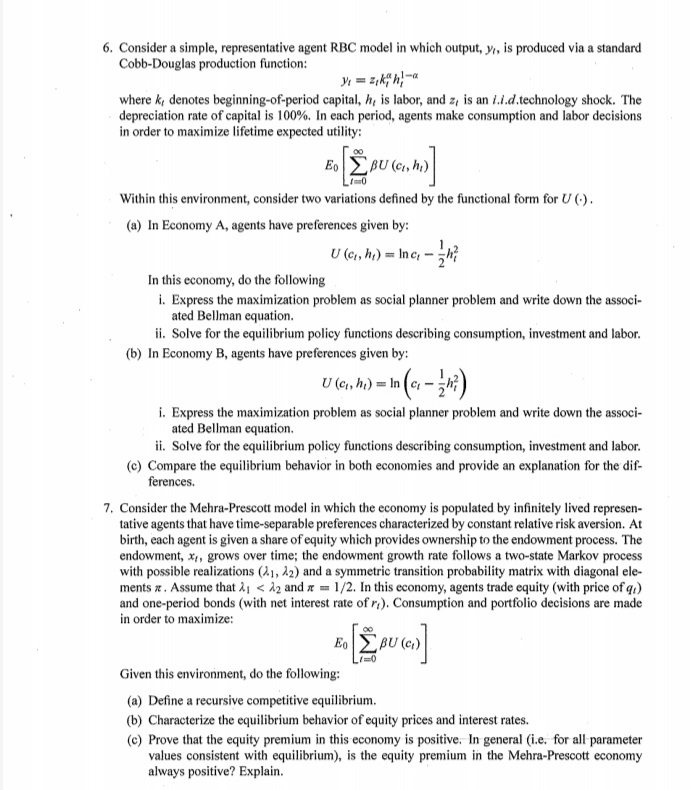
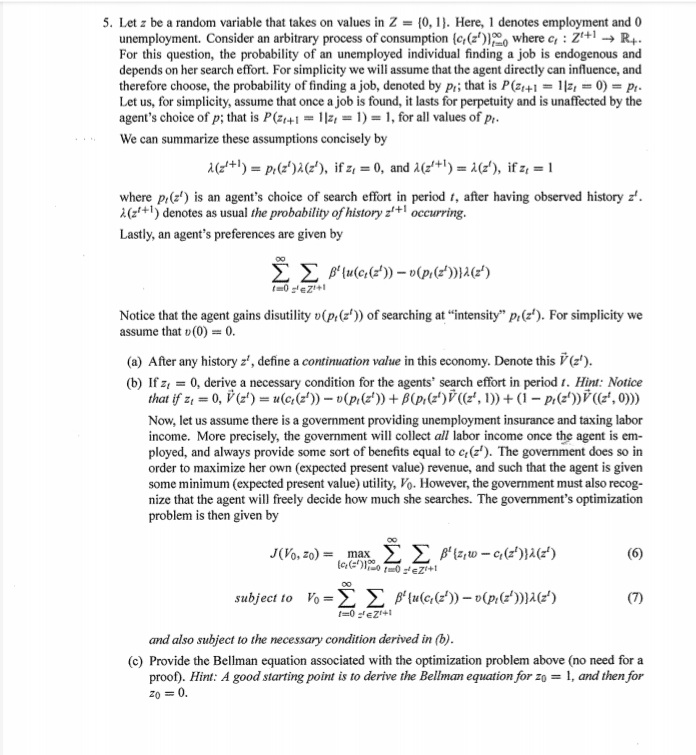
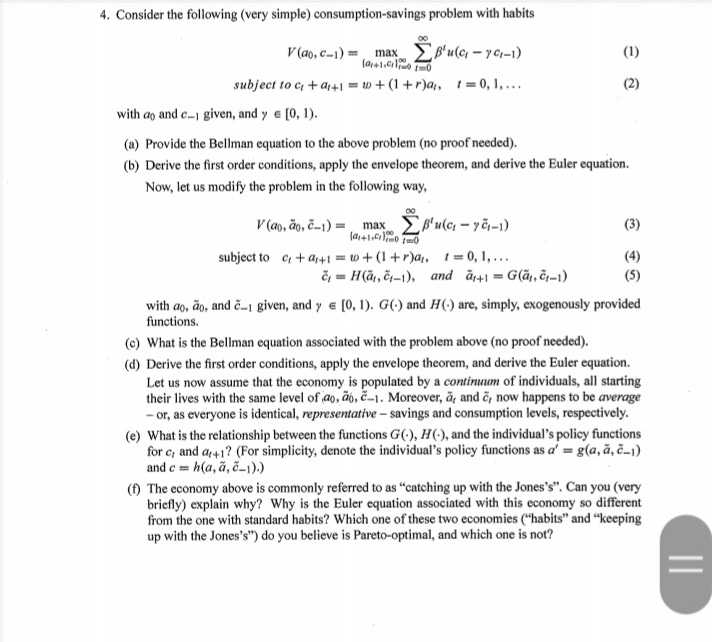
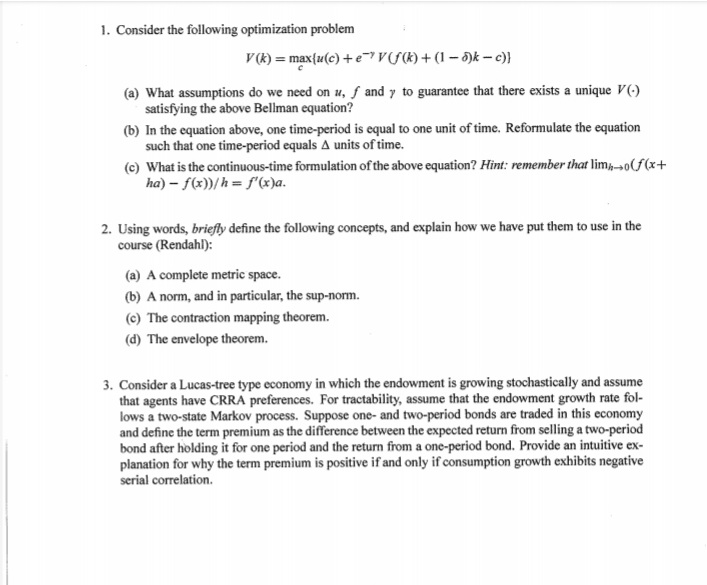
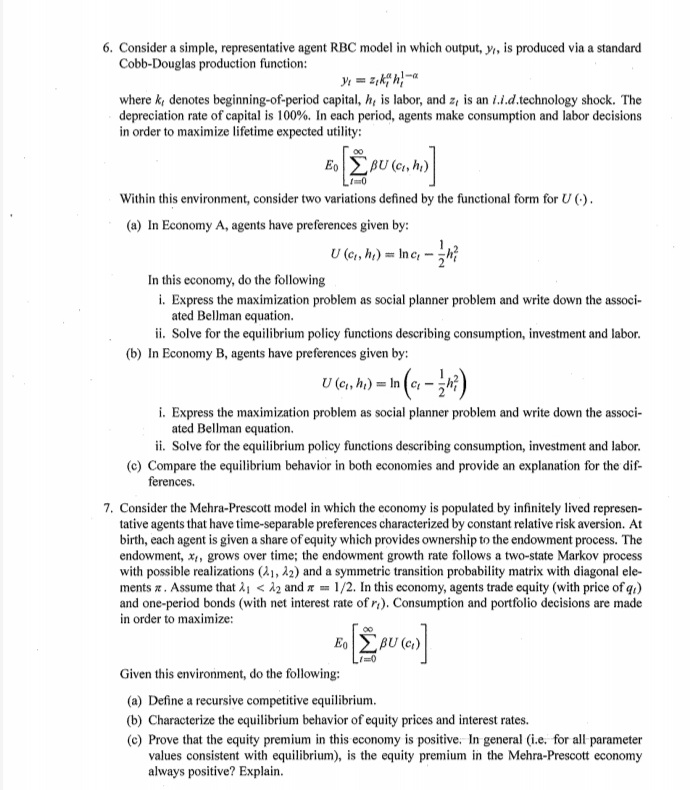
6. Consider a simple, representative agent RBC model in which output, y, is produced via a standard Cobb-Douglas production function: where k, denotes beginning-of-period capital, h, is labor, and z, is an /./.d.technology shock. The depreciation rate of capital is 100%. In each period, agents make consumption and labor decisions in order to maximize lifetime expected utility: Within this environment, consider two variations defined by the functional form for U (.). (a) In Economy A, agents have preferences given by: U (cq, h,) = Inc - 2" In this economy, do the following i. Express the maximization problem as social planner problem and write down the associ- ated Bellman equation. ii. Solve for the equilibrium policy functions describing consumption, investment and labor. (b) In Economy B, agents have preferences given by: U (cq, hi) = In (c - 2"?) i. Express the maximization problem as social planner problem and write down the associ- ated Bellman equation. ii. Solve for the equilibrium policy functions describing consumption, investment and labor. (c) Compare the equilibrium behavior in both economies and provide an explanation for the dif- ferences. 7. Consider the Mehra-Prescott model in which the economy is populated by infinitely lived represen- tative agents that have time-separable preferences characterized by constant relative risk aversion. At birth, each agent is given a share of equity which provides ownership to the endowment process. The endowment, x, grows over time; the endowment growth rate follows a two-state Markov process with possible realizations (21, 12) and a symmetric transition probability matrix with diagonal ele- ments *. Assume that 2,
Step by Step Solution
There are 3 Steps involved in it

Get step-by-step solutions from verified subject matter experts
 Study Help