







Question: Need help. Problem 1. We usually write numbers in decimal form (or base 10), meaning numbers are composed using 10 different digits {0, 1, ...,9).
Need help.
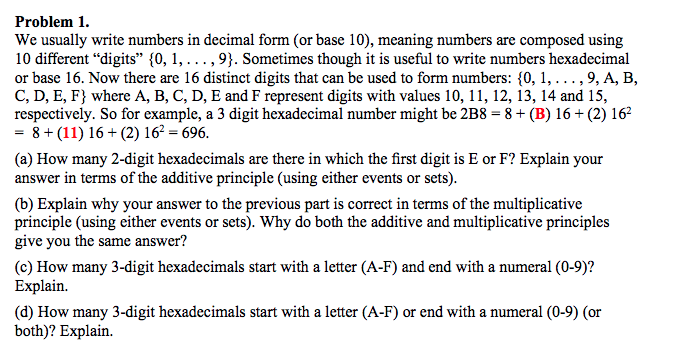
Problem 1. We usually write numbers in decimal form (or base 10), meaning numbers are composed using 10 different "digits" {0, 1, ...,9). Sometimes though it is useful to write numbers hexadecimal or base 16. Now there are 16 distinct digits that can be used to form numbers: {0, 1, . . . , 9, A, B, C, D, E, F} where A, B, C. D, E and F represent digits with values 10, 11, 12, 13, 14 and 15, respectively. So for example, a 3 digit hexadecimal number might be 2B8 = 8 + (B) 16 + (2) 162 = 8+ (11) 16 + (2) 162 = 696. (a) How many 2-digit hexadecimals are there in which the first digit is E or F? Explain your answer in terms of the additive principle (using either events or sets). (b) Explain why your answer to the previous part is correct in terms of the multiplicative principle (using either events or sets). Why do both the additive and multiplicative principles give you the same answer? (c) How many 3-digit hexadecimals start with a letter (A-F) and end with a numeral (0-9)? Explain. (d) How many 3-digit hexadecimals start with a letter (A-F) or end with a numeral (0-9) (or both)? Explain
Step by Step Solution
There are 3 Steps involved in it

Get step-by-step solutions from verified subject matter experts
 Study Help