Question: need help! questions are highlighted in yellow. ABC A A OB Case Study Assessment 2 In this case assessment you will find two cases:1. Uber:
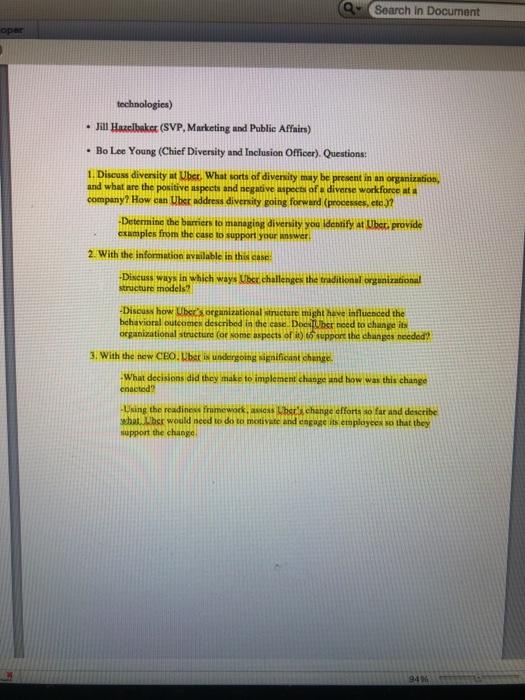
need help! questions are highlighted in yellow.
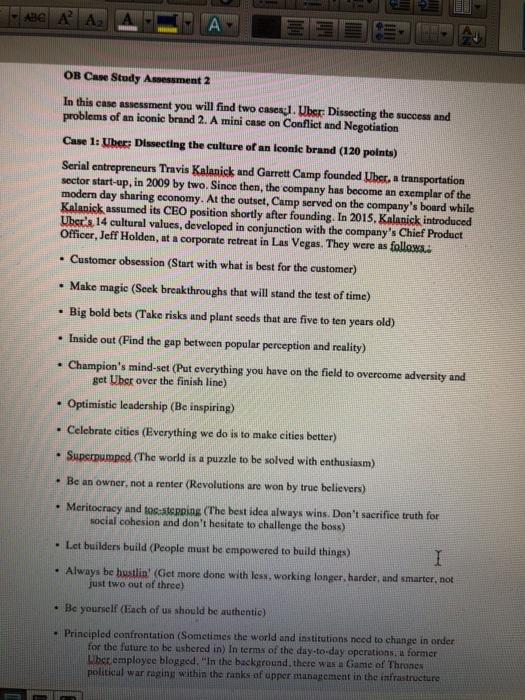
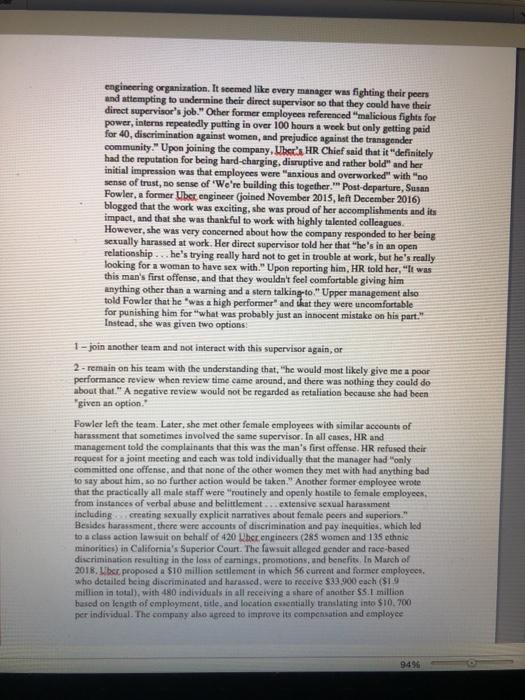
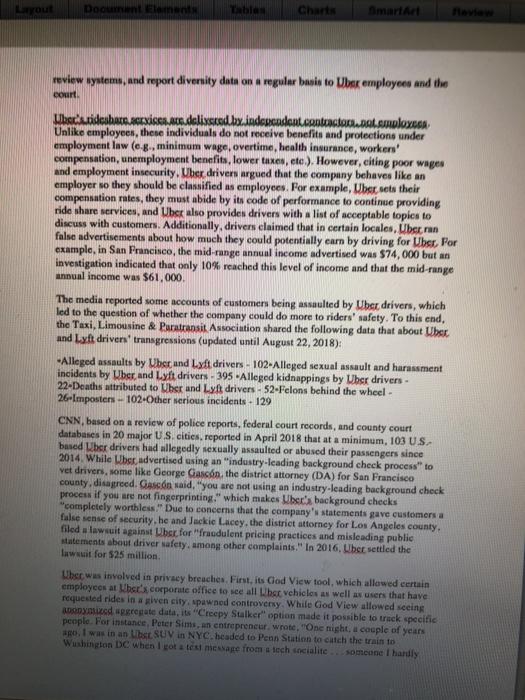
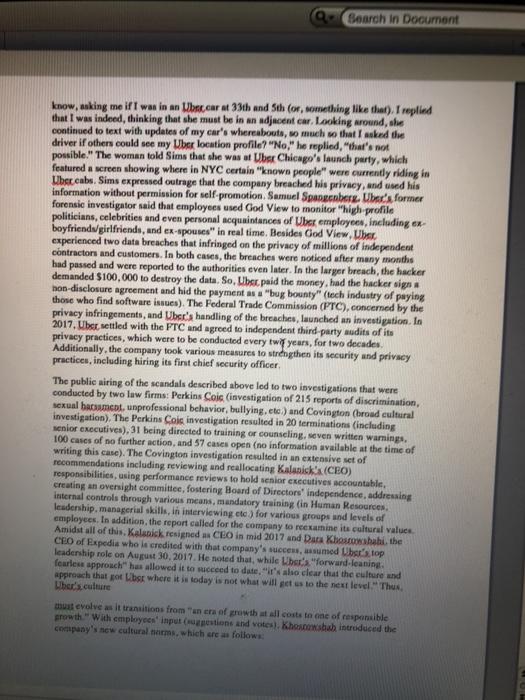
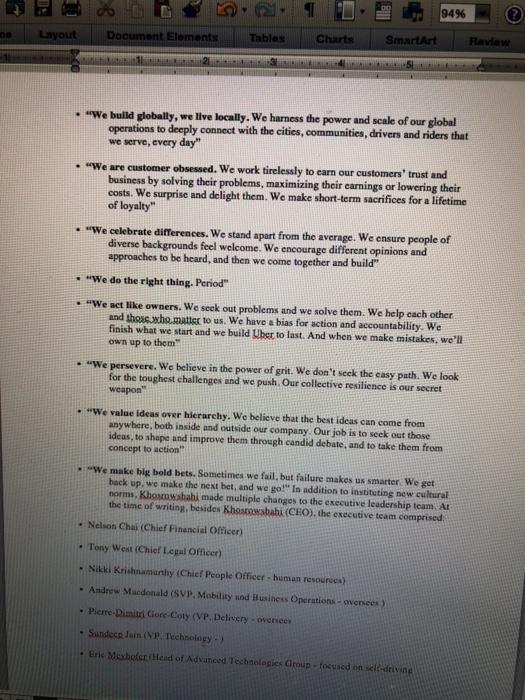
ABC A A OB Case Study Assessment 2 In this case assessment you will find two cases:1. Uber: Dissecting the success and problems of an iconic brand 2. A mini case on Conflict and Negotiation Case 1: Uber: Dissecting the culture of an iconic brand (120 points) Serial entrepreneurs Travis Kalanick and Garrett Camp founded Uber, a transportation sector start-up, in 2009 by two. Since then, the company has become an exemplar of the modern day sharing economy. At the outset, Camp served on the company's board while Kalanick assumed its CEO position shortly after founding. In 2015. Kalanick introduced Uber's 14 cultural values, developed in conjunction with the company's Chief Product Officer, Jeff Holden, at a corporate retreat in Las Vegas. They were as follows: Customer obsession (Start with what is best for the customer) Make magic (Seek breakthroughs that will stand the test of time) Big bold bets (Take risks and plant seeds that are five to ten years old) Inside out (Find the gap between popular perception and reality) . Champion's mind-set (Put everything you have on the field to overcome adversity and get Uber over the finish line) Optimistic leadership (Be inspiring) . Celebrate cities (Everything we do is to make cities better) Superpumped (The world is a puzzle to be solved with enthusiasm) Be an owner, not a renter (Revolutions are won by true believers) Meritocracy and tosatering (The best idea always wins. Don't sacrifice truth for social cohesion and don't hesitate to challenge the boss) Let builders build (People must be empowered to build things) I Always be bustlin' (Get more done with less, working longer, harder, and smarter, not just two out of three) Be yourself (Each of us should be authentic) - Principled confrontation (Sometimes the world and institutions need to change in order for the future to be ushered in) In terms of the day-to-day operations, a former Liber employee blogged. In the background, there was a Game of Thrones political war raging within the ranks of upper management in the infrastructure engineering organization. It seemed like every manager was fighting their peers and attempting to undermine their direct supervisor so that they could have their direct supervisor's job." Other former employees referenced "malicious fights for power, interns repeatedly putting in over 100 hours a week but only getting paid for 40, discrimination against women, and prejudice against the transgender community." Upon joining the company, Uber HR Chief said that it "definitely had the reputation for being hard-charging, disruptive and rather bold" and her initial impression was that employees were anxious and overworked with "no sense of trust, no sense of 'We're building this together." Post-departure, Susan Fowler, a former Uber engineer (joined November 2015, left December 2016) blogged that the work was exciting, she was proud of her accomplishments and its impact, and that she was thankful to work with highly talented colleagues However, she was very concerned about how the company responded to her being sexually harassed at work. Her direct supervisor told her that he's in an open relationship... he's trying really hard not to get in trouble at work, but he's really looking for a woman to have sex with." Upon reporting him, HR told her, "It was this man's first offense, and that they wouldn't feel comfortable giving him anything other than a warning and a stern talking to " Upper management also told Fowler that he was a high performer" and that they were uncomfortable for punishing him for what was probably just an innocent mistake on his part." Instead, she was given two options 1-join another team and not interact with this supervisor again, or 2- remain on his team with the understanding that, "he would most likely give me a pour performance review when review time came around, and there was nothing they could do about that." A negative review would not be regarded as retaliation because she had been "given an option Fowler left the team. Later, she met other female employees with similar accounts of harassment that sometimes involved the same supervisor. In all cases, HR an management told the complainants that this was the man's first offense HR refused their request for a joint meeting and each was told individually that the manager had only committed one offense, and that none of the other women they met with had anything bad to say about him, so no further action would be taken." Another former employee wrote that the practically all male staff were routinely and openly hostile to female employees, from instances of verbal abuse and belittlement.extensive sexual harassment including creating sexually explicit narratives about female peers and superiors." Besides harassment, there were accounts of discrimination and pay inequities, which led to a class action lawsuit on behalf of 420 Uber engineers (285 women and 135 ethnic minorities) in California's Superior Court. The fuwsuit alleged gender and race-based discrimination resulting in the loss of carings, promotions, and benefits. In March of 2018. Liber proposed a $10 million scilement in which 56 current and former employees who detailed being discriminated and harassed, were to receive $33.900 each ($1.9 million in total), with 480 individuals in all receiving a share of another $5.1 million based on length of employment, title, and location esentially translating into $10.700 per individual. The company also agreed to improve its compensation and employee 949 Layout Document Elements Tables Charts martArt review nystems, and report diversity data on a regular basis to Uber employees and the court Uheidshare.cccxigaste.delisted by indecadent.contacto. not smployees Unlike employees, these individuals do not receive benefits and protections under employment law (c.g., minimum wage, overtime, health insurance, workers compensation, unemployment benefits, lower taxes, etc.). However, citing poor wages and employment insecurity. Uber drivers argued that the company behaves like an employer so they should be classified as employees. For example, Uber sets their compensation rates, they must abide by its code of performance to continue providing ride share services, and Uber also provides drivers with a list of acceptable topics to discuss with customers. Additionally, drivers claimed that in certain locales, Uberran false advertisements about how much they could potentially earn by driving for Uber. Por example, in San Francisco, the mid-range annual income advertised was $74,000 but an investigation indicated that only 10% reached this level of income and that the mid-range annual income was $61,000 The media reported some accounts of customers being assaulted by Uber drivers, which led to the question of whether the company could do more to riders' safety. To this end, the Taxi, Limousine & Paratransit Association shared the following data that about Uber and Lyft drivers transgressions (updated until August 22, 2018): Alleged assaults by Uber and Lydt drivers - 102-Alleged sexual assault and harassment incidents by Uber, and Lytt drivers - 395 .Alleged kidnappings by Uber drivers 22-Deaths attributed to Uber and Lyft drivers - 52-Felons behind the wheel 26-Imposters - 102.Other serious incidents - 129 CNN, based on a review of police reports, federal court records, and county court databases in 20 major US cities, reported in April 2018 that at a minimum, 103 US. based Uber drivers had allegedly sexually assaulted or abused their passengers since 2014. While Uber advertised using an industry-leading background check process to vet drivers, some like George Gascn, the district attorney (DA) for San Francisco county, disagreed. Gascn said. "you are not using an industry-leading background check process if you are not fingerprinting," which makes Use background checks "completely worthless. Due to concerns that the company's statements gave customers a false sense of security, he and Jackie Lacey, the district attorney for Los Angeles county. filed a lawsuit against Ubst for "fraudulent pricing practices and misleading public statements about driver safety, among other complaints." In 2016. Uber settled the lawsuit for $25 million Uber was involved in privacy breaches. First, its Cod View tool, which allowed certain employees at What's corporate office to see all bec vehicles as well as users that have requested rides in a given city, spawned controversy. While God View allowed seeing mixed pregate data, its "Creepy Stalker" option made it possible to truck specific people. For instance, Peter Sims, un entrepreneur wrote, "One night, a couple of years o. I was in an List SUV in NYC. headed to Pean Station to catch the train to Wushington DC when I got a text message from toch socialite someone I hardly Q. Bearch In Document know, asking me if I was in an Ubaccarat 33th and Sth (or, something like that. I replied that I was indeed, thinking that she must be in an adjacent car. Looking around, the continued to text with updates of my car's whereabouts, so much so that I asked the driver if others could see my Uber location profile? "No," he replied, that's not possible." The woman told Sims that she was at Uber Chicago's launch party, which featured a screen showing where in NYC certain "known people" were currently riding in Uber cabs. Sims expressed outrage that the company breached his privacy, and used his information without permission for self-promotion, Samuel Spangenbere. Ubar's former forensic investigator said that employees used God View to monitor "high-profile politicians, celebrities and even personal acquaintances of Uber employees, including ex- boyfriends/girlfriends, and ex-spouses in real time. Besides God View, Uber experienced two data breaches that infringed on the privacy of millions of independent contractors and customers. In both cases, the breaches were noticed after many months had passed and were reported to the authorities even later. In the larger breach, the hacker demanded $100,000 to destroy the data. So, Uber, paid the money, had the hacker sig non-disclosure agreement and hid the payment as a "bug bounty" (tech industry of paying those who find software issues). The Federal Trade Commission (PTC),concerned by the privacy infringements, and Uber's handling of the breaches, launched an investigation. In 2017. Uber settled with the PTC and agreed to independent third party audits of its privacy practices, which were to be conducted every two years, for two decades Additionally, the company took various measures to strengthen its security and privacy practices, including hiring its fint chief security officer The public airing of the scandals described above led to two investigations that were conducted by two law firms: Perkins Cois (investigation of 215 reports of discrimination, sexual acument, unprofessional behavior, bullying, etc.) and Covington (broad cultural investigation), The Perkins Cols investigation resulted in 20 terminations (including senior executives), 31 being directed to training or counseling, even written warnings, 100 cases of no further action, and 57 cases open (no information available at the time of writing this case). The Covington investigation resulted in an extensive set of recommendations including reviewing and reallocating Kalesisk (CEO) responsibilities, using performance reviews to hold senior executives accountable, creating an oversight committee, fostering Board of Directors' independence, addressing Internal controls through various means, mandatory training (in Human Resources, leadership, managerial skills, in interviewing etc) for various groups and levels of employees. In addition, the report called for the company to examine its cultural values Amidst all of this, Kalanick resigned as CEO in mid 2017 and Dara Kboschahi, the CEO of Expedia whole credited with that company's succes, sumed Ube's.top leadership role on August 30, 2017. He noted that, while Les "forward-leaning, fearle approach" has allowed it to succeed to date, it's also clear that the culture and approach that of Lose where it is today is not what will get to the next level. Thus Uhers.culture mas evolve as it transitions from an era of growth at all costs to one of responsible growth" With employees input (estions and votes). Khobah introduced the company's new cultural ems, which are as follows: 1 94% Layout Document Elements Tables Charts SmartArt Review "We build globally, we live locally. We harness the power and scale of our global operations to deeply connect with the cities, communities, drivers and riders that we serve, every day" . "We are customer obsessed. We work tirelessly to carn our customers' trust and business by solving their problems, maximizing their earnings or lowering their costs. We surprise and delight them. We make short-term sacrifices for a lifetime of loyalty" . "We celebrate differences. We stand apart from the average. We ensure people of diverse backgrounds feel welcome. We encourage different opinions and approaches to be heard, and then we come together and build" "We do the right thing. Period "We act like owners. We seek out problems and we solve them. We help each other and those who matter to us. We have a bias for action and accountability. We finish what we start and we build Uber to last. And when we make mistakes, we'll own up to them" "We persevere. We believe in the power of grit. We don't seek the casy path. We look for the toughest challenges and we push. Our collective resilience is our secret weapon" "We value Ideas over hierarchy. We believe that the best ideas can come from anywhere, both inside and outside our company. Our job is to seck out those ideas, to shape and improve them through candid debate, and to take them from concept to action" - "We make big bold bets. Sometimes we fail, but failure makes us smarter We get back up, we make the next bet, and we go!" In addition to instituting new cultural norms, Khosrowshahi made multiple changes to the executive leadership team. At the time of writing, besides Khosowsbahi (CEO). the executive team comprised Nelson Chai (Chief Financial Officer) Tony West (Chiel Legal Officer) Nikki Krishnamurthy (Chief People Officer - human resources) . Andrew Macdonald (SVP. Mobility and Business Operation - oversees) Pierre-Dimitri Gore-Coty (VP. Delivery overeer Sunderlain (VP Technology - Erle Merbolt Head of Advanced Technologies Group - focused on sci-driving Q Search in Document oper technologies) . Ul Hazelbaket (SVP, Marketing and Public Affairs) . Bo Lee Young (Chief Diversity and Inclusion Officer). Questions: 1. Discuss diversity at Uber, What sorts of diversity may be present in an organization, and what are the positive aspects and negative aspects of a diverse workforce at company? How can Uber address diversity going forward (processes, etc.)? -Determine the barriers to managing diversity you identify at Uber, provide cxamples from the case to support your answer 2. With the information available in this case: Discuss ways in which ways Uber challenges the traditional organizational structure models? -Discuss how Us organizational structure might have influenced the behavioral outcomes described in the case. Door her need to change its organizational structure for some aspects of it) 65 support the changes needed! 3. With the new CEO. Uber i undergoing Minificant change What decisions did they make to implement change and how was this change enacted Using the readiness framework, ons What's change efforts so far and describe what Liher would need to do to motivate and engage its employees so that they support the change 94 ABC A A OB Case Study Assessment 2 In this case assessment you will find two cases:1. Uber: Dissecting the success and problems of an iconic brand 2. A mini case on Conflict and Negotiation Case 1: Uber: Dissecting the culture of an iconic brand (120 points) Serial entrepreneurs Travis Kalanick and Garrett Camp founded Uber, a transportation sector start-up, in 2009 by two. Since then, the company has become an exemplar of the modern day sharing economy. At the outset, Camp served on the company's board while Kalanick assumed its CEO position shortly after founding. In 2015. Kalanick introduced Uber's 14 cultural values, developed in conjunction with the company's Chief Product Officer, Jeff Holden, at a corporate retreat in Las Vegas. They were as follows: Customer obsession (Start with what is best for the customer) Make magic (Seek breakthroughs that will stand the test of time) Big bold bets (Take risks and plant seeds that are five to ten years old) Inside out (Find the gap between popular perception and reality) . Champion's mind-set (Put everything you have on the field to overcome adversity and get Uber over the finish line) Optimistic leadership (Be inspiring) . Celebrate cities (Everything we do is to make cities better) Superpumped (The world is a puzzle to be solved with enthusiasm) Be an owner, not a renter (Revolutions are won by true believers) Meritocracy and tosatering (The best idea always wins. Don't sacrifice truth for social cohesion and don't hesitate to challenge the boss) Let builders build (People must be empowered to build things) I Always be bustlin' (Get more done with less, working longer, harder, and smarter, not just two out of three) Be yourself (Each of us should be authentic) - Principled confrontation (Sometimes the world and institutions need to change in order for the future to be ushered in) In terms of the day-to-day operations, a former Liber employee blogged. In the background, there was a Game of Thrones political war raging within the ranks of upper management in the infrastructure engineering organization. It seemed like every manager was fighting their peers and attempting to undermine their direct supervisor so that they could have their direct supervisor's job." Other former employees referenced "malicious fights for power, interns repeatedly putting in over 100 hours a week but only getting paid for 40, discrimination against women, and prejudice against the transgender community." Upon joining the company, Uber HR Chief said that it "definitely had the reputation for being hard-charging, disruptive and rather bold" and her initial impression was that employees were anxious and overworked with "no sense of trust, no sense of 'We're building this together." Post-departure, Susan Fowler, a former Uber engineer (joined November 2015, left December 2016) blogged that the work was exciting, she was proud of her accomplishments and its impact, and that she was thankful to work with highly talented colleagues However, she was very concerned about how the company responded to her being sexually harassed at work. Her direct supervisor told her that he's in an open relationship... he's trying really hard not to get in trouble at work, but he's really looking for a woman to have sex with." Upon reporting him, HR told her, "It was this man's first offense, and that they wouldn't feel comfortable giving him anything other than a warning and a stern talking to " Upper management also told Fowler that he was a high performer" and that they were uncomfortable for punishing him for what was probably just an innocent mistake on his part." Instead, she was given two options 1-join another team and not interact with this supervisor again, or 2- remain on his team with the understanding that, "he would most likely give me a pour performance review when review time came around, and there was nothing they could do about that." A negative review would not be regarded as retaliation because she had been "given an option Fowler left the team. Later, she met other female employees with similar accounts of harassment that sometimes involved the same supervisor. In all cases, HR an management told the complainants that this was the man's first offense HR refused their request for a joint meeting and each was told individually that the manager had only committed one offense, and that none of the other women they met with had anything bad to say about him, so no further action would be taken." Another former employee wrote that the practically all male staff were routinely and openly hostile to female employees, from instances of verbal abuse and belittlement.extensive sexual harassment including creating sexually explicit narratives about female peers and superiors." Besides harassment, there were accounts of discrimination and pay inequities, which led to a class action lawsuit on behalf of 420 Uber engineers (285 women and 135 ethnic minorities) in California's Superior Court. The fuwsuit alleged gender and race-based discrimination resulting in the loss of carings, promotions, and benefits. In March of 2018. Liber proposed a $10 million scilement in which 56 current and former employees who detailed being discriminated and harassed, were to receive $33.900 each ($1.9 million in total), with 480 individuals in all receiving a share of another $5.1 million based on length of employment, title, and location esentially translating into $10.700 per individual. The company also agreed to improve its compensation and employee 949 Layout Document Elements Tables Charts martArt review nystems, and report diversity data on a regular basis to Uber employees and the court Uheidshare.cccxigaste.delisted by indecadent.contacto. not smployees Unlike employees, these individuals do not receive benefits and protections under employment law (c.g., minimum wage, overtime, health insurance, workers compensation, unemployment benefits, lower taxes, etc.). However, citing poor wages and employment insecurity. Uber drivers argued that the company behaves like an employer so they should be classified as employees. For example, Uber sets their compensation rates, they must abide by its code of performance to continue providing ride share services, and Uber also provides drivers with a list of acceptable topics to discuss with customers. Additionally, drivers claimed that in certain locales, Uberran false advertisements about how much they could potentially earn by driving for Uber. Por example, in San Francisco, the mid-range annual income advertised was $74,000 but an investigation indicated that only 10% reached this level of income and that the mid-range annual income was $61,000 The media reported some accounts of customers being assaulted by Uber drivers, which led to the question of whether the company could do more to riders' safety. To this end, the Taxi, Limousine & Paratransit Association shared the following data that about Uber and Lyft drivers transgressions (updated until August 22, 2018): Alleged assaults by Uber and Lydt drivers - 102-Alleged sexual assault and harassment incidents by Uber, and Lytt drivers - 395 .Alleged kidnappings by Uber drivers 22-Deaths attributed to Uber and Lyft drivers - 52-Felons behind the wheel 26-Imposters - 102.Other serious incidents - 129 CNN, based on a review of police reports, federal court records, and county court databases in 20 major US cities, reported in April 2018 that at a minimum, 103 US. based Uber drivers had allegedly sexually assaulted or abused their passengers since 2014. While Uber advertised using an industry-leading background check process to vet drivers, some like George Gascn, the district attorney (DA) for San Francisco county, disagreed. Gascn said. "you are not using an industry-leading background check process if you are not fingerprinting," which makes Use background checks "completely worthless. Due to concerns that the company's statements gave customers a false sense of security, he and Jackie Lacey, the district attorney for Los Angeles county. filed a lawsuit against Ubst for "fraudulent pricing practices and misleading public statements about driver safety, among other complaints." In 2016. Uber settled the lawsuit for $25 million Uber was involved in privacy breaches. First, its Cod View tool, which allowed certain employees at What's corporate office to see all bec vehicles as well as users that have requested rides in a given city, spawned controversy. While God View allowed seeing mixed pregate data, its "Creepy Stalker" option made it possible to truck specific people. For instance, Peter Sims, un entrepreneur wrote, "One night, a couple of years o. I was in an List SUV in NYC. headed to Pean Station to catch the train to Wushington DC when I got a text message from toch socialite someone I hardly Q. Bearch In Document know, asking me if I was in an Ubaccarat 33th and Sth (or, something like that. I replied that I was indeed, thinking that she must be in an adjacent car. Looking around, the continued to text with updates of my car's whereabouts, so much so that I asked the driver if others could see my Uber location profile? "No," he replied, that's not possible." The woman told Sims that she was at Uber Chicago's launch party, which featured a screen showing where in NYC certain "known people" were currently riding in Uber cabs. Sims expressed outrage that the company breached his privacy, and used his information without permission for self-promotion, Samuel Spangenbere. Ubar's former forensic investigator said that employees used God View to monitor "high-profile politicians, celebrities and even personal acquaintances of Uber employees, including ex- boyfriends/girlfriends, and ex-spouses in real time. Besides God View, Uber experienced two data breaches that infringed on the privacy of millions of independent contractors and customers. In both cases, the breaches were noticed after many months had passed and were reported to the authorities even later. In the larger breach, the hacker demanded $100,000 to destroy the data. So, Uber, paid the money, had the hacker sig non-disclosure agreement and hid the payment as a "bug bounty" (tech industry of paying those who find software issues). The Federal Trade Commission (PTC),concerned by the privacy infringements, and Uber's handling of the breaches, launched an investigation. In 2017. Uber settled with the PTC and agreed to independent third party audits of its privacy practices, which were to be conducted every two years, for two decades Additionally, the company took various measures to strengthen its security and privacy practices, including hiring its fint chief security officer The public airing of the scandals described above led to two investigations that were conducted by two law firms: Perkins Cois (investigation of 215 reports of discrimination, sexual acument, unprofessional behavior, bullying, etc.) and Covington (broad cultural investigation), The Perkins Cols investigation resulted in 20 terminations (including senior executives), 31 being directed to training or counseling, even written warnings, 100 cases of no further action, and 57 cases open (no information available at the time of writing this case). The Covington investigation resulted in an extensive set of recommendations including reviewing and reallocating Kalesisk (CEO) responsibilities, using performance reviews to hold senior executives accountable, creating an oversight committee, fostering Board of Directors' independence, addressing Internal controls through various means, mandatory training (in Human Resources, leadership, managerial skills, in interviewing etc) for various groups and levels of employees. In addition, the report called for the company to examine its cultural values Amidst all of this, Kalanick resigned as CEO in mid 2017 and Dara Kboschahi, the CEO of Expedia whole credited with that company's succes, sumed Ube's.top leadership role on August 30, 2017. He noted that, while Les "forward-leaning, fearle approach" has allowed it to succeed to date, it's also clear that the culture and approach that of Lose where it is today is not what will get to the next level. Thus Uhers.culture mas evolve as it transitions from an era of growth at all costs to one of responsible growth" With employees input (estions and votes). Khobah introduced the company's new cultural ems, which are as follows: 1 94% Layout Document Elements Tables Charts SmartArt Review "We build globally, we live locally. We harness the power and scale of our global operations to deeply connect with the cities, communities, drivers and riders that we serve, every day" . "We are customer obsessed. We work tirelessly to carn our customers' trust and business by solving their problems, maximizing their earnings or lowering their costs. We surprise and delight them. We make short-term sacrifices for a lifetime of loyalty" . "We celebrate differences. We stand apart from the average. We ensure people of diverse backgrounds feel welcome. We encourage different opinions and approaches to be heard, and then we come together and build" "We do the right thing. Period "We act like owners. We seek out problems and we solve them. We help each other and those who matter to us. We have a bias for action and accountability. We finish what we start and we build Uber to last. And when we make mistakes, we'll own up to them" "We persevere. We believe in the power of grit. We don't seek the casy path. We look for the toughest challenges and we push. Our collective resilience is our secret weapon" "We value Ideas over hierarchy. We believe that the best ideas can come from anywhere, both inside and outside our company. Our job is to seck out those ideas, to shape and improve them through candid debate, and to take them from concept to action" - "We make big bold bets. Sometimes we fail, but failure makes us smarter We get back up, we make the next bet, and we go!" In addition to instituting new cultural norms, Khosrowshahi made multiple changes to the executive leadership team. At the time of writing, besides Khosowsbahi (CEO). the executive team comprised Nelson Chai (Chief Financial Officer) Tony West (Chiel Legal Officer) Nikki Krishnamurthy (Chief People Officer - human resources) . Andrew Macdonald (SVP. Mobility and Business Operation - oversees) Pierre-Dimitri Gore-Coty (VP. Delivery overeer Sunderlain (VP Technology - Erle Merbolt Head of Advanced Technologies Group - focused on sci-driving Q Search in Document oper technologies) . Ul Hazelbaket (SVP, Marketing and Public Affairs) . Bo Lee Young (Chief Diversity and Inclusion Officer). Questions: 1. Discuss diversity at Uber, What sorts of diversity may be present in an organization, and what are the positive aspects and negative aspects of a diverse workforce at company? How can Uber address diversity going forward (processes, etc.)? -Determine the barriers to managing diversity you identify at Uber, provide cxamples from the case to support your answer 2. With the information available in this case: Discuss ways in which ways Uber challenges the traditional organizational structure models? -Discuss how Us organizational structure might have influenced the behavioral outcomes described in the case. Door her need to change its organizational structure for some aspects of it) 65 support the changes needed! 3. With the new CEO. Uber i undergoing Minificant change What decisions did they make to implement change and how was this change enacted Using the readiness framework, ons What's change efforts so far and describe what Liher would need to do to motivate and engage its employees so that they support the change 94









 Study Help