







Question: Need help ! -Select-payments are known as lump sums. We can solve for the future value or the present value of a lump sum as
 Need help !
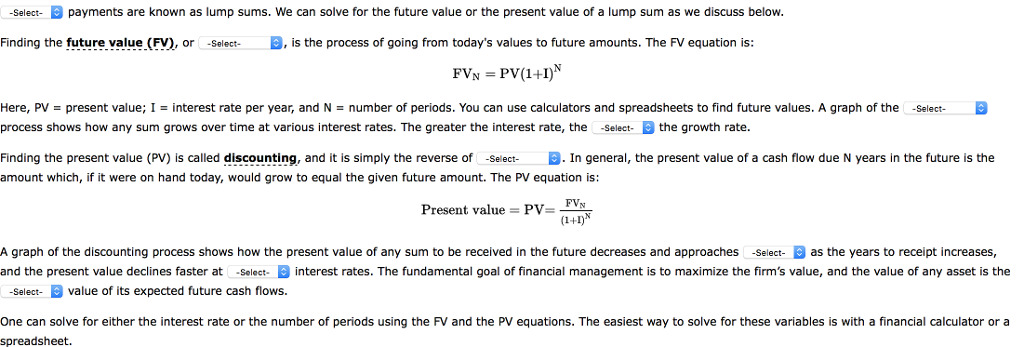
-Select-payments are known as lump sums. We can solve for the future value or the present value of a lump sum as we discuss below. Finding the future value (FV), orSelect- is the process of going from today's values to future amounts. The FV equation is FVN = PV(1+1)N B Here, PV = present value; 1 = interest rate per year, and N = number of periods. You can use calculators and spreadsheets to find future values. A graph of the process shows how any sum grows over time at various interest rates. The greater the interest rate, the the growth rate. -Select- Finding the present value (PV) is called discounting, and it is simply the reverse of Select- .In general, the present value of a cash flow due N years in the future is the amount which, if it were on hand today, would grow to equal the given future amount. The PV equation is: Present value = PV- PV A graph of the discounting process shows how the present value of any sum to be received in the future decreases and approaches-Selt- as the years to receipt increases, and the present value declines faster at -Selectinterest rates. The fundamental goal of financial management is to maximize the firm's value, and the value of any asset is the -Select- value of its expected future cash flows. One can solve for either the interest rate or the number of periods using the FV and the PV equations. The easiest way to solve for these variables is with a financial calculator or a spreadsheet -Select-payments are known as lump sums. We can solve for the future value or the present value of a lump sum as we discuss below. Finding the future value (FV), orSelect- is the process of going from today's values to future amounts. The FV equation is FVN = PV(1+1)N B Here, PV = present value; 1 = interest rate per year, and N = number of periods. You can use calculators and spreadsheets to find future values. A graph of the process shows how any sum grows over time at various interest rates. The greater the interest rate, the the growth rate. -Select- Finding the present value (PV) is called discounting, and it is simply the reverse of Select- .In general, the present value of a cash flow due N years in the future is the amount which, if it were on hand today, would grow to equal the given future amount. The PV equation is: Present value = PV- PV A graph of the discounting process shows how the present value of any sum to be received in the future decreases and approaches-Selt- as the years to receipt increases, and the present value declines faster at -Selectinterest rates. The fundamental goal of financial management is to maximize the firm's value, and the value of any asset is the -Select- value of its expected future cash flows. One can solve for either the interest rate or the number of periods using the FV and the PV equations. The easiest way to solve for these variables is with a financial calculator or a spreadsheet
Step by Step Solution
There are 3 Steps involved in it

Get step-by-step solutions from verified subject matter experts
 Study Help