







Question: Need help solving these and seeing if 4 is correct. 2. (a to d:) Which of the following compounds is able to undergo addition polymerizations?
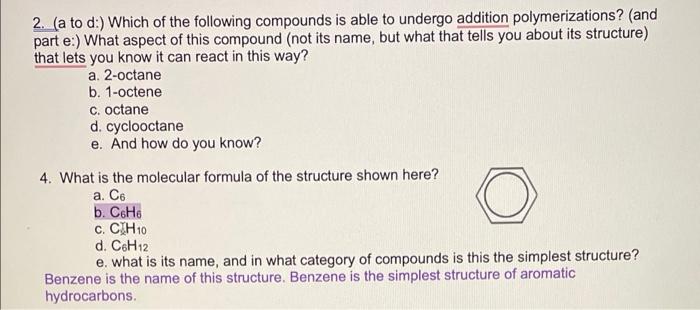
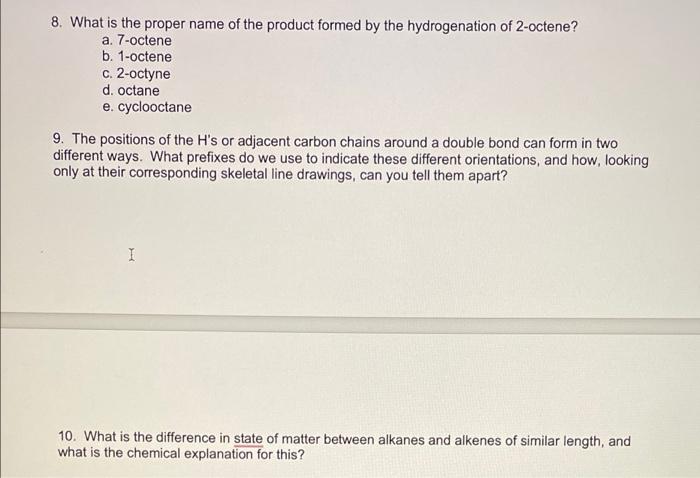
2. (a to d:) Which of the following compounds is able to undergo addition polymerizations? (and part :) What aspect of this compound (not its name, but what that tells you about its structure) that lets you know it can react in this way? a. 2-octane b. 1-octene c. octane d. cyclooctane e. And how do you know? 4. What is the molecular formula of the structure shown here? a. C6 b. C6H6 C, CH10 d. C6H12 e. what is its name, and in what category of compounds is this the simplest structure? Benzene is the name of this structure. Benzene is the simplest structure of aromatic hydrocarbons 8. What is the proper name of the product formed by the hydrogenation of 2-octene? a. 7-octene b. 1-octene C. 2-octyne d. octane e. cyclooctane 9. The positions of the H's or adjacent carbon chains around a double bond can form in two different ways. What prefixes do we use to indicate these different orientations, and how, looking only at their corresponding skeletal line drawings, can you tell them apart? I 10. What is the difference in state of matter between alkanes and alkenes of similar length, and what is the chemical explanation for this
Step by Step Solution
There are 3 Steps involved in it

Get step-by-step solutions from verified subject matter experts
 Study Help