







Question: Need help solving these in matlab! Root Solving Methods 1) Iterative Algebra a) Because the definition of the square root of a number p can
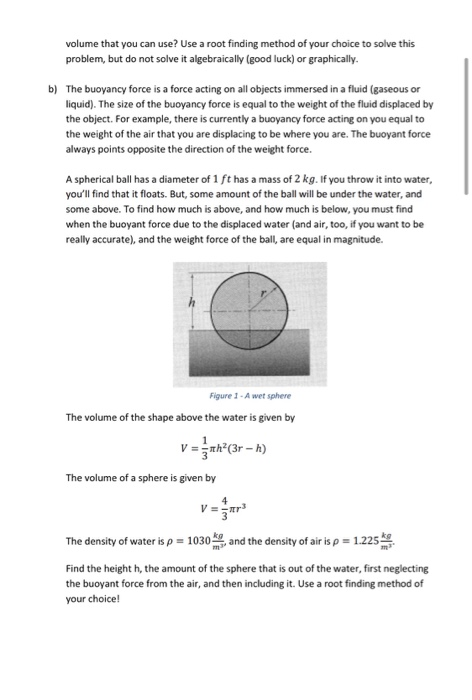
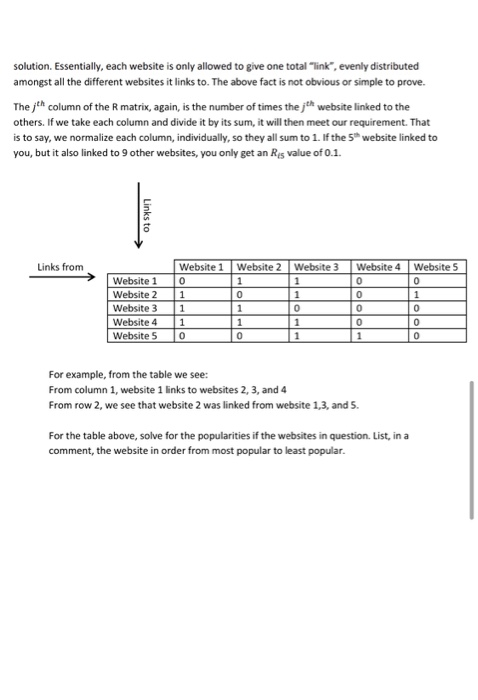
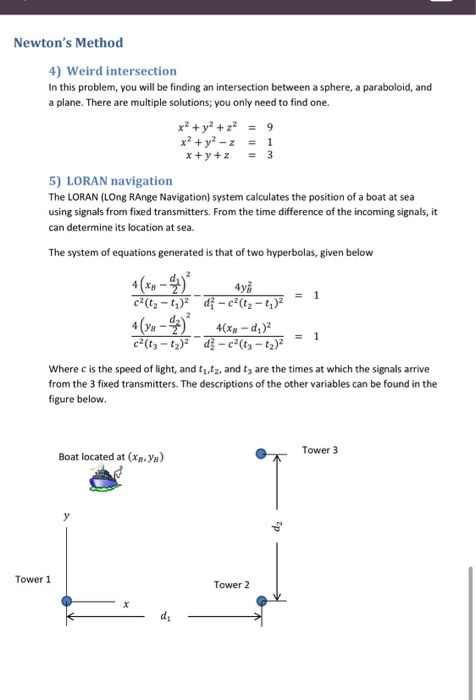
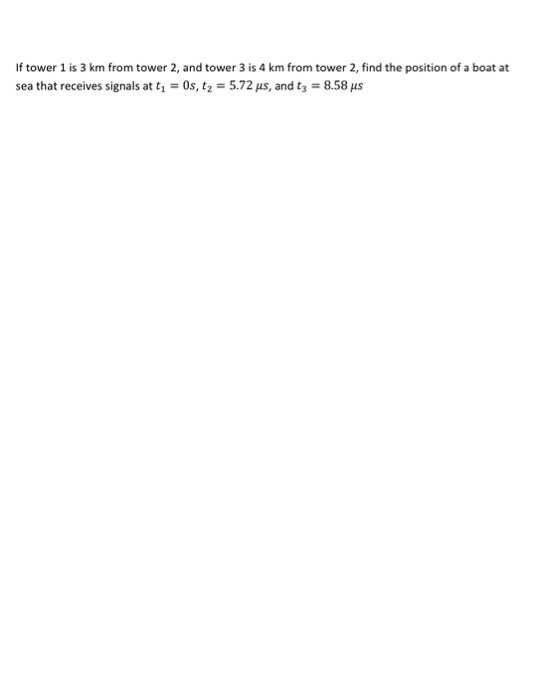
Root Solving Methods 1) Iterative Algebra a) Because the definition of the square root of a number p can be described as the value x which satisfies x? = p, one could develop an algorithm to calculate square roots of any number using Newton's method. Write a script that can find the square root of any number, using Newton's method. Show the method with a test case where you find the square root of a specific number, but I should be able to change the test number to any positive value, and it should still work. What will happen if you give the method a negative number? b) Utilize the same method described above to write a secant method which solves for the natural log of any real number > 0. What will happen if you give your method a negative number? 2) Physical relationships a) The van der Waals equation is a modification of the ideal gas law to account for a few properties of real gases (molecule size and momentum exchange with collisions). The equation relates the same things that the ideal gas law does. It is given by nRT na P= V-nby2 Where P, n, R, T, and V all represent the same things they do in the ideal gas law. a and b, however, are material constants (depend on the gas in question) that account for this additional behavior. If you plan to put 5 kg of room temperature (25C) nitrogen gas(a = 1.39 motem, b = 0.03913 mole) into a container that, due to structural limitations, has a maximum allowable pressure of 25 atm, what is the minimum container volume that you can use? Use a root finding method of your choice to solve this problem, but do not solve it algebraically (good luck) or graphically. b) The buoyancy force is a force acting on all objects immersed in a fluid (gaseous or liquid). The size of the buoyancy force is equal to the weight of the fluid displaced by the object. For example, there is currently a buoyancy force acting on you equal to the weight of the air that you are displacing to be where you are. The buoyant force always points opposite the direction of the weight force. A spherical ball has a diameter of 1 ft has a mass of 2 kg. If you throw it into water, you'll find that it floats. But, some amount of the ball will be under the water, and some above. To find how much is above, and how much is below, you must find when the buoyant force due to the displaced water (and air, too, if you want to be really accurate), and the weight force of the ball, are equal in magnitude. Figure 1 - Awet sphere The volume of the shape above the water is given by th?(3r - A) The volume of a sphere is given by The density of water is p = 1030. and the density of air is p = 1.225 Find the height h, the amount of the sphere that is out of the water, first neglecting the buoyant force from the air, and then including it. Use a root finding method of your choice! Eigenvalue problems 3) The popularity problem The google search algorithm, in its infancy, solved a problem in linear algebra called the popularity problem. It attempts to answer the following question in a straightforward yet sophisticated way: If I ask a group of n websites which among the other n - 1 sites are the most popular, how can rank each website's popularity? The simplest method is just count links. Every time a website is linked to, it's popularity increases by 1. But this is problematic, and doesn't always give results that people agree with Maybe one site is linked to many times, but it is exclusively from sites that are unpopular themselves. Also, maybe certain sites contain a ton of links, so their individual links shouldn't carry as much weight. We would like to find the popularity of each website, where instead of simply counting links, we sum the popularity of each website that linked to each other website. Read the following paragraphs slowly and several times. Let Rijbe a 1 ora 0 depending on whether or not the 'h website linked to the website, and let p, be the popularity of the website. In that case, a sensible expression for the popularity of the 1" website would be P: = R12P2 + ... RIP We could write a similar equation for every single website, i 1... n. This creates a system of equations of the form Rp = p where Ris a matrix containing all of the R entries, and p is an unknown column vector containing the popularities of each website. This should be immediately recognizable as an eigenvalue problem. Remember, the eigenvalue equation is Az = 2x It is not at all clear that the above equation (Rp = p) would, in general, have a solution. That's because it isn't a general eigenvalue equation. It specifically has an eigenvalue of 1. An arbitrary matrix R will not necessarily have that eigenvalue. However, we can fix this problem if we enforce the following rule:every column of R must sum to 1. If every column adds up to one, the matrix is guaranteed to have 1 as an eigenvalue, and the above equation will have a solution. Essentially, each website is only allowed to give one total"link", evenly distributed amongst all the different websites it links to. The above fact is not obvious or simple to prove. The jh column of the R matrix, again, is the number of times the website linked to the others. If we take each column and divide it by its sum, it will then meet our requirement. That is to say, we normalize each column, individually, so they all sum to 1. If the 5 website linked to you, but it also linked to 9 other websites, you only get an Rig value of 0.1 Links from Website 3 Website 4 | Website 5 Website 1 Website 2 Website 1 10 Website 2 1 Website 3 11 11 Website 4 11 1 Website 5 0 0 10 1 O For example, from the table we see: From column 1, website 1 links to websites 2, 3, and 4 From row 2, we see that website 2 was linked from website 1,3, and 5. For the table above, solve for the popularities if the websites in question. List, in a comment, the website in order from most popular to least popular Newton's Method 4) Weird intersection In this problem, you will be finding an intersection between a sphere, a paraboloid, and a plane. There are multiple solutions; you only need to find one. x + y2 + 2 = 9 x2 + y2 -z = 1 x+y+z = 3 5) LORAN navigation The LORAN (LOng Range Navigation system calculates the position of a boat at sea using signals from fixed transmitters. From the time difference of the incoming signals, it can determine its location at sea. The system of equations generated is that of two hyperbolas, given below 4(x - ca (tz - ,2 4(ys-") c(tz - 4y d -c?(tz - ,2 4(x3 - d.)2 di- c(ty - 12 Where is the speed of light, and 1.tz, and t3 are the times at which the signals arrive from the 3 fixed transmitters. The descriptions of the other variables can be found in the figure below Boat located at (XY) Tower 3 - Tower 1 Tower 2 - di If tower 1 is 3 km from tower 2, and tower 3 is 4 km from tower 2, find the position of a boat at sea that receives signals at ty=0s, tz = 5.72 us, and tz = 8.58 us
Step by Step Solution
There are 3 Steps involved in it

Get step-by-step solutions from verified subject matter experts
 Study Help