



Question: need help than Atlas can suppiy. Note: Do not round intermediate calculations. Round all answers to 2 decimal places. a. What is the cost of
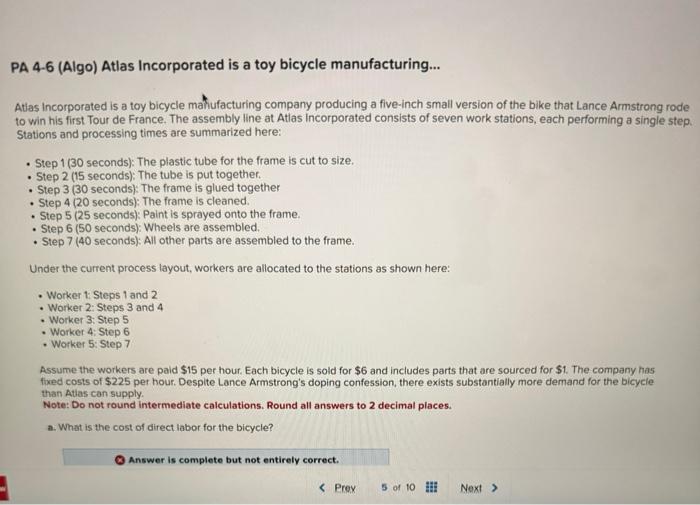
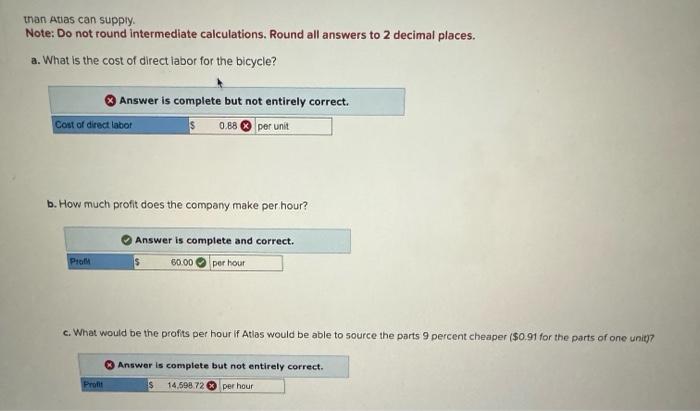
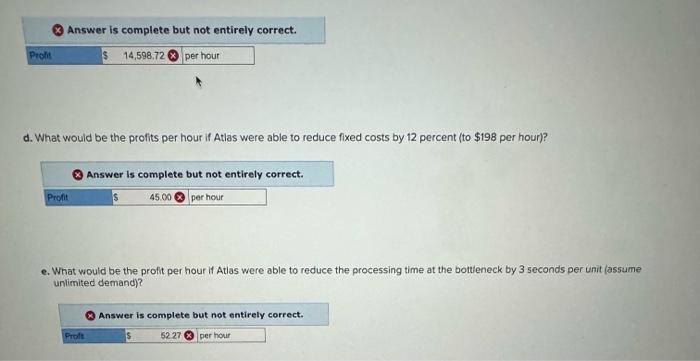
than Atlas can suppiy. Note: Do not round intermediate calculations. Round all answers to 2 decimal places. a. What is the cost of direct labor for the bicycle? Answer is complete but not entirely correct. b. How much profit does the company make per hour? Answer is complete and correct. c. What would be the profits per hour if Atlas would be able to source the parts 9 percent cheaper (\$0.91 for the parts of one unit)? Answer is complete but not entirely correct. Atias Incorporated is a toy bicycle mahufacturing company producing a five-inch small version of the bike that Lance Armstrong rode to win his first Tour de France. The assembly line at Atlas incorporated consists of seven work stations, each performing a single step. Stations and processing times are summarized here: - Step 1(30 seconds): The plastic tube for the frame is cut to size. - Step 2 (15 seconds): The tube is put together. - Step 3 (30 seconds): The frame is glued together - Step 4(20 seconds): The frame is cleaned. - Step 5 (25 seconds): Paint is sprayed onto the frame. - Step 6 ( 50 seconds): Wheels are assembled. - Step 7 ( 40 seconds): All other parts are assembled to the frame. Under the current process layout, workers are allocated to the stations as shown here: - Worker 1: Steps 1 and 2 - Worker 2: Steps 3 and 4 - Worker 3: Step 5 - Worker 4: Step 6 - Worker 5: Step 7 Assume the workers are paid $15 per hour. Each bicycle is sold for $6 and includes parts that are sourced for $1. The company has fixed costs of $225 per hour. Despite Lance Armstrong's doping confession, there exists substantially more demand for the bicycle than Atas can supply. Note: Do not round intermediate calculations. Round all answers to 2 decimal places. a. What is the cost of direct labor for the bicycle? (8) Answer is complete but not entirely correct. Prole thour d. What would be the profits per hour if Atlas were able to reduce fixed costs by 12 percent (to $198 per hour)? Answer is complete but not entirely correct. Profit \$ 45.00 \& perhour e. What would be the profit per hour if Atias were able to reduce the processing time at the bottleneck by 3 seconds per unit (assume unimited demand)? Answer is complete but not entirely correct
Step by Step Solution
There are 3 Steps involved in it

Get step-by-step solutions from verified subject matter experts