







Question: Need help with 1,2, and 3 please :) Your Retirement Plan at Deck Out My Yacht You have been at your job at Deck Out
Need help with 1,2, and 3 please :)
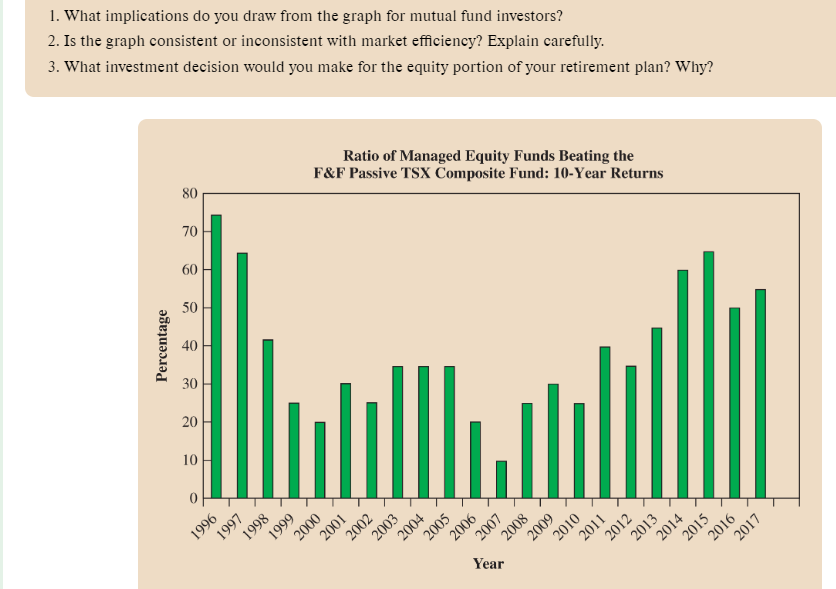
Your Retirement Plan at Deck Out My Yacht You have been at your job at Deck Out My Yacht for a week now and have decided you need to sign up for the company's retirement plan. Even after your discussion with the Marshall & McLaren Financial Services representative, you are still unsure which investment option you should choose. Recall that the options available to you are stock in Deck Out My Yacht, the M&M TSX Composite Index Fund, the M&M Small-Cap Fund, the M&M Large-Company Stock Fund, the M&M Bond Fund, and the M&M Money Market Fund. You have decided that you should invest in a diversified portfolio, with 70 percent of your investment in equity, 25 percent in bonds, and 5 percent in the money market fund. You have also decided to focus your equity investment on large-cap stocks, but you are debating whether to select the TSX/S&P Composite Index Fund or the Large Company Stock Fund. In thinking it over, you understand the basic difference in the two funds. One is a purely passive fund that replicates a widely followed large-cap index, the TSX Composite, and has low fees. The other is actively managed with the intention that the skill of the portfolio manager will result in improved performance relative to an index. Fees are higher in the latter fund. You are just not certain which way to go, so you ask Belinda Price, who works in the company's finance area, for advice. After discussing your concerns, Belinda gives you some information comparing the performance of equity mutual funds and the F&F Passive TSX Composite Fund. The F&F Passive TSX Composite Fund is the largest fictitious equity index mutual fund based on the TSX. It replicates the TSX Composite, and its return is only negligibly different from the TSX Composite. Fees are very low. As a result, the fund is essentially identical to the M&M TSX Composite Index Fund offered in the retirement plan, but it has been in existence for much longer, so you can study its track record for over two decades. The graph below summarizes Belinda's comments by showing the percentage of equity mutual funds that outperformed the fund over the previous 10 years. So, for example, from January 1987 to December 1996, about 75 percent of equity mutual funds outperformed the fund. Belinda suggests that you study the graph and answer the following questions: 1. What implications do you draw from the graph for mutual fund investors? 2. Is the graph consistent or inconsistent with market efficiency? Explain carefully. 3. What investment decision would you make for the equity portion of your retirement plan? Why? Ratio of Managed Equity Funds Beating the F&F Passive TSX Composite Fund: 10-Year Returns Percentage TTTT 2001 2012 1996 1997 1998 1999 2000 Year 2002 2003 2004 2005 N 2006 2007 2008 2009 2010 2011 2013 2014 2015 2016 2017
Step by Step Solution
There are 3 Steps involved in it

Get step-by-step solutions from verified subject matter experts
 Study Help