







Question: Need help with all three questions //SquareContainer2.cpp #include #include using namespace std; #include SquareContainer2.h // Prefix form of next operator SquareContainer::iterator SquareContainer::iterator::operator++() { // Don't
Need help with all three questions 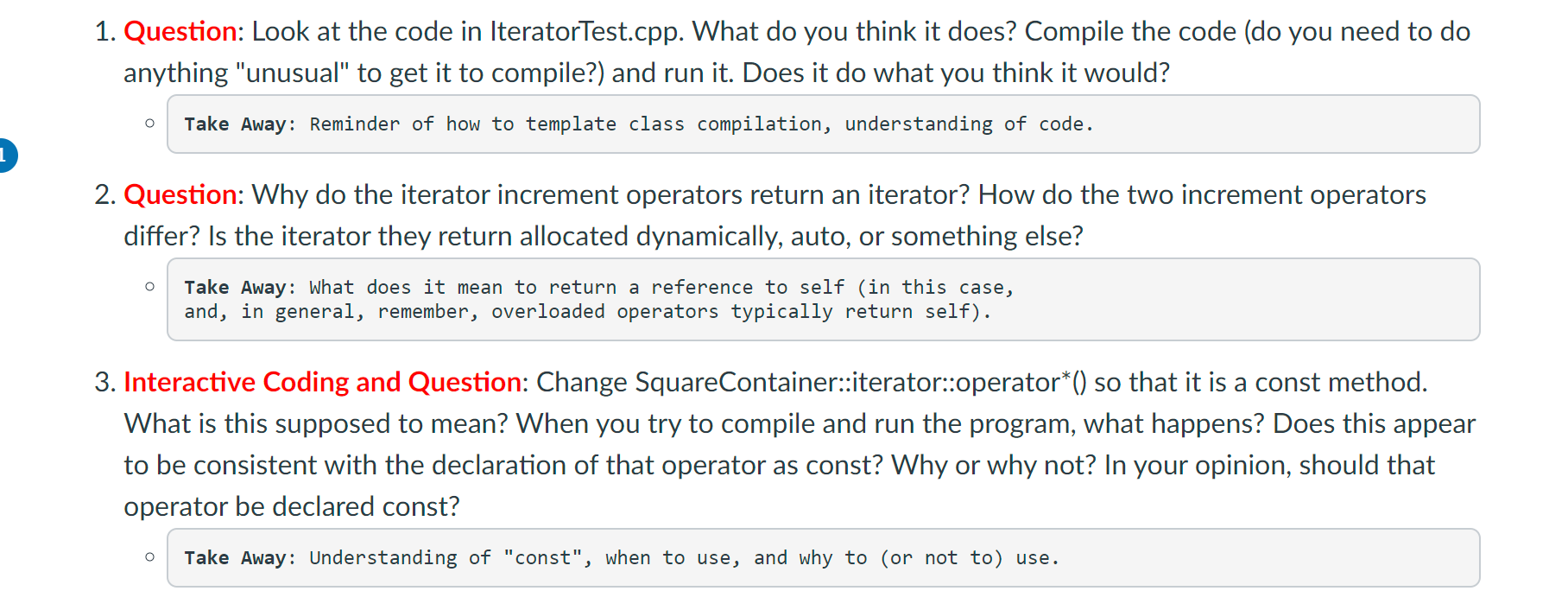
//SquareContainer2.cpp
#include
#include
using namespace std;
#include "SquareContainer2.h"
// Prefix form of "next" operator
SquareContainer::iterator
SquareContainer::iterator::operator++()
{
// Don't do anything if we're already past the end
if (y ySize) {
if (++x >= theContainer->xSize) {
x = 0;
y++;
}
}
return *this;
}
// Postfix form of "next"
SquareContainer::iterator
SquareContainer::iterator::operator++(int)
{
iterator returnValue = *this;
// Don't do anything if we're already past the end
if (y ySize) {
if (++x >= theContainer->xSize) {
x = 0;
y++;
}
}
return returnValue;
}
// Returns the current item
int& SquareContainer::iterator::operator*()
{
// If we're past the end, it's really an error. You could throw an
// exception, if you like. Make sure you document the iterator's
// behavior in these circumstances.
if (y >= theContainer->ySize) {
cerr
exit(EXIT_FAILURE);
}
return theContainer->contents[x][y];
}
bool SquareContainer::iterator::operator==(const iterator& rhs) const
{
return (theContainer == rhs.theContainer) && (x==rhs.x) && (y==rhs.y);
}
bool SquareContainer::iterator::operator!=(const iterator& rhs) const
{
return (theContainer != rhs.theContainer) || (x != rhs.x) || (y != rhs.y);
}
//IteratorTest.cpp
#include
using namespace std;
#include "SquareContainer2.h"
int main()
{
// You create a container like so:
SquareContainer mc;
// and use it in various ways:
SquareContainer::iterator ci = mc.begin();
unsigned i = 1;
while (ci != mc.end()) {
cout
*(ci++) = i++;
}
for (SquareContainer::iterator ci = mc.begin();
ci != mc.end();
++ci) {
cout
}
}
//SquareContainer.h
#pragma once
class SquareContainer {
public:
class iterator; // forward declaration
friend class iterator; // friend declaration
/*!
@class iterator
This is a nested class. Note that it is in the public section of
SquareContainer
*/
class iterator {
public:
/*!
Initializes the iterator by associating it with a
SquareContainer object, starting it at the beginning.
*/
iterator(SquareContainer* c, unsigned xloc = 0, unsigned yloc = 0) :
theContainer(c), x(xloc), y(yloc) {}
// You may need a copy constructor; we don't have it here
// iterator(const iterator& it);
// Prefix form of "next" operator
iterator operator++();
// Postfix form of "next"
iterator operator++(int);
// Returns the current item
int& operator*() const;
// Comparison operators
bool operator==(const iterator& rhs) const;
bool operator!=(const iterator& rhs) const;
private:
/*! Keep track of where we are in theContainer */
unsigned x, y;
/*! The SquareContainer object this iterator is associated with */
SquareContainer* theContainer;
};
//Returns iterator that refers to first item, using iterator constructor
iterator begin(void) { return iterator(this); }
const iterator end(void) { return iterator(this, 0, ySize); }
private:
static const unsigned xSize = 5;
static const unsigned ySize = 5;
int contents[xSize][ySize];
};
1. Question: Look at the code in IteratorTest.cpp. What do you think it does? Compile the code (do you need to do anything "unusual" to get it to compile?) and run it. Does it do what you think it would? Take Away: Reminder of how to template class compilation, understanding of code. 2. Question: Why do the iterator increment operators return an iterator? How do the two increment operators differ? Is the iterator they return allocated dynamically, auto, or something else? - Take Away: What does it mean to return a reference to self (in this case, and, in general, remember, overloaded operators typically return self). 3. Interactive Coding and Question: Change SquareContainer::iterator::operator*() so that it is a const method. What is this supposed to mean? When you try to compile and run the program, what happens? Does this appear to be consistent with the declaration of that operator as const? Why or why not? In your opinion, should that operator be declared const? Take Away: Understanding of "const", when to use, and why to (or not to) use
Step by Step Solution
There are 3 Steps involved in it

Get step-by-step solutions from verified subject matter experts
 Study Help