







Question: Need help with (b) 5. Let L be the language generated by the following context-free grammar, G. The DPDA, which we call P, shown is
Need help with (b)
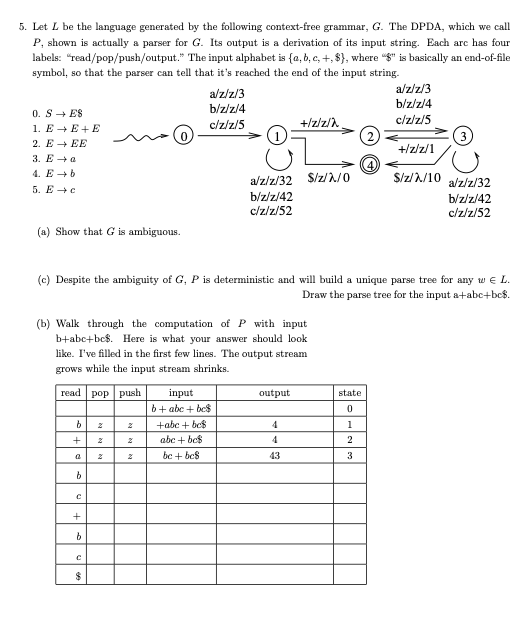
5. Let L be the language generated by the following context-free grammar, G. The DPDA, which we call P, shown is actually a parser for G. Its output is a derivation of its input string. Each arc has four labels: "Tead/pop/push/output." The input alphabet is {a,b,c +, $), where is basically an end-of-file symbol, so that the parser can tell that it's reached the end of the input string a/z/z/3 a/z/z/3 0. SES b/z/z/4 b/z/z/4 c/z/z/5 1. E +E+E > O 2. E EE 3. E + a 4. Eb a/z/z/32 $/z/w/0 S//w/10 a/z/z/32 5. E + b/z/z/42 b/z/z/42 c/z/z/52 c/z/z/52 (a) Show that G is ambiguous. mooc/z/z/5 3 2/2/ 1 Sizraio (c) Despite the ambiguity of G, P is deterministic and will build a unique parse tree for any w EL. Draw the parse tree for the input +abc+bc$ (b) Walk through the computation of P with input b+abc+bc$. Here is what your answer should look like. I've filled in the first few lines. The output stream grows while the input stream shrinks. read pop push output input b + ab + bcs +abe + bc$ abc + bc$ be + bc8 4 4 3 4
Step by Step Solution
There are 3 Steps involved in it

Get step-by-step solutions from verified subject matter experts
 Study Help