







Question: Need Help With both. Please 8. We already know that p V q is equivalent to its canonical DNF (19) V (PA) (p A q)
Need Help With both. Please
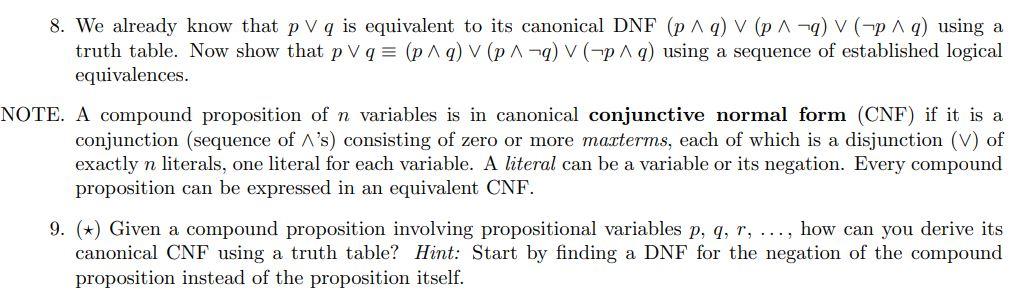
8. We already know that p V q is equivalent to its canonical DNF (19) V (PA) (p A q) using a truth table. Now show that p V q = ( pq) (p1-9) (p) using a sequence of established logical equivalences. NOTE. A compound proposition of n variables is in canonical conjunctive normal form (CNF) if it is a conjunction (sequence of A's) consisting of zero or more maxterms, each of which is a disjunction (V) of exactly n literals, one literal for each variable. A literal can be a variable or its negation. Every compound proposition can be expressed in an equivalent CNF. 9. (*) Given a compound proposition involving propositional variables p, q, r, ..., how can you derive its canonical CNF using a truth table? Hint: Start by finding a DNF for the negation of the compound proposition instead of the proposition itself
Step by Step Solution
There are 3 Steps involved in it

Get step-by-step solutions from verified subject matter experts
 Study Help