







Question: need help with following 13. A baseball is hit when it is 3 it above the ground. It leaves the bat with initial speed of
need help with following
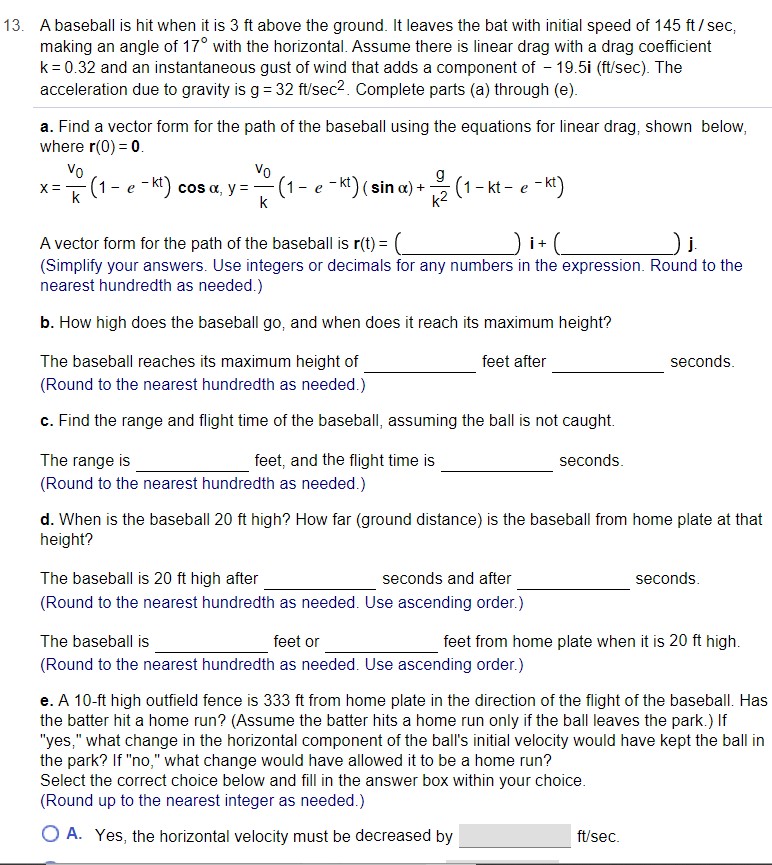
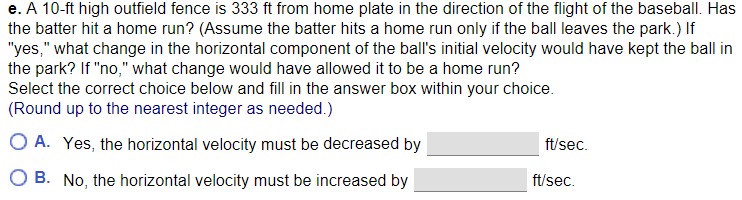
13. A baseball is hit when it is 3 it above the ground. It leaves the bat with initial speed of 145 ft / sec, making an angle of 17" with the horizontal. Assume there is linear drag with a drag coefficient k = 0.32 and an instantaneous gust of wind that adds a component of - 19.5i (ft/sec). The acceleration due to gravity is g = 32 ft/sec2. Complete parts (a) through (e). a. Find a vector form for the path of the baseball using the equations for linear drag, shown below, where r(0) = 0. Vo x= * (1 - e -kl) cosa, y= (1 - e - kt) ( sin a) + (1 12 ( 1 - kt - e - kt ) A vector form for the path of the baseball is r(t) = ( Ji+ ( i. (Simplify your answers. Use integers or decimals for any numbers in the expression. Round to the nearest hundredth as needed.) b. How high does the baseball go, and when does it reach its maximum height? The baseball reaches its maximum height of feet after seconds. (Round to the nearest hundredth as needed.) c. Find the range and flight time of the baseball, assuming the ball is not caught. The range is feet, and the flight time is seconds. (Round to the nearest hundredth as needed.) d. When is the baseball 20 ft high? How far (ground distance) is the baseball from home plate at that height? The baseball is 20 ft high after seconds and after seconds. (Round to the nearest hundredth as needed. Use ascending order.) The baseball is feet or feet from home plate when it is 20 ft high. (Round to the nearest hundredth as needed. Use ascending order.) e. A 10-ft high outfield fence is 333 ft from home plate in the direction of the flight of the baseball. Has the batter hit a home run? (Assume the batter hits a home run only if the ball leaves the park. ) If "yes," what change in the horizontal component of the ball's initial velocity would have kept the ball in the park? If "no," what change would have allowed it to be a home run? Select the correct choice below and fill in the answer box within your choice. (Round up to the nearest integer as needed.) O A. Yes, the horizontal velocity must be decreased by ft/sec.e. A 10-ft high outfield fence is 333 ft from home plate in the direction of the flight of the baseball. Has the batter hit a home run? (Assume the batter hits a home run only if the ball leaves the park. ) If "yes," what change in the horizontal component of the ball's initial velocity would have kept the ball in the park? If "no," what change would have allowed it to be a home run? Select the correct choice below and fill in the answer box within your choice. (Round up to the nearest integer as needed.) O A. Yes, the horizontal velocity must be decreased by ft/sec. O B. No, the horizontal velocity must be increased by ft/sec
Step by Step Solution
There are 3 Steps involved in it

Get step-by-step solutions from verified subject matter experts
 Study Help