







Question: need help with hw 3201 - Chapter 9 1. A company should abandon the historical cost principle when the future utility of the inventory item
 need help with hw
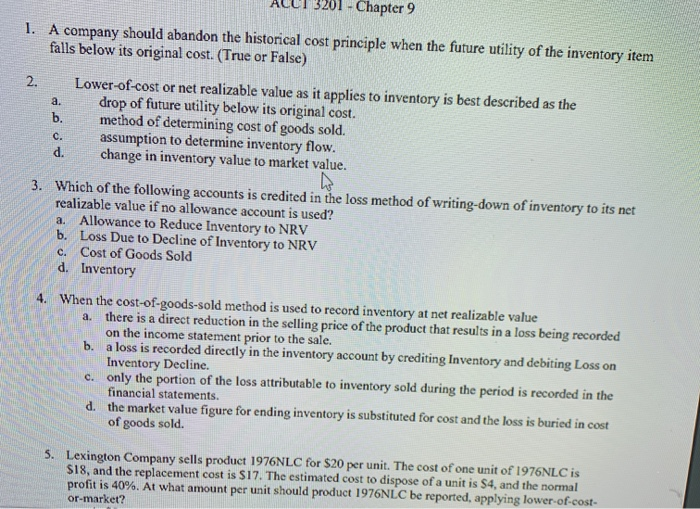
 3201 - Chapter 9 1. A company should abandon the historical cost principle when the future utility of the inventory item falls below its original cost. (True or False) 2. Lower-of-cost or net realizable value as it applies to inventory is best described as the drop of future utility below its original cost. b. method of determining cost of goods sold. assumption to determine inventory flow. d. change in inventory value to market value. a. c. 3. Which of the following accounts is credited in the loss method of writing-down of inventory to its net realizable value if no allowance account is used? a. Allowance to Reduce Inventory to NRV b. Loss Due to Decline of Inventory to NRV c. Cost of Goods Sold d. Inventory 4. When the cost-of-goods-sold method is used to record inventory at net realizable value a. there is a direct reduction in the selling price of the product that results in a loss being recorded on the income statement prior to the sale. a loss is recorded directly in the inventory account by crediting Inventory and debiting Loss on Inventory Decline. c. only the portion of the loss attributable to inventory sold during the period is recorded in the financial statements. d. the market value figure for ending inventory is substituted for cost and the loss is buried in cost of goods sold. b. 5. Lexington Company sells product 1976NLC for $20 per unit. The cost of one unit of 1976NLC is $18, and the replacement cost is $17. The estimated cost to dispose of a unit is $4, and the normal profit is 40%. At what amount per unit should product 1976NLC be reported, applying lower-of-cost- or-market
Step by Step Solution
There are 3 Steps involved in it

Get step-by-step solutions from verified subject matter experts
 Study Help