







Question: Need help with last 3 questions. Improvement: Use iterative (looping) controls to reduce the number of identical statements. What new action or ability must be
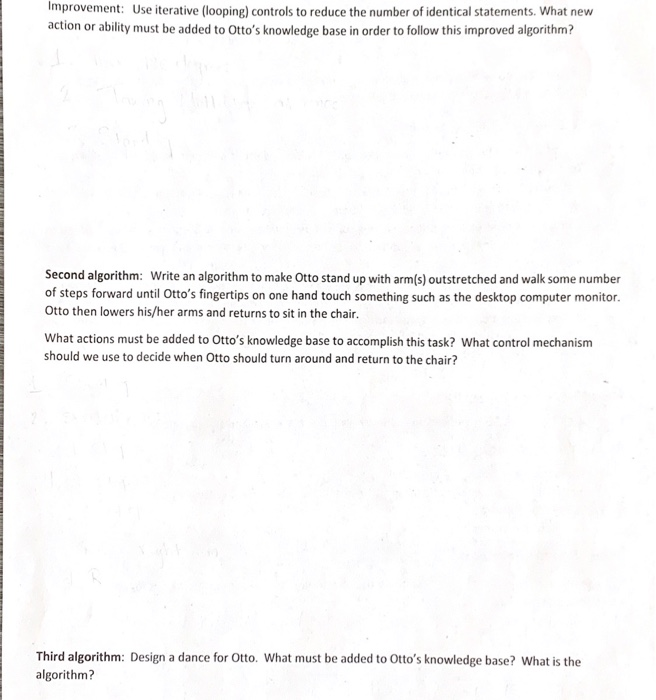
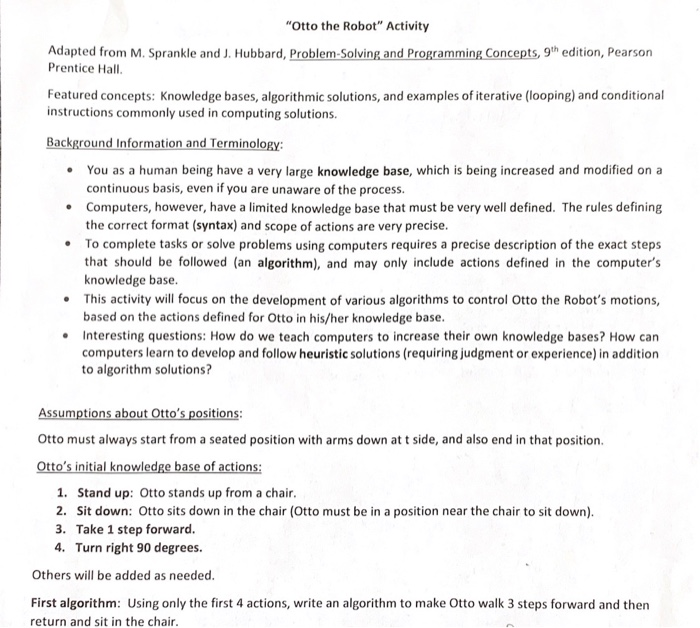
Improvement: Use iterative (looping) controls to reduce the number of identical statements. What new action or ability must be added to Otto's knowledge base in order to follow this improved algorithm? Second algorithm: Write an algorithm to make Otto stand up with arm(s) outstretched and walk some number of steps forward until Otto's fingertips on one hand touch something such as the desktop computer monitor. Otto then lowers his/her arms and returns to sit in the chair. What actions must be added to Otto's knowledge base to accomplish this task? What control mechanism should we use to decide when Otto should turn around and return to the chair? Third algorithm: Design a dance for Otto. What must be added to Otto's knowledge base? What is the algorithm? "Otto the Robot" Activity Adapted from M. Sprankle and J. Hubbard, Problem Solving and Programming Concepts, 9th edition, Pearson Prentice Hall. Featured concepts: Knowledge bases, algorithmic solutions, and examples of iterative (looping) and conditional instructions commonly used in computing solutions Background Information and Terminology: You as a human being have a very large knowledge base, which is being increased and modified on a continuous basis, even if you are unaware of the process. Computers, however, have a limited knowledge base that must be very well defined. The rules defining the correct format (syntax) and scope of actions are very precise. To complete tasks or solve problems using computers requires a precise description of the exact steps that should be followed (an algorithm), and may only include actions defined in the computer's knowledge base. This activity will focus on the development of various algorithms to control Otto the Robot's motions, based on the actions defined for Otto in his/her knowledge base. Interesting questions: How do we teach computers to increase their own knowledge bases? How can computers learn to develop and follow heuristic solutions (requiring judgment or experience) in addition to algorithm solutions? Assumptions about Otto's positions: Otto must always start from a seated position with arms down at t side, and also end in that position. Otto's initial knowledge base of actions: 1. Stand up: Otto stands up from a chair. 2. Sit down: Otto sits down in the chair (Otto must be in a position near the chair to sit down). 3. Take 1 step forward. 4. Turn right 90 degrees. Others will be added as needed. First algorithm: Using only the first 4 actions, write an algorithm to make Otto walk 3 steps forward and then return and sit in the chair. Improvement: Use iterative (looping) controls to reduce the number of identical statements. What new action or ability must be added to Otto's knowledge base in order to follow this improved algorithm? Second algorithm: Write an algorithm to make Otto stand up with arm(s) outstretched and walk some number of steps forward until Otto's fingertips on one hand touch something such as the desktop computer monitor. Otto then lowers his/her arms and returns to sit in the chair. What actions must be added to Otto's knowledge base to accomplish this task? What control mechanism should we use to decide when Otto should turn around and return to the chair? Third algorithm: Design a dance for Otto. What must be added to Otto's knowledge base? What is the algorithm? "Otto the Robot" Activity Adapted from M. Sprankle and J. Hubbard, Problem Solving and Programming Concepts, 9th edition, Pearson Prentice Hall. Featured concepts: Knowledge bases, algorithmic solutions, and examples of iterative (looping) and conditional instructions commonly used in computing solutions Background Information and Terminology: You as a human being have a very large knowledge base, which is being increased and modified on a continuous basis, even if you are unaware of the process. Computers, however, have a limited knowledge base that must be very well defined. The rules defining the correct format (syntax) and scope of actions are very precise. To complete tasks or solve problems using computers requires a precise description of the exact steps that should be followed (an algorithm), and may only include actions defined in the computer's knowledge base. This activity will focus on the development of various algorithms to control Otto the Robot's motions, based on the actions defined for Otto in his/her knowledge base. Interesting questions: How do we teach computers to increase their own knowledge bases? How can computers learn to develop and follow heuristic solutions (requiring judgment or experience) in addition to algorithm solutions? Assumptions about Otto's positions: Otto must always start from a seated position with arms down at t side, and also end in that position. Otto's initial knowledge base of actions: 1. Stand up: Otto stands up from a chair. 2. Sit down: Otto sits down in the chair (Otto must be in a position near the chair to sit down). 3. Take 1 step forward. 4. Turn right 90 degrees. Others will be added as needed. First algorithm: Using only the first 4 actions, write an algorithm to make Otto walk 3 steps forward and then return and sit in the chair
Step by Step Solution
There are 3 Steps involved in it

Get step-by-step solutions from verified subject matter experts
 Study Help