







Question: Need help with part a and b thanks Problem 2: Shale gas reservoirs have become popular in the past decade. Natural gas, mostly methane, is
Need help with part a and b thanks
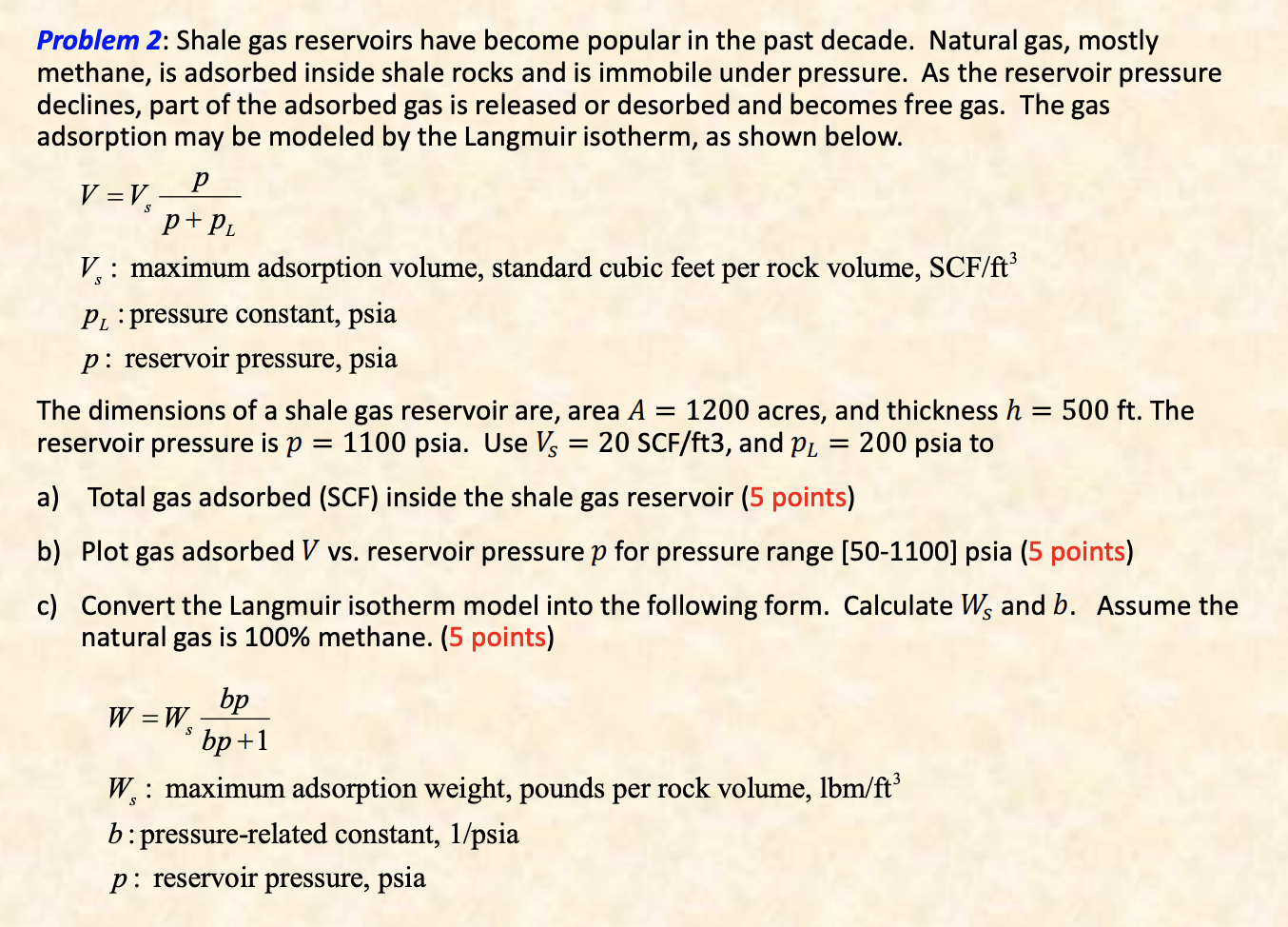
Problem 2: Shale gas reservoirs have become popular in the past decade. Natural gas, mostly methane, is adsorbed inside shale rocks and is immobile under pressure. As the reservoir pressure declines, part of the adsorbed gas is released or desorbed and becomes free gas. The gas adsorption may be modeled by the Langmuir isotherm, as shown below. V=Vsp+pLp Vs : maximum adsorption volume, standard cubic feet per rock volume, SCF/ft3 pL: pressure constant, psia p: reservoir pressure, psia The dimensions of a shale gas reservoir are, area A=1200 acres, and thickness h=500ft. The reservoir pressure is p=1100 psia. Use VS=20SCF/ft3, and pL=200 psia to a) Total gas adsorbed (SCF) inside the shale gas reservoir (5 points) b) Plot gas adsorbed V vs. reservoir pressure p for pressure range [50-1100] psia (5 points) c) Convert the Langmuir isotherm model into the following form. Calculate Ws and b. Assume the natural gas is 100% methane. (5 points) W=Wsbp+1bp Ws: maximum adsorption weight, pounds per rock volume, 1bm/ft3 b: pressure-related constant, 1/ psia p: reservoir pressure, psia
Step by Step Solution
There are 3 Steps involved in it

Get step-by-step solutions from verified subject matter experts
 Study Help