







Question: need help with problem 19 a-d. all the information is given and the answers for the problem are 3.19 a. CL=0.11; CD=0.0186; T/w=0.166;-dX/dW=0.147mi/gal;dWf/dt=20916lb/h 3.19 b.

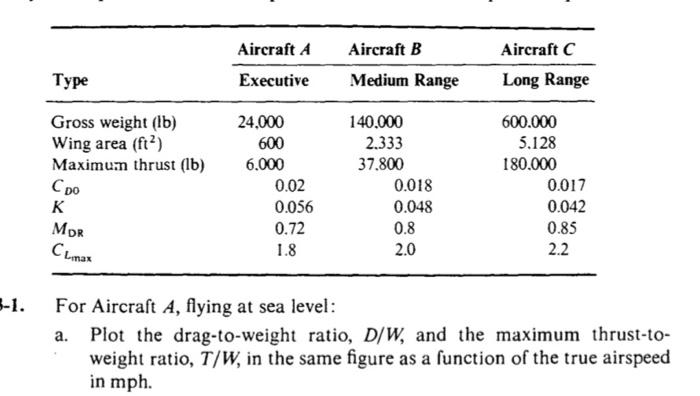
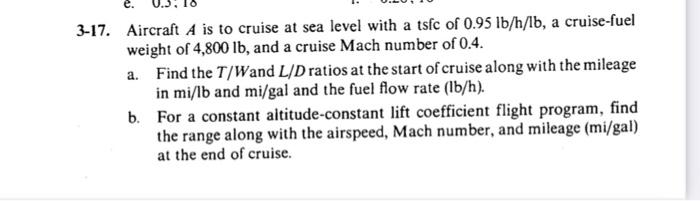

3-19. Do Prob. 3-17 but for Aircraft B with a tsfc of 0.9 1b/h/lb, a cruise-fuel weight of 35,000 lb, and a cruise Mach number of 0.6. Aircraft A Aircraft B Aircraft C Type Executive Medium Range Long Range Gross weight (lb) Wing area (ft?) Maximun thrust (lb) 24.000 600 6.000 0.02 0.056 0.72 1.8 140.000 2.333 37.800 0.018 0.048 0.8 2.0 600.000 5.128 180.000 0.017 0.042 0.85 2.2 K MOR Climax 5-1. For Aircraft A, flying at sea level: a. Plot the drag-to-weight ratio, D/W, and the maximum thrust-to- weight ratio, T/W, in the same figure as a function of the true airspeed in mph. e. 3-17. Aircraft A is to cruise at sea level with a tsfc of 0.95 lb/h/lb, a cruise-fuel weight of 4,800 lb, and a cruise Mach number of 0.4. a. Find the T/Wand L/Dratios at the start of cruise along with the mileage in mi/lb and mi/gal and the fuel flow rate (lb/h). b. For a constant altitude-constant lift coefficient flight program, find the range along with the airspeed, Mach number, and mileage (mi/gal) at the end of cruise. C. For a cruise-climb flight program, find the range along with the altitude and mileage (mi/gal) at the end of cruise and the average flight-path angle. d. For a constant altitude-constant airspeed flight program, find the range along with the mileage (mi/gal) at the end of cruise
Step by Step Solution
There are 3 Steps involved in it

Get step-by-step solutions from verified subject matter experts
 Study Help