







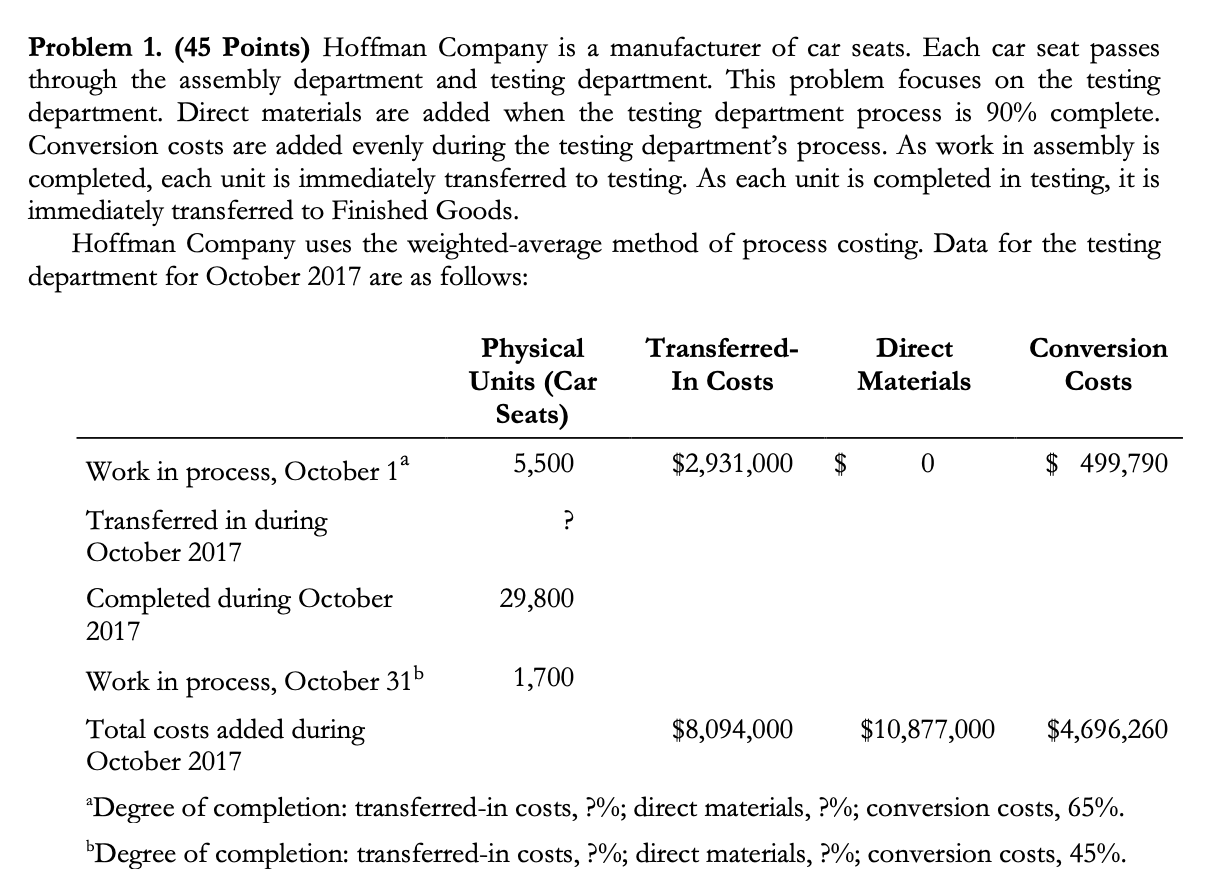
Question: need help with question 2 Problem 1. (45 Points) Hoffman Company is a manufacturer of car seats. Each car seat passes through the assembly department
 need help with question 2
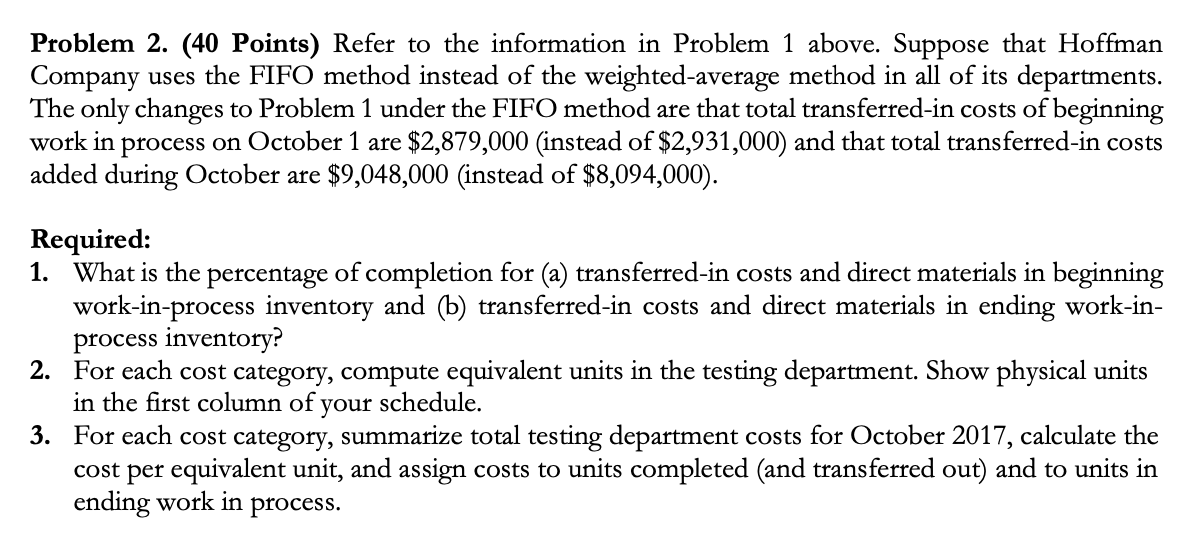
Problem 1. (45 Points) Hoffman Company is a manufacturer of car seats. Each car seat passes through the assembly department and testing department. This problem focuses on the testing department. Direct materials are added when the testing department process is 90% complete. Conversion costs are added evenly during the testing department's process. As work in assembly is completed, each unit is immediately transferred to testing. As each unit is completed in testing, it is immediately transferred to Finished Goods. Hoffman Company uses the weighted-average method of process costing. Data for the testing department for October 2017 are as follows: Transferred- In Costs Direct Materials Conversion Costs Physical Units (Car Seats) 5,500 $2,931,000 $ $ 499,790 ? Work in process, October 1a Transferred in during October 2017 Completed during October 2017 29,800 Work in process, October 31b 1,700 Total costs added during $8,094,000 $10,877,000 $4,696,260 October 2017 *Degree of completion: transferred-in costs, ?%; direct materials, ?%; conversion costs, 65%. bDegree of completion: transferred-in costs, ?%; direct materials, ?%; conversion costs, 45%. > Problem 2. (40 Points) Refer to the information in Problem 1 above. Suppose that Hoffman Company uses the FIFO method instead of the weighted-average method in all of its departments. The only changes to Problem 1 under the FIFO method are that total transferred-in costs of beginning work in process on October 1 are $2,879,000 (instead of $2,931,000) and that total transferred-in costs added during October are $9,048,000 (instead of $8,094,000). Required: 1. What is the percentage of completion for (a) transferred-in costs and direct materials in beginning work-in-process inventory and (b) transferred-in costs and direct materials in ending work-in- process inventory? 2. For each cost category, compute equivalent units in the testing department. Show physical units in the first column of your schedule. 3. For each cost category, summarize total testing department costs for October 2017, calculate the cost per equivalent unit, and assign costs to units completed (and transferred out) and to units in ending work in process. Problem 1. (45 Points) Hoffman Company is a manufacturer of car seats. Each car seat passes through the assembly department and testing department. This problem focuses on the testing department. Direct materials are added when the testing department process is 90% complete. Conversion costs are added evenly during the testing department's process. As work in assembly is completed, each unit is immediately transferred to testing. As each unit is completed in testing, it is immediately transferred to Finished Goods. Hoffman Company uses the weighted-average method of process costing. Data for the testing department for October 2017 are as follows: Transferred- In Costs Direct Materials Conversion Costs Physical Units (Car Seats) 5,500 $2,931,000 $ $ 499,790 ? Work in process, October 1a Transferred in during October 2017 Completed during October 2017 29,800 Work in process, October 31b 1,700 Total costs added during $8,094,000 $10,877,000 $4,696,260 October 2017 *Degree of completion: transferred-in costs, ?%; direct materials, ?%; conversion costs, 65%. bDegree of completion: transferred-in costs, ?%; direct materials, ?%; conversion costs, 45%. > Problem 2. (40 Points) Refer to the information in Problem 1 above. Suppose that Hoffman Company uses the FIFO method instead of the weighted-average method in all of its departments. The only changes to Problem 1 under the FIFO method are that total transferred-in costs of beginning work in process on October 1 are $2,879,000 (instead of $2,931,000) and that total transferred-in costs added during October are $9,048,000 (instead of $8,094,000). Required: 1. What is the percentage of completion for (a) transferred-in costs and direct materials in beginning work-in-process inventory and (b) transferred-in costs and direct materials in ending work-in- process inventory? 2. For each cost category, compute equivalent units in the testing department. Show physical units in the first column of your schedule. 3. For each cost category, summarize total testing department costs for October 2017, calculate the cost per equivalent unit, and assign costs to units completed (and transferred out) and to units in ending work in process
Step by Step Solution
There are 3 Steps involved in it

Get step-by-step solutions from verified subject matter experts
 Study Help