







Question: need help with question #3 #4 #5 Problem Sets Answer all the following questions in the order provided Show all work and units. 1. Calculate
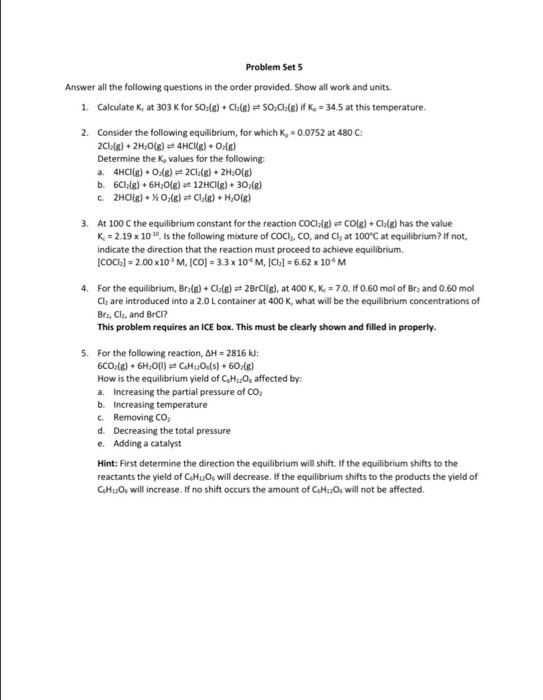
Problem Sets Answer all the following questions in the order provided Show all work and units. 1. Calculate K. at 303 K for 50:(8) + Cl:(8) = 50Cle) if K = 34.5 at this temperature 2. Consider the following equilibrium, for which K = 0.0752 at 480 C 2C1:48) + 2H2O(g) = 4HCl(s) +O48) Determine the K, values for the following: a. 4HCl(g) + O:(g) = 2148) + 2H2O(g) b. 6C12(e) + 6H,0() 12HCl(s) + 30:() 2HCl(g) + O2(g) = Cl:(8) + H2018) 3. At 100C the equilibrium constant for the reaction Colle) = CO(g) + Cla(e) has the value K = 2.19 x 100 is the following mixture of COCI, CO and Cl, at 100C at equilibrium? If not, indicate the direction that the reaction must proceed to achieve equilibrium COCI] = 2.00x10* M. [CO] = 3.3 x 10*M, [Cla] = 6.62 x 10*M 4. For the equilibrium, Br:(8)+cl=(8) = 2BrCl(e), at 400K, K = 7.0.1 0.60 mol of Brand 0.60 mol Cl are introduced into a 2.0L container at 400 K, what will be the equilibrium concentrations of Bra, Cla, and BrCI? This problem requires an ICE box. This must be clearly shown and filled in properly. 5. For the following reaction, AH = 2816 K): 6CO:(8) + 6H2011) = CHIO(s) + 60:() How is the equilibrium yield of CH20. affected by: a Increasing the partial pressure of CO2 b. Increasing temperature c Removing Co d. Decreasing the total pressure e Adding a catalyst Hint: First determine the direction the equilibrium will shift. If the equilibrium shifts to the reactants the yield of CHO will decrease. If the equilibrium shifts to the products the yield of GHO will increase. If no shift occurs the amount of C.H.O. will not be affected
Step by Step Solution
There are 3 Steps involved in it

Get step-by-step solutions from verified subject matter experts
 Study Help