







Question: Need help with question 3 and 4 only 1. Assume the demand and supply for housing are of the following form: Qd = 500 QS
Need help with question 3 and 4 only
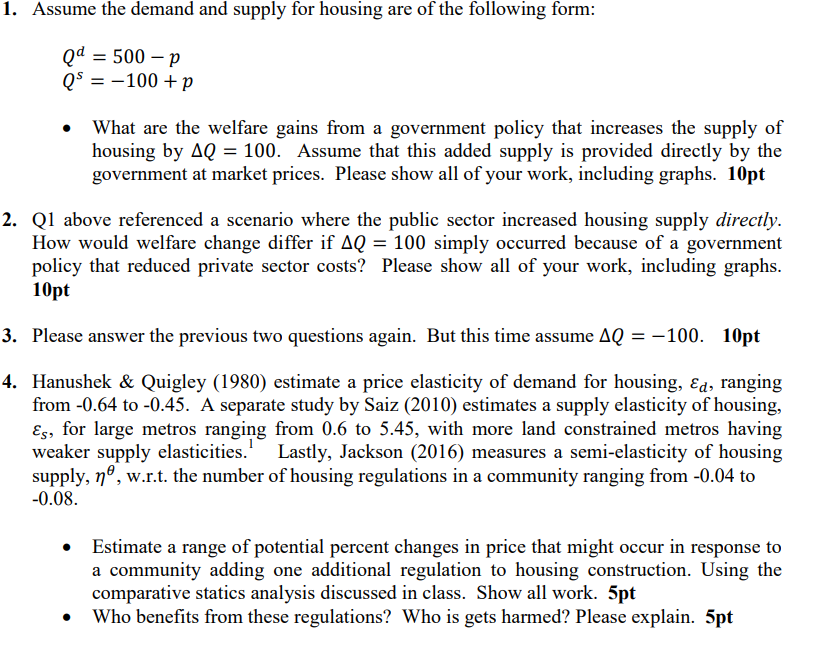
1. Assume the demand and supply for housing are of the following form: Qd = 500 QS = -100+p What are the welfare gains from a government policy that increases the supply of housing by AQ = 100. Assume that this added supply is provided directly by the government at market prices. Please show all of your work, including graphs. 10pt 2. Q1 above referenced a scenario where the public sector increased housing supply directly. How would welfare change differ if AQ = 100 simply occurred because of a government policy that reduced private sector costs? Please show all of your work, including graphs. 10pt 3. Please answer the previous two questions again. But this time assume AQ = -100. 10pt 4. Hanushek & Quigley (1980) estimate a price elasticity of demand for housing, &d, ranging from -0.64 to -0.45. A separate study by Saiz (2010) estimates a supply elasticity of housing, Es, for large metros ranging from 0.6 to 5.45, with more land constrained metros having weaker supply elasticities. Lastly, Jackson (2016) measures a semi-elasticity of housing supply, n, w.r.t. the number of housing regulations in a community ranging from -0.04 to -0.08. Estimate a range of potential percent changes in price that might occur in response to a community adding one additional regulation to housing construction. Using the comparative statics analysis discussed in class. Show all work. 5pt Who benefits from these regulations? Who is gets harmed? Please explain. 5pt 1. Assume the demand and supply for housing are of the following form: Qd = 500 QS = -100+p What are the welfare gains from a government policy that increases the supply of housing by AQ = 100. Assume that this added supply is provided directly by the government at market prices. Please show all of your work, including graphs. 10pt 2. Q1 above referenced a scenario where the public sector increased housing supply directly. How would welfare change differ if AQ = 100 simply occurred because of a government policy that reduced private sector costs? Please show all of your work, including graphs. 10pt 3. Please answer the previous two questions again. But this time assume AQ = -100. 10pt 4. Hanushek & Quigley (1980) estimate a price elasticity of demand for housing, &d, ranging from -0.64 to -0.45. A separate study by Saiz (2010) estimates a supply elasticity of housing, Es, for large metros ranging from 0.6 to 5.45, with more land constrained metros having weaker supply elasticities. Lastly, Jackson (2016) measures a semi-elasticity of housing supply, n, w.r.t. the number of housing regulations in a community ranging from -0.04 to -0.08. Estimate a range of potential percent changes in price that might occur in response to a community adding one additional regulation to housing construction. Using the comparative statics analysis discussed in class. Show all work. 5pt Who benefits from these regulations? Who is gets harmed? Please explain. 5pt
Step by Step Solution
There are 3 Steps involved in it

Get step-by-step solutions from verified subject matter experts
 Study Help