







Question: Need help with question 4d)See question 1e) for information needed to complete 4d), because it makes use of preference relation defined in 1e)Bear in mind
Need help with question 4d)See question 1e) for information needed to complete 4d), because it makes use of preference relation defined in 1e)Bear in mind Q4d has parts i and ii
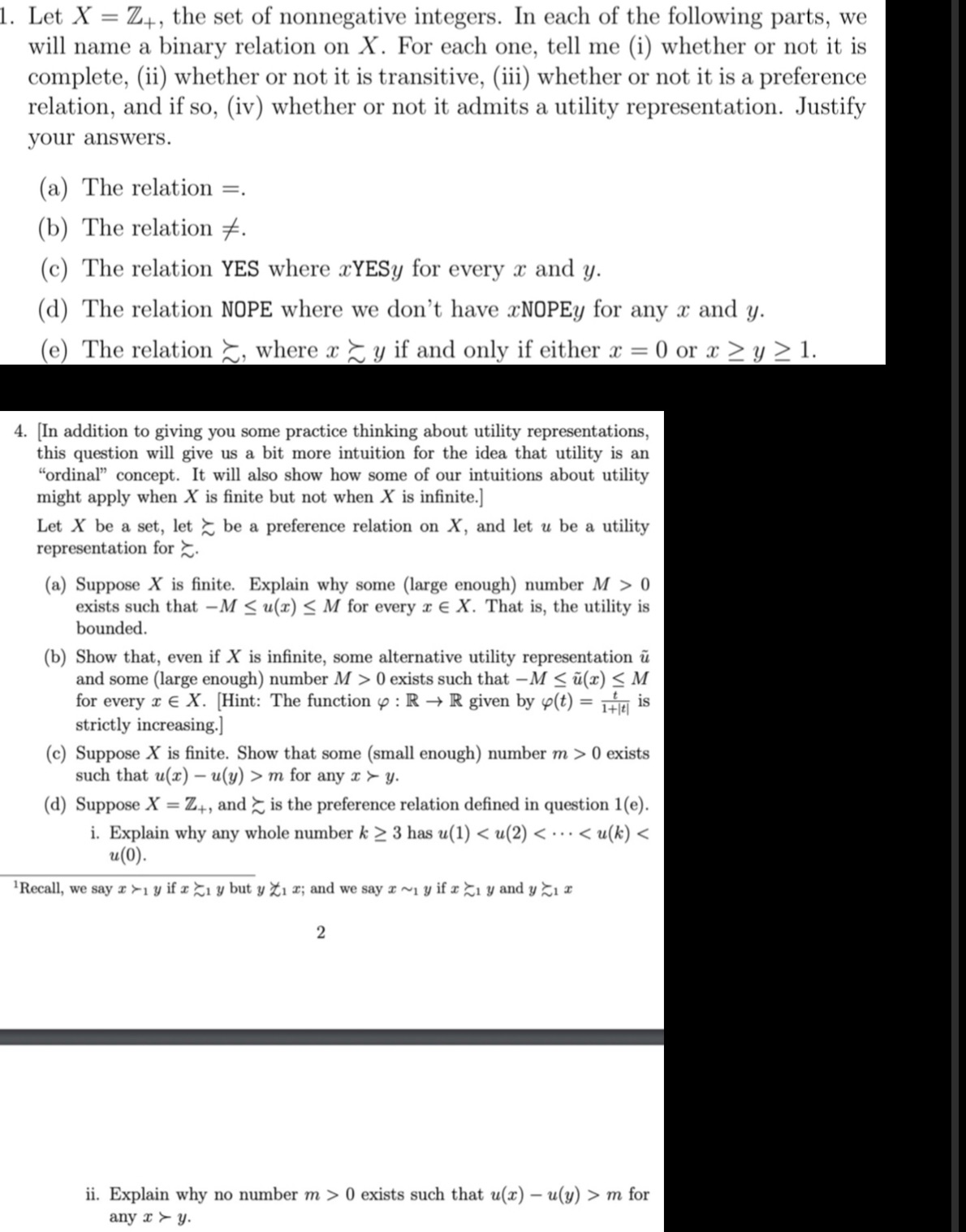
1. Let X = Z+, the set of nonnegative integers. In each of the following parts, we will name a binary relation on X. For each one, tell me (i) whether or not it is complete, (ii) whether or not it is transitive, (iii) whether or not it is a preference relation, and if so, (iv) whether or not it admits a utility representation. Justify your answers. (a) The relation =. (b) The relation . (c) The relation YES where YESy for every a and y. (d) The relation NOPE where we don't have aNOPEy for any a and y. (e) The relation , where a ~ y if and only if either x = 0 or x 2 y > 1. 4. [In addition to giving you some practice thinking about utility representations, this question will give us a bit more intuition for the idea that utility is an "ordinal" concept. It will also show how some of our intuitions about utility might apply when X is finite but not when X is infinite.] Let X be a set, let _ be a preference relation on X, and let u be a utility representation for . (a) Suppose X is finite. Explain why some (large enough) number M > 0 exists such that -M J u(x) _ M for every r E X. That is, the utility is bounded. (b) Show that, even if X is infinite, some alternative utility representation u and some (large enough) number M > 0 exists such that -M S u(x) S M for every r E X. [Hint: The function 4 : R - R given by 4(t) = 1+14 is strictly increasing.] (c) Suppose X is finite. Show that some (small enough) number m > 0 exists such that u(x) - u(y) > m for any = > y. (d) Suppose X = Z+, and _ is the preference relation defined in question 1(e). i. Explain why any whole number k 2 3 has u(1) 1 y if I Z1 y but y X1 x; and we say a ~ y if z Z1 y and y X1 I 2 ii. Explain why no number m > 0 exists such that u(x) - u(y) > m for any x > y
Step by Step Solution
There are 3 Steps involved in it

Get step-by-step solutions from verified subject matter experts
 Study Help