Question: Need help with questions 4-5 only. CHAPTER 20 illecane variability in labor laws, un structure, workplace attitudes and collective bargaining processes created a compless, changing
Need help with questions 4-5 only.
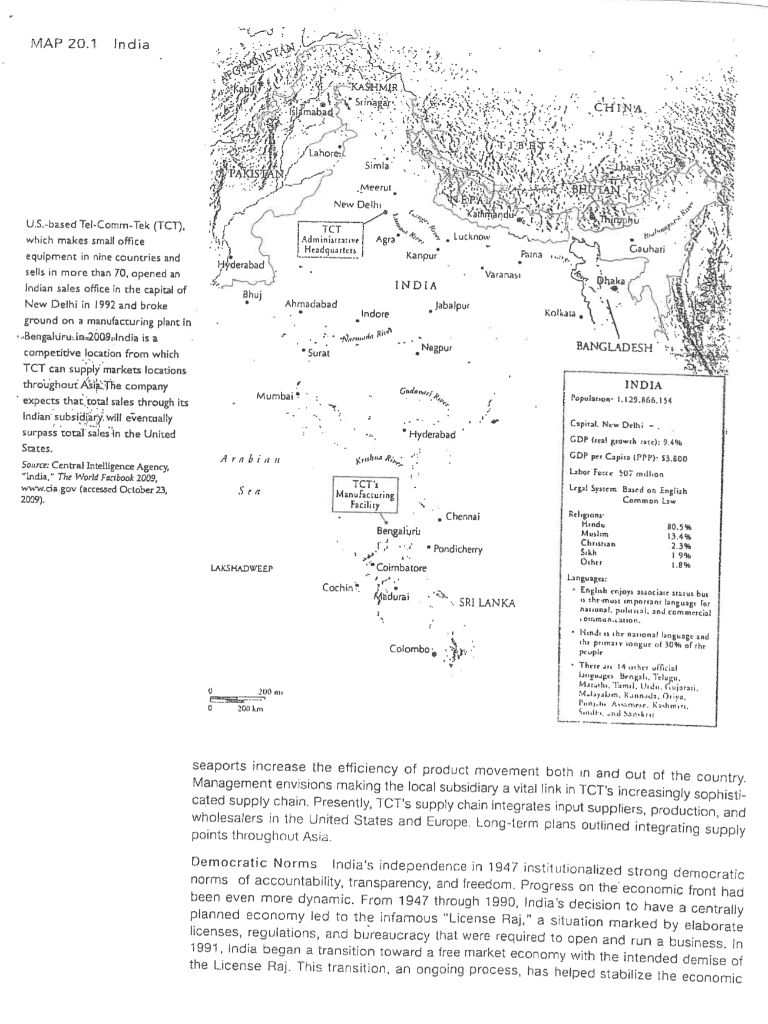
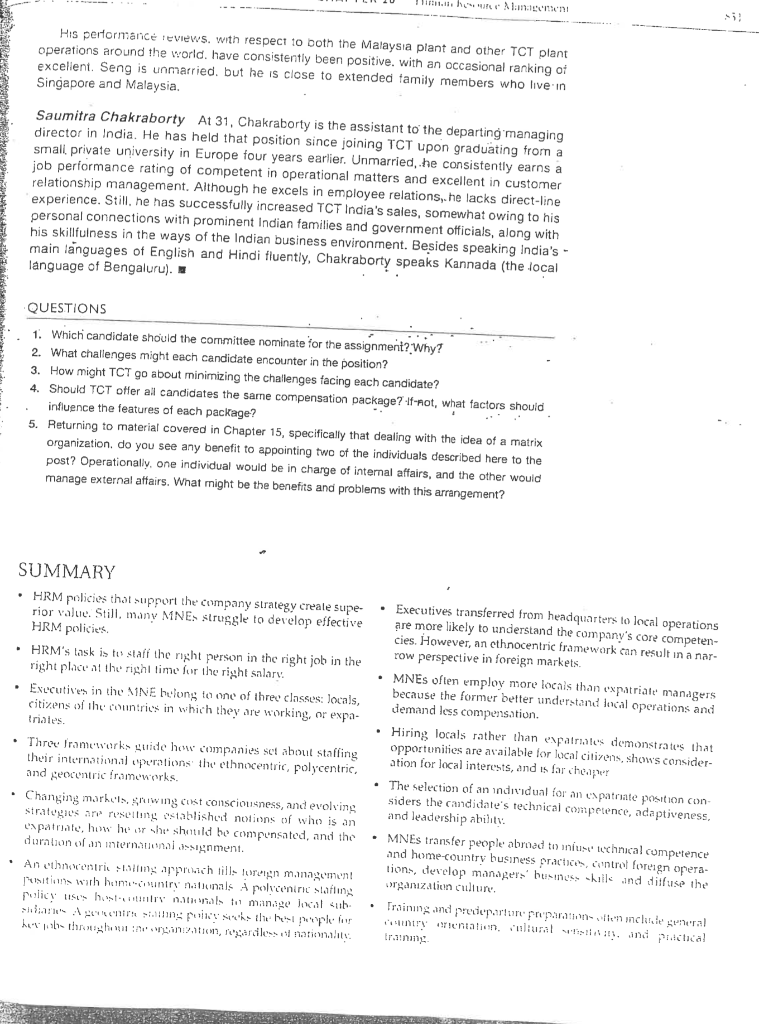
CHAPTER 20 illecane variability in labor laws, un structure, workplace attitudes and collective bargaining processes created a compless, changing situation. Atost AINEs ruasened that headquarters was poorly positioned to manage worldwide labor relations. Hence, they delegated responsibility to local managers. This outlook is giving way to a trend toward greater coordination and control of global labor policies by the senior leadership of MNES. Coordinating globally dispersed value chains spurs headquarters to preempt disruptions caused by sporadic workplace activism in once less but now more interlinked sites around the world. Moreover, companies whose value creation is sensitive to labor costs no longer can delegate labor relations to a series of local managers. Integrating global operations pushes MNEs to integrate labor relations. Growing attention to and integration of their relations creates powerful advan- tages for MNEs. They translate their understanding of how to use the threat of production switching or resource redirection to strengthen their collective-bargaining positions. Tel-Comm-Tek (TCT) in May 2010, Mark Hopkins of Tel-Comm-Tek (TCT) India, a company headquartered in the United States, announced his resignation and intention to return to his home in Vermont.116 At the time, he was the managing director of the Indian subsidiary of TCT.-During his tenure, Hopkins oversaw steady growth in market share and profitability of the Indian operation. Upon his announcement, TCT began searching for his replacement. TCT: A Brief Introduction . TCT manufactures a variety of small office equipment in nine different countries. It distributes and sells products such as copying machines, dictation units, laser printers, and paper shred- ders worldwide. TCT reported sales in more than 70 countries. TCT has sold and serviced products in India since the early 1980s even though it lacked its own in-country manufacturing facility. Originally, it hired independent importers to sell its products. It soon realized that gener- mating higher sales required setting up its own operations. In 1992, it opened a sales office in New Delhi. Map 20.1 profiles features of India. Today, TCT is poised to expand its Indian operations. Local sales have been increasing at double-digit rates. powered by a boom in the Indian information-technology sector. Forecasts saw this trend accelerating over the next decade. Headquarters projected TCT India evolving into a key element of its global value chain and, ultimately, the center point of its Asian operations India: The Next Economic Juggernaut? Some see India developing into the world's next big industrial power. This projection has led global companies to increase their local operations. For example, IBM, a longtime customer of TCT, increased its Indian staff from a handtul to more than 100.000 employees between the inid-1990s and 2010 through a series of acquisitions and investments. Moreover, internal com- pany analysis indicates that the economic growth rate for the overali economy, along with the sectors that TCT serves, could move total sales of the Indian subsidiary past those in the com- Sany's home market. Expansion: Pros mproving Intrastructure Shaping TCT India's expansion plans is the ongoing improve- nent in India's transportation infrastructure. Improvements in highways, railways, and RE AFGHANISTAN Umabad (kom Agra Milupe Paina * " - ** .it Ro . MAP 20.1 India KASHMIR Srinagar CHINA Lahore: Simla Meerut BEGIAN New Delhi Kathmand hinyphu U.S.-based Tel-Comm-Tek (TCT). TCT Lucknow which makes small office Administrative Gauhati Headquarters Kanpur equipment in nine countries and Hyderabad Varanasi sells in more than 70, opened an Dhaka INDIA Indian sales office in the capital of Bhuj New Delhi in 1992 and broke Ahmadabad Jabalpur Indore Kolkata ground on a manufacturing plant in Bengaluru.in 2009. India is a BANGLADESH competitive location from which Surat TCT can supply markets locations INDIA throughout Asia: The company Mumbai Population 1.129.166.154 expects that total sales through its Indian subsidiary will eventually Capital, New Delhi - surpass total sales in the United Hyderabad GDP real growth rate: 9.4% States. GDP per capira PPP)- 53.800 Arabia Source: Central Intelligence Agency, Laher Ferce 507 million "India, " The World Factbook 2009, TCT'S Lepal System Based on English www.da.gov (accessed October 23, Manufacturing Common Law 2009). Facility Chennai Religiony Hindu 30.5% Bengaluru Muslim 13.4% Chan 2.3% Pondicherry SA 1966 Och 1.8% LAKSHADWEEP Coimbatore Languages: Cochin Madurai SRI LANKA the must important language for national pulumal, and commercial ...on Hand the arenal language and the primary longue of 30% of the Colombo prupit There are 14 other official Langwe Bengali Telugu Marathi, Tamil Urdu Gujarati U Malayalam, Kannada Diva Pune Armee, min. 0 200 m Sunndars Nagpur Godewi RE 200 seaports increase the efficiency of product movement both in and out of the country. Management envisions making the local subsidiary a vital link in TCT's increasingly sophisti- cated supply chain. Presently, TCT's supply chain integrates input suppliers, production, and wholesalers in the United States and Europe. Long-term plans outlined integrating supply points throughout Asia. Democratic Norms India's independence in 1947 institutionalized strong democrat norms of accountability, transparency, and freedom. Progress on the economic front had been even more dynamic. From 1947 through 1990. India's decision to have a centrally planned economy led to the infamous "License Raj." a situation marked by elaborate licenses, regulations, and bureaucracy that were required to open and run a business. In 1991, India began a transition toward a free market economy with the intended demise of the License Raj. This transition, an ongoing process, has helped stabilize the economic foreign and U.S. locations. Headquarters sees international experience as an important facet of executive leadership. The Candidates The Asian Regional Office charged a selection committee to nominate the new managing director for TCT India. The committee identified six candidates: Tom Wallace A 30-year TCT veteran, Wallace is experienced in the technical and sales aspects. He has supported some supply-chain initiatives in the U.S. market. Although he has riever worked abroad, he has toured the company's foreign operations and always expressed interest in an expatriate position. His superiors rate his performance as proficient. He will retire in about four and a half years. He and his wife speak English. Their children are grown and live with their own families in the United States. Presently, Wallace supervises a U.S.-based operation that is about the size of that in. India. However, the merger of Wallace's unit with another TCT division will eliminate his cur rent position within six months. Brett Harrison Harrison, 40, has spent 15 years with TCT, both running line activitie and supervising staff. His superiors consider him highly competent and poised to move into upper-level management within the next few years. For the past three years, he has worked in the Asian regional office and has regularly toured TCT's Southeast Asian oper ations. Both he and his wife have traveled to India several times in the last 20 years and are well acquainted with its geography, politics, customs, and outlooks.-The Harrisons know man U.S. expatriates in the Bengaluru.region. Their children, ages 14 and 16, have also vaca tioned in India with their parents. Mrs. Harrison is a midlevel executive with a multinational pharmaceuticals company that presently does not have an operation in India; there were rumors of a sales office opening in a few years. Atasi Das Born in the United States, Das joined TCT 12 years ago after earning her MBA from a university in New England. At 37, she has successfully moved between staff and line positions, with broader responsibilities in strategic planning. For two years, she was the sec ond in command of a product group that was about half the size of the Indian operations. Her performance regularly earns excellent ratings. Currently, she works on a planning-staff team based at TCT headquarters. When she joined TCT, she noted that her ultimate goal was to be assigned international: responsibilities, and she pointed to her undergraduate major in international management as evidence of her long-term plan. She recently reiterated her interest in international respons bilities, seeing it as an essential career step. She speaks Hindi and is unmarried. Her parents, who live in the United States, are first-generation immigrants from India. Several family meme bers and relatives live in Kashmir and Punjab, northern states of India. 19 Ravi Desai Desai, 33, is currently an assistant managing director in the larger Aslan operation. He helps oversee production and sales for the Southeast Asian markets in Singapore, Malaysia and China. A citizen of India, he has spent his 10 years with To working in operational slots throughout Southeast Asia. He holds an MBA from the presti gious Indian Institute of Management. Some in TCT see him as a candidate to eventual direct the Indian operation. He is married, has four children (ages two to seven), and speaks English and Hindi weil. His wife, also a native of India, neither works outside the home nor speaks English, Jalan Bukit Seng Seng. 38, is the managing director of TCT's assembly operation in Malaysia. A citizen of Singapore. Seng has worked in either Singapore or Malaysia his entire life. However, he did earn undergraduate and MBA degrees from leading universities in the United States. He is fluent in Singapore's four official languages--Malay. English, Mandarin and Tamil-and sees himself learning other languages as needed. men: His performance reviews, with respect to both the Malaysia plant and other TCT plant operations around the world. have consistently been positive. with an occasional ranking of excellent. Seng is unmarried, but he is close to extended family members who live in Singapore and Malaysia. Saumitra Chakraborty At 31, Chakraborty is the assistant to the departing managing director in India. He has held that position since joining TCT upon graduating from a small private university in Europe four years earlier. Unmarried, he consistently earns a job performance rating of competent in operational matters and excellent in customer relationship management. Although he excels in employee relations,.he lacks direct-line experience. Still, he has successfully increased TCT India's sales, somewhat owing to his personal connections with prominent Indian families and government officials, along with skillfulness in the ways of the Indian business environment. Besides speaking india's - main languages of English and Hindi fluently, Chakraborty speaks Kannada (the local language of Bengaluru). QUESTIONS 1. Which candidate should the committee nominate for the assignment? Why? 2. What challenges might each candidate encounter in the position? 3. How might TCT go about minimizing the challenges facing each candidate? 4. Should TCT offer all candidates the same compensation package? If not, what factors should influence the features of each package? 5. Returning to material covered in Chapter 15, specifically that dealing with the idea of a matrix organization. do you see any benefit to appointing two of the individuals described here to the post? rationally, one individual would be in charge of internal affairs, and the other would manage external affairs. What might be the benefits and problems with this arrangement? SUMMARY HRM policies that support the company strategy creale supe rior value. Still, many MNES struggle to develop effective HRM policies HRM's task is to staff the nght person in the night job in the right place at the right time for the right salary Executives in the AINE belong to one of three classes: Jocals, citizens of the countries in which they are working, or expa- triates. Three frameworks guide how companies set about staffing their international experations the ethnocentric, polycentric, and geocentric frameworks. Changing marhe'ls gnwing cost consciousness, and evolving strategies are resulting established notions or who is an expatriate, how he or she shutuld be compunsated, and the duration of an internal assignment. An ethn wentri garpruch tills during management Isians with humeuntry Dunals A polveenin safling pulicy lists hantre nanals to manage local sub har en sang puke the pins hebthrough manzation, regardles nationalt Executives transferred from headquarters lo local operations are more likely to understand the company's core competen- cies. However, an ethnocentric framework can result in a nar- row perspective in foreign markets. MNEs often employ more locals than expatriate managers because the former better understand local operations and demand less compensation. Hiring locals rather than expatrales demonstrates that opportunities are available for local citizens, shows consider- ation for local interests, and is far cheaper The selection of an individual for an expatriate position con siders the candidate's technical competence, adaptiveness, and leadership ability MNEs transfer people abroad to unus'chnical competence and home-country business practice, centret foreign opera- tions, develop anagers' business whils and difuse the organizatiunculur. Training and presdeparture preparation include general Ty mentale. tural , and practical training 39









 Study Help