Question: Need help with red x's. Week 5 - Assignment eBook Print Item Twenty metrics of liquidity, Solvency, and Profitability The comparative financial statements of Automotive
Need help with red x's.
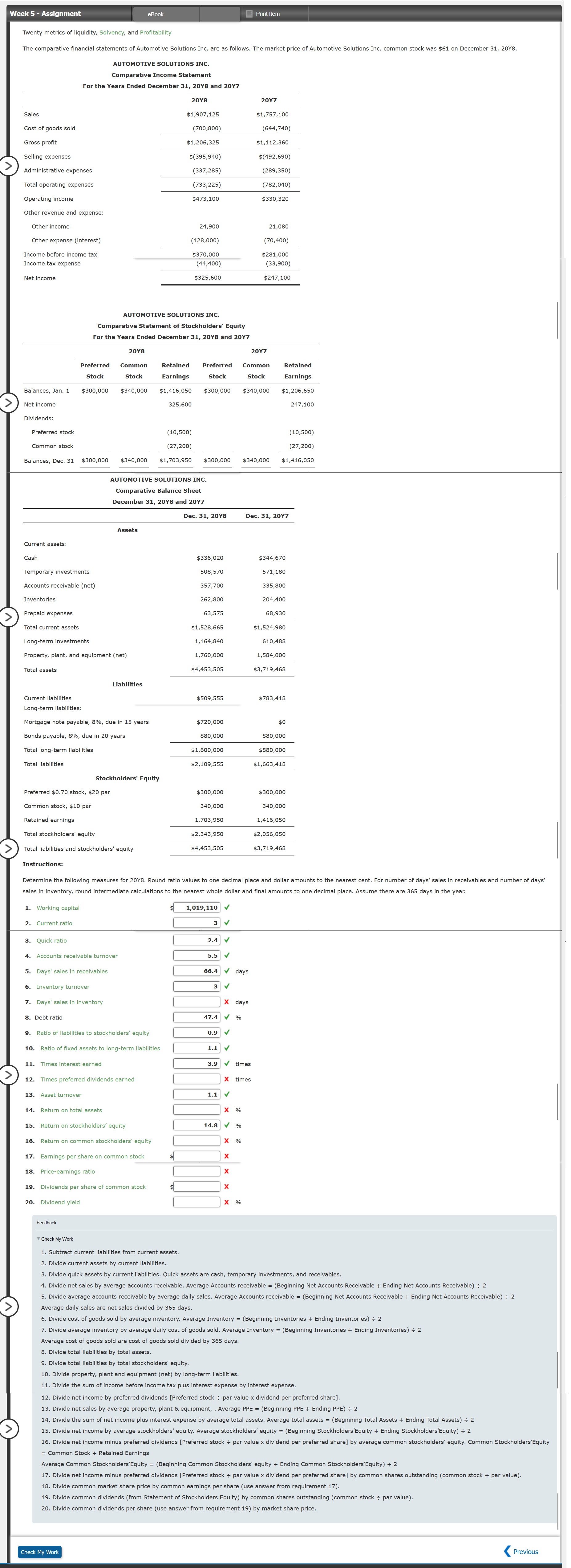
Week 5 - Assignment eBook Print Item Twenty metrics of liquidity, Solvency, and Profitability The comparative financial statements of Automotive Solutions Inc. are as follows. The market price of Automotive Solutions Inc. common stock was $61 on December 31, 20YS. AUTOMOTIVE SOLUTIONS INC Comparative Income Statement For the Years Ended December 31, 20Y8 and 20Y7 20Y8 20Y7 Sales $1,907,125 $1,757,100 Cost of goods sold (700,800) (644,740) Gross profit $1,206,325 $1,112,360 Selling expenses $(395,940) $(492,690) Administrative expenses 337,285) 289,350) otal operating expenses (733,225) (782,040) Operating income 473,100 $330,320 Other revenue and expense: Other income 24,900 21,080 Other expense (interest) (128,000) (70,400) income before income tax $370,000 $281,00 Income tax expense 44,400) (33,900) Net Income $325,600 $247,100 AUTOMOTIVE SOLUTIONS INC. Comparative nt of Stockholders' Equity For the Years Ended December 31, 20Y8 and 20Y7 20Y 20Y7 Preferred Common Retained Preferred Common Retained Stock Stock Earnings Stock Stock Earnings Balances, Jan. 1 $300,000 $340,000 $1,416,050 $300,000 $340,000 $1,206,650 Net income 325,600 247,100 Dividends: Preferred stock (10,500) (10,500) Common stock (27,200) (27,200) Balances, Dec. 31 $300,000 $340,000 $1,703,950 $300,000 $340,000 $1,416,050 AUTOMOTIVE SOLUTIONS INC. Comparative Balance Sheet December 31, 20YS and 2017 Dec. 31, 20Y8 Dec. 31, 20Y7 Assets Current assets: Cash $336,020 $344,670 Temporary investments 508,570 571 ,180 Accounts receivable (net) 57,70 335,800 inventories 262,80 204,400 Prepaid expenses 63,575 68,930 total current assets $1,528,665 $1,524,980 Long-term investments 1,164,840 610,488 Property, plant, and equipment (net) 1,760,000 1,584,000 Total assets $4,453,505 $3,719,468 Liabilities Current liabilities $509,555 $783,418 Long-term liabilities: Mortgage note payable, 8%, due In 15 years 720,000 $0 Bonds payable, 8%, due in 20 years 880,00 380,000 Total long-term liabilities $1,600,000 $880,000 otal liabilities $2,109,555 $1,663,418 Stockholders' Equity Preferred $0.70 stock, $20 par $300,000 $300,000 Common stock, $10 par 340,000 340,000 Retained earnings 1,703,950 1,416,050 otal stockholders' equity $2,343,950 $2,056,050 Total liabilities and stockholders' equity $4,453,505 $3,719,468 Instructions: Determine the following measures for 20 values to one decimal place e nearest cent. For number of days' sales in receivables and number of days' sales in inventory, round intern calculations to the nearest whole dollar and final an . Assume there are 365 days in the year. 1. Working capital 1,019,110 2. Current ratio 3. Quick ratio 2.4 4. Accounts receivable turnover 5.5 V 5. Days' sales in receivables 66.4 V days 6. Inventory turnover 3 V 7. Days' sales in inventory X days B. Debt ratio 47.4 V % . Ratio of liabilities to stock 0.9 10. Ratio of fixed assets to long-term liabilities 1.1 11. Times interest earned 3.9 V times 12. Times preferred dividends earned X times 13. Asset turnover 1.1 V 14. Return on total assets 15. Return on stockholders' equity 14.8 V 16. Return on common stockholders' equity X % 17. Earnings per share on common stock 18. Price-earnings ratio 19. Dividends per share of common stock 20. Dividend yield Feedback Check My Work 1. Subtract current liabilities from current assets. 2. Divide current assets by current liabilities. 3. Divide quick assets by curre es. Quick assets are cash, temporary investments, and receivables. 4. Divide net sales by average eivable. Average Accounts receivable = (Beginning Net Accounts Receivable + Ending Net Accounts Receivable) + 2 5. Divide average acco vable by average daily sales. Average Accounts receivable = (Beginning Net Accounts Receivable + Ending Net Accounts Receivable) + 2 Average daily sales are net sa divided by 365 days. 6. Divide cost of goods sold by average inventory. Average Inventory = (Beginning Inventories + Ending Inventories) + 2 7. Divide average In cost of goods sold. Average Inventory = (Beginning Inventories + Ending Inventories) + 2 Average cost of goods sold are cost of goods sold divided by 365 days. 8. Divide total liabilities by total assets. 9. Divide total liabilities by to stockholders' equity. 10. Divide property, plant and ment (net) by long-term liabilities. 1. Divide the sum of income 12. Divide net income by + par value x dividend per preferred share]. 13. Divide net sales by avera . Average PPE = (Beginning PPE + Ending PPE) + 2 14. Divide the s ts = (Beginning Total Assets + Ending Total Assets) + 2 15. Divide net income by ave quity. Average stockholders' equity = (Beginning Stockholders'Equity + Ending Stockholders'Equity) + 2 6. Divide net income minus preferred divi nd per preferred share] by average common stockholders' equity. Common Stockholders'Equity = Common St Average Common St mon Stockholders'Equity) + 17. Divide net income minus er preferred share] by common shares outstanding (common stock + par value). 18. Divide common ma irement 17). 19. Divide common div utstanding (common stock + par value). 20. Divide common dividends per sh quirement 19) by market share price. Check My Work Previous
Step by Step Solution
There are 3 Steps involved in it
1 Expert Approved Answer
Step: 1 Unlock
Question Has Been Solved by an Expert!
Get step-by-step solutions from verified subject matter experts
Step: 2 Unlock
Step: 3 Unlock
Students Have Also Explored These Related Accounting Questions!









 Study Help