







Question: need help with the following . . . X For Problems 4,6,8, give the signs of the first and second derivatives for the function. Each
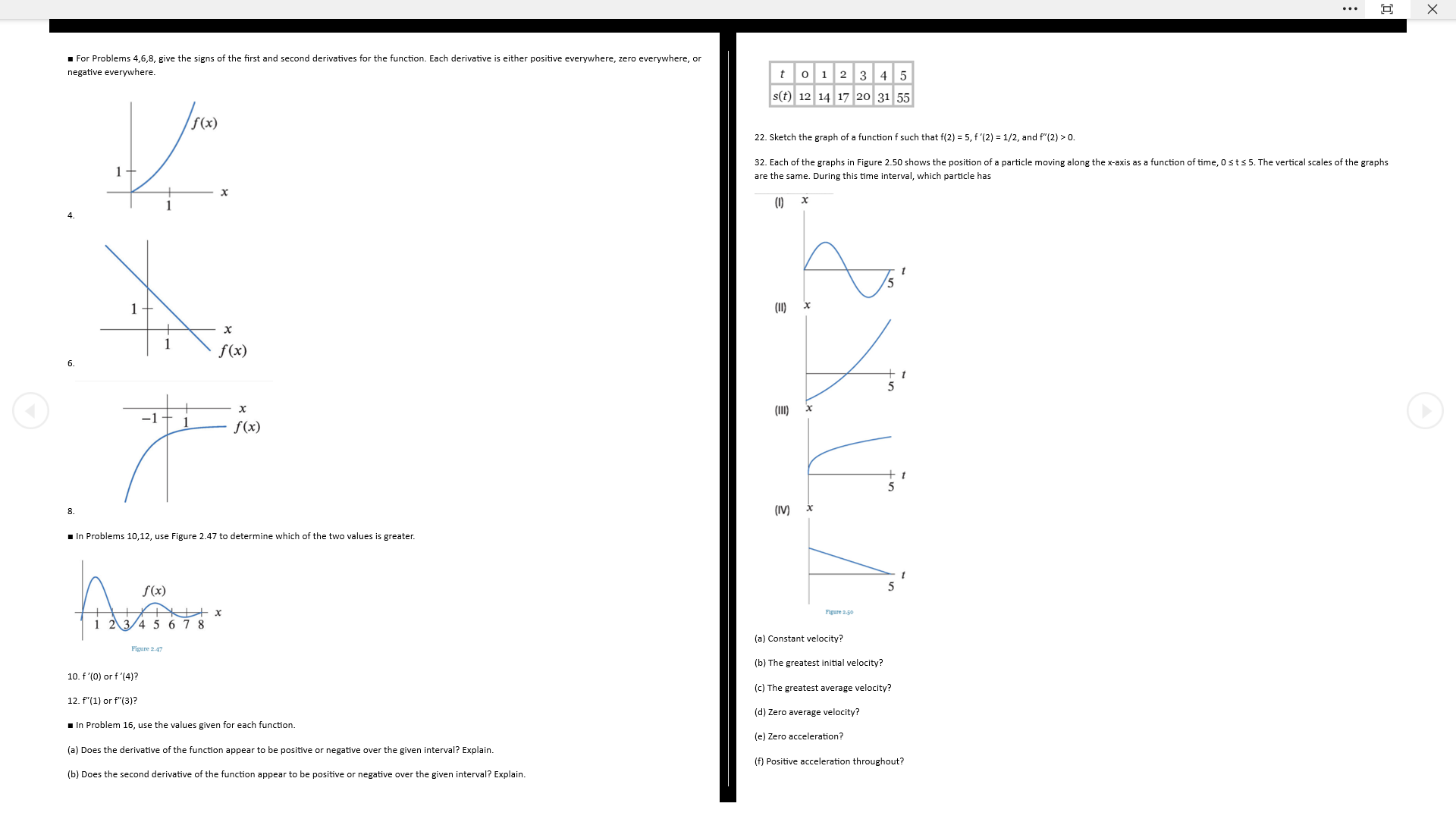
need help with the following
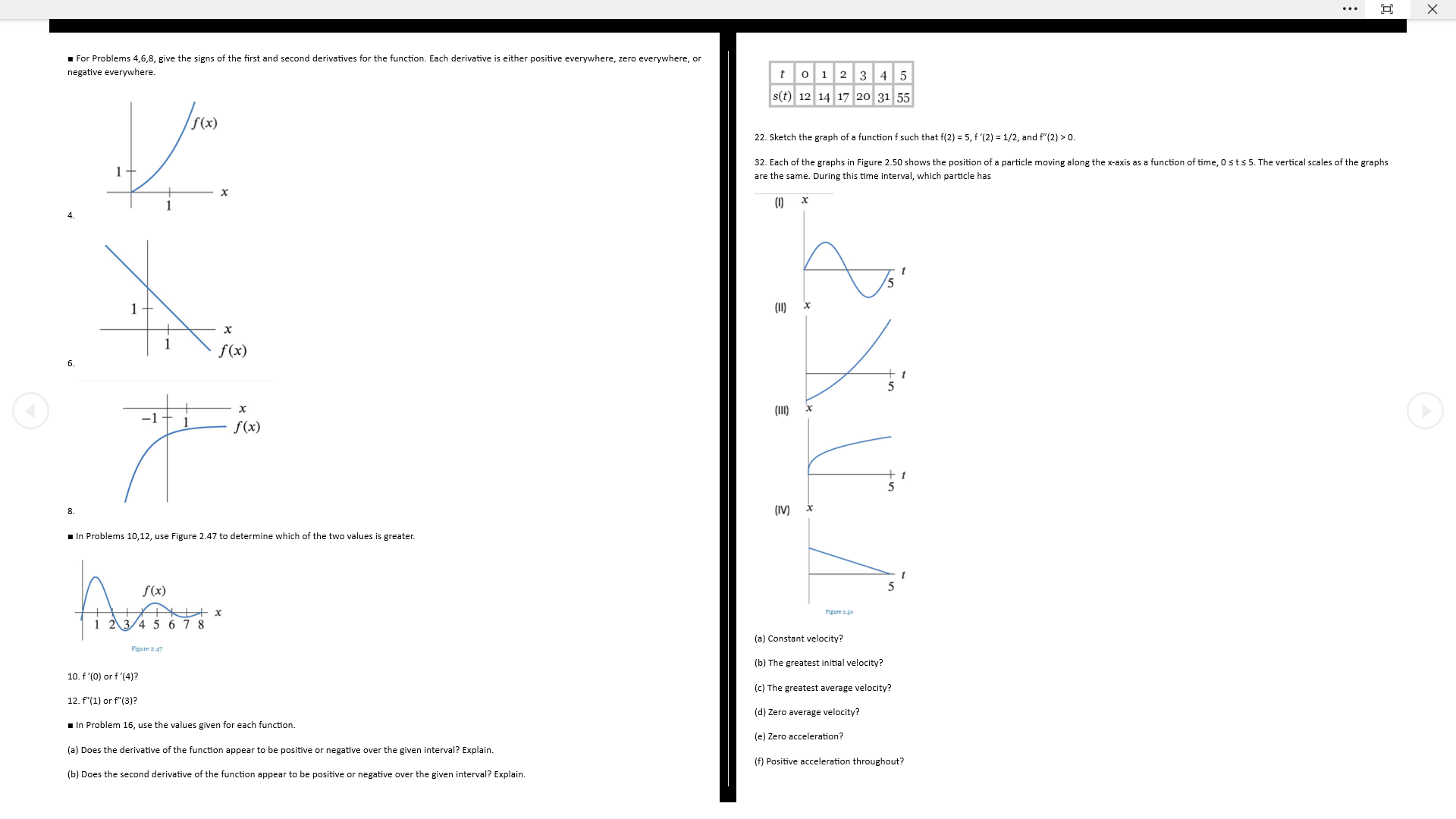
. . . X For Problems 4,6,8, give the signs of the first and second derivatives for the function. Each derivative is either positive everywhere, zero everywhere, or negative everywhere to 1 2 3 4 5 s(t) 12 14 17 20 31 55 f ( x ) 22. Sketch the graph of a function f such that f(2) = 5, f"(2) = 1/2, and f"(2) > 0. 32. Each of the graphs in Figure 2.50 shows the position of a particle moving along the x-axis as a function of time, 0 sts 5. The vertical scales of the graphs are the same. During this time interval, which particle has X f (x) x (III) f ( x ) (IV) In Problems 10,12, use Figure 2.47 to determine which of the two values is greater. f(x) 12 3/ 4567 8 Figure 2.50 (a) Constant velocity? Figure 2.47 (b) The greatest initial velocity? 10. f'(0) or f '(4)? (c) The greatest average velocity? 12. f"(1) or f"(3)? d) Zero average velocity? " In Problem 16, use the values given for each function. (e) Zero acceleration? (a) Does the derivative of the function appear to be positive or negative over the given interval? Explain. (f) Positive acceleration throughout? (b) Does the second derivative of the function appear to be positive or negative over the given interval? Explain
Step by Step Solution
There are 3 Steps involved in it

Get step-by-step solutions from verified subject matter experts
 Study Help