Question: Need help with the questions below. 3. Deposit insurance programs What are federal deposit insurance programs? The presence of federal deposit insurance on your accounts
Need help with the questions below.
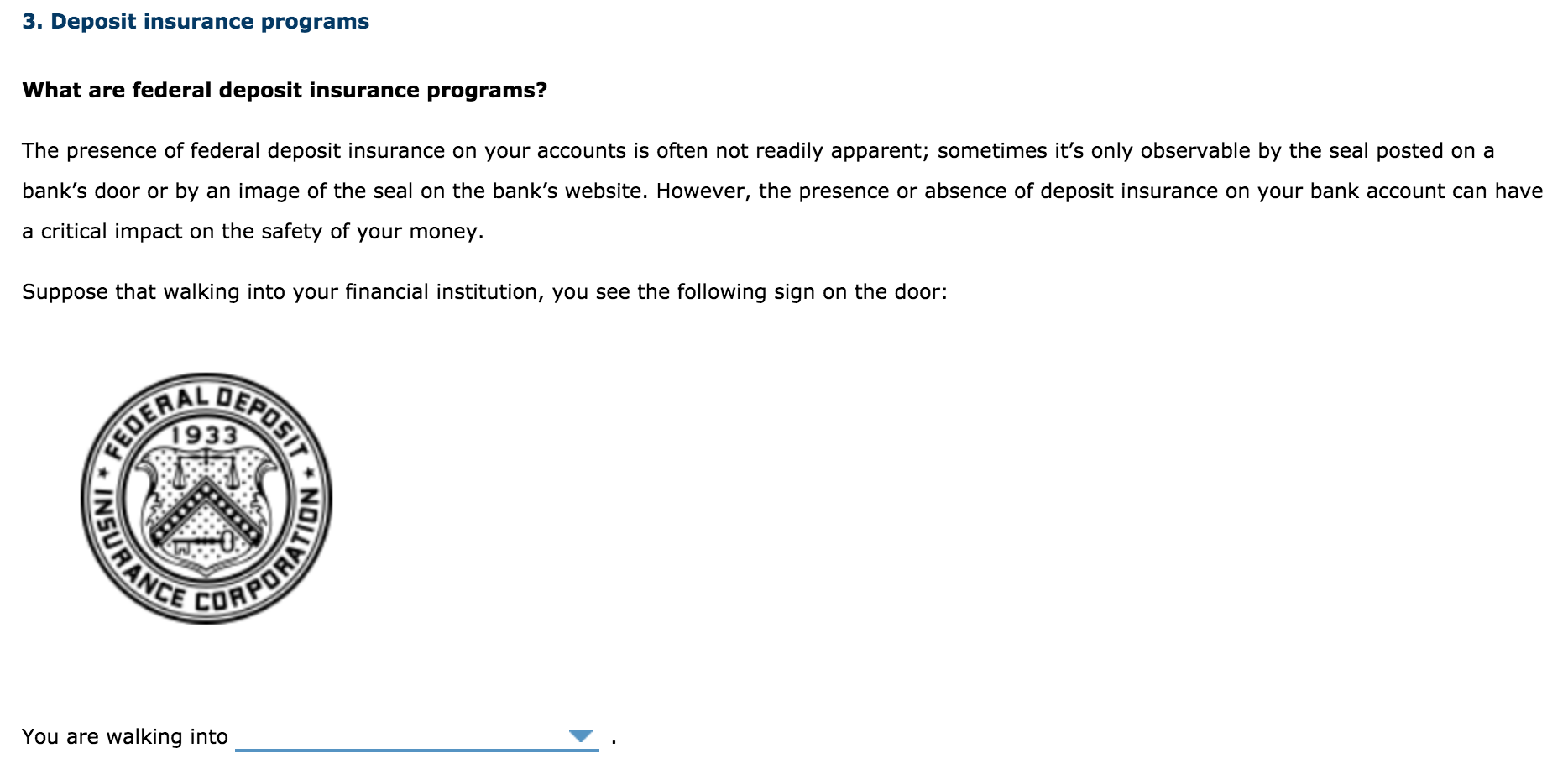
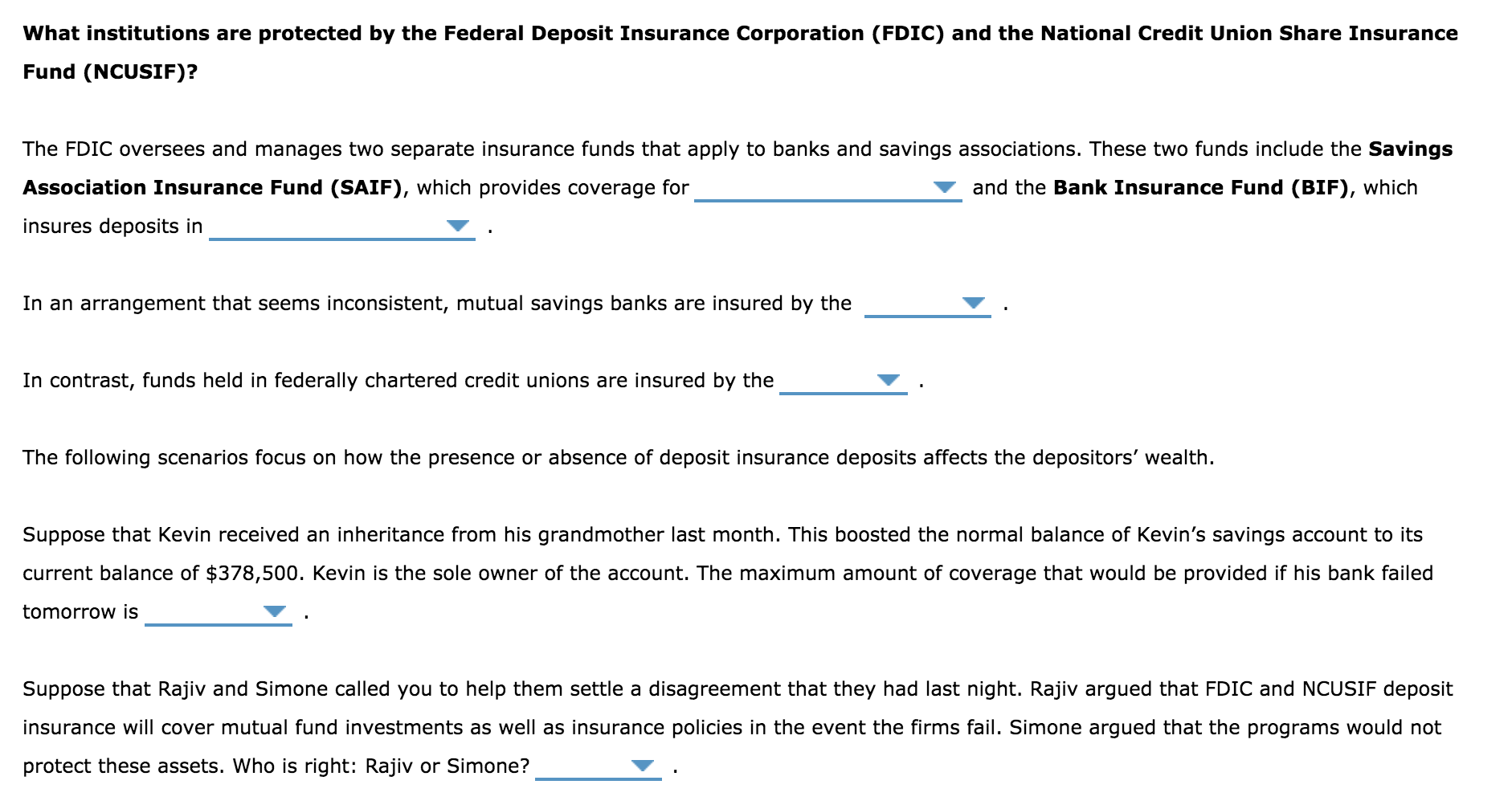
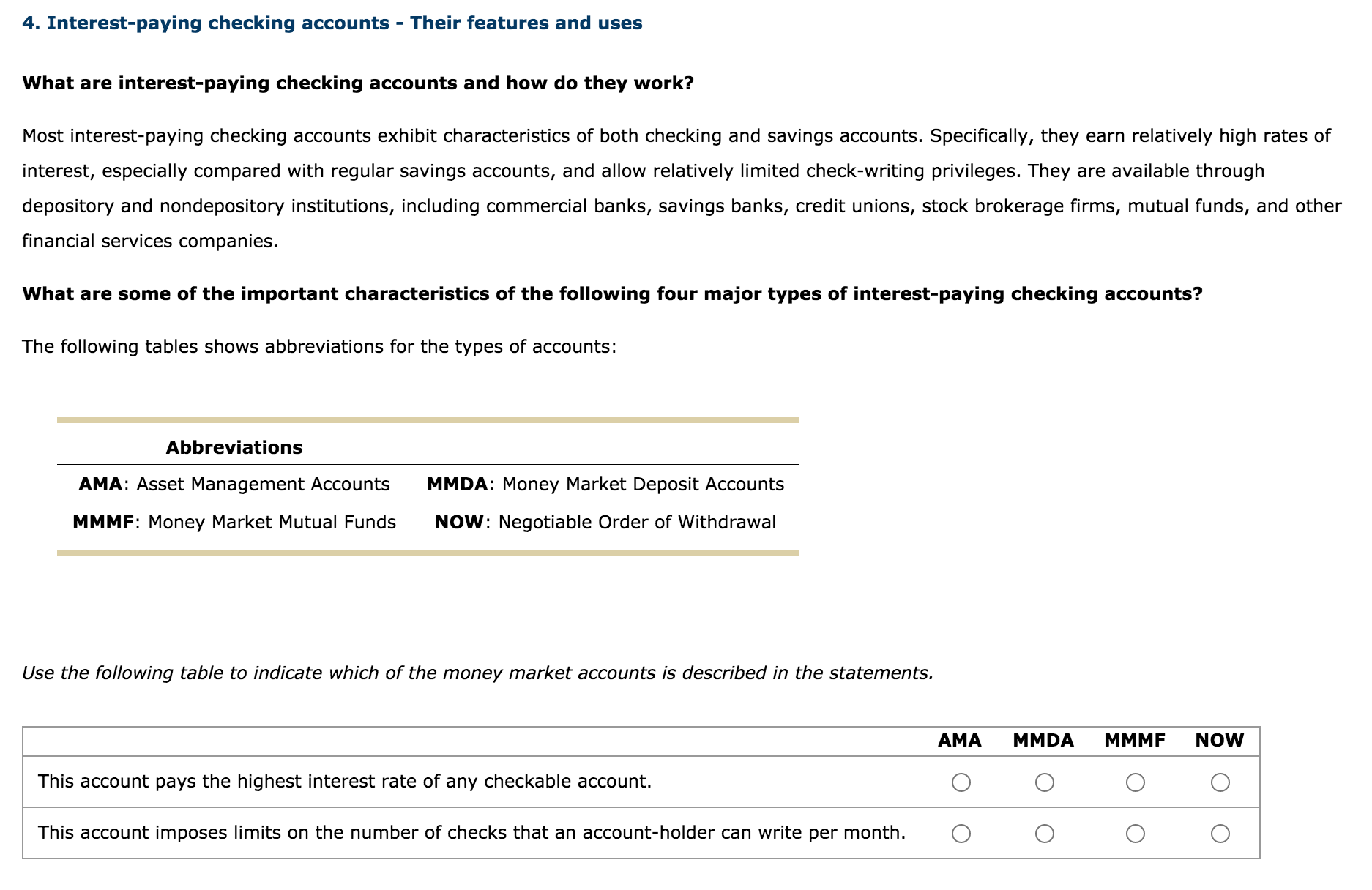
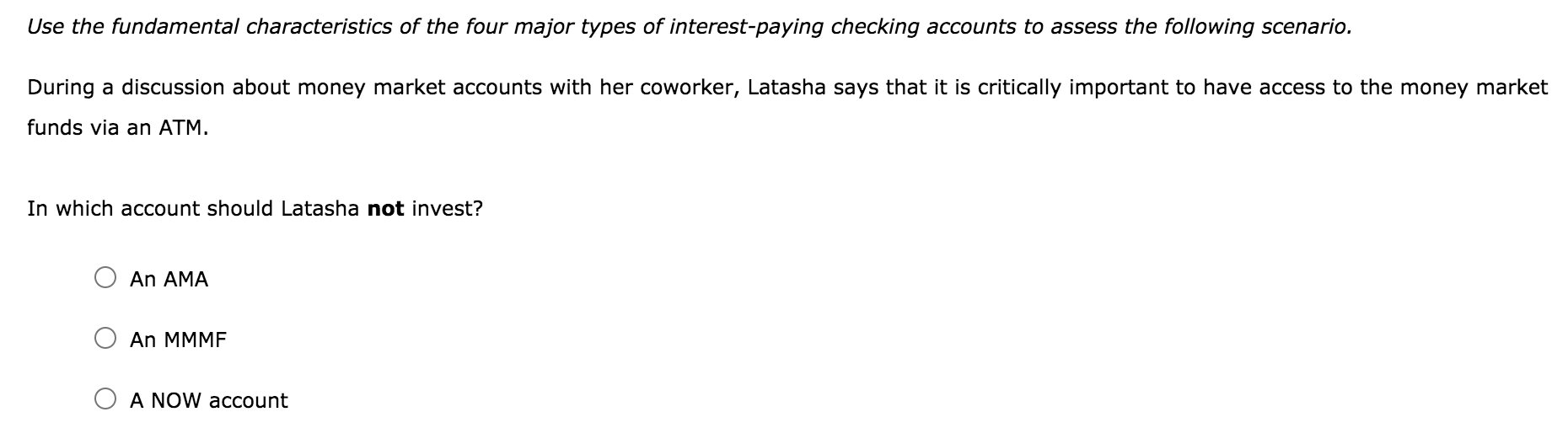
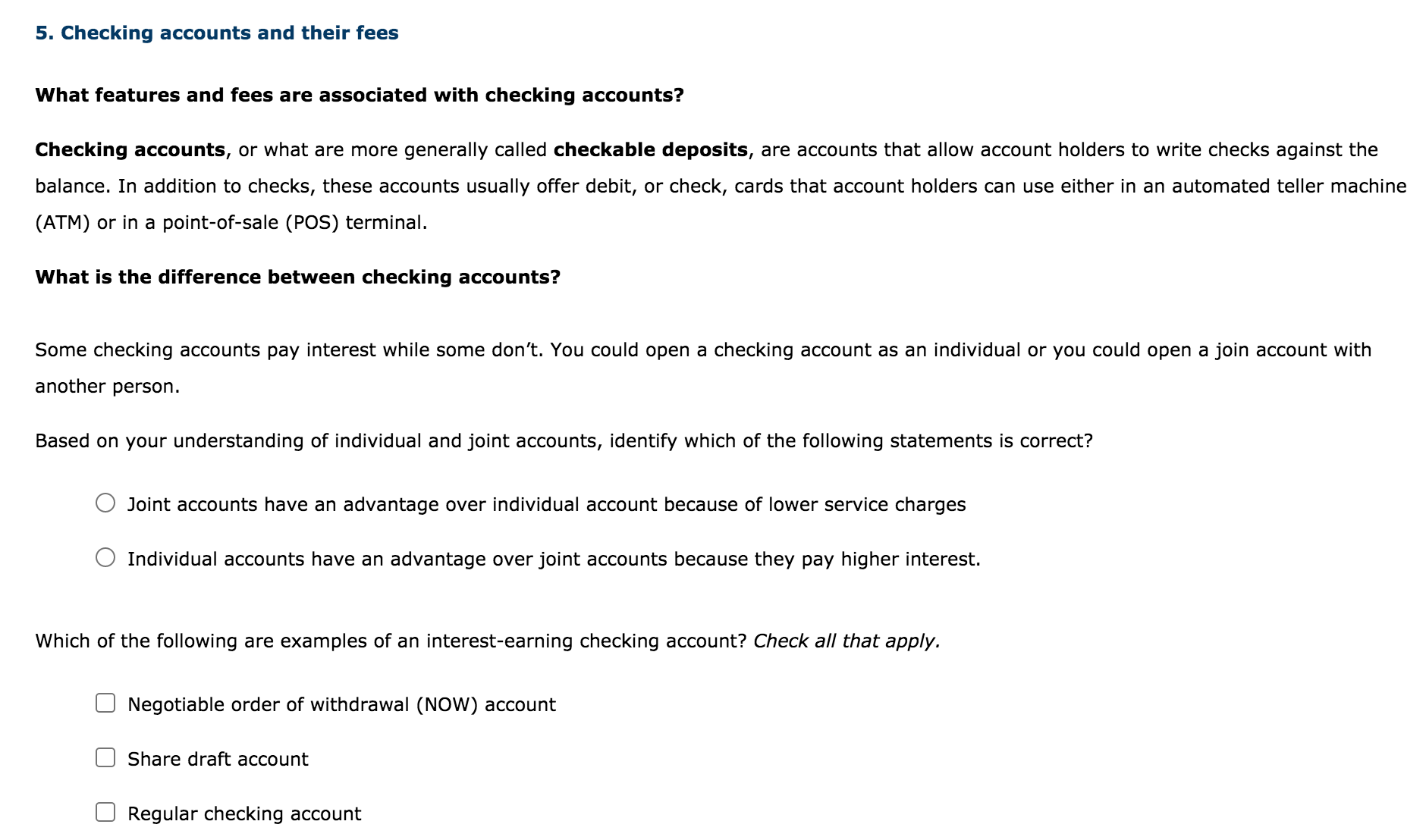
3. Deposit insurance programs What are federal deposit insurance programs? The presence of federal deposit insurance on your accounts is often not readily apparent; sometimes it's only observable by the seal posted on a bank's door or by an image of the seal on the bank's website. However, the presence or absence of deposit insurance on your bank account can have a critical impact on the safety of your money. Suppose that walking into your nancial institution, you see the following sign on the door: You are walking into v . What institutions are protected by the Federal Deposit Insurance Corporation (FDIC) and the National Credit Union Share Insurance Fund (NCUSIF)? The FDIC oversees and manages two separate insurance funds that apply to banks and savings associations. These two funds include the Savings Association Insurance Fund (SAIF), which provides coverage for V and the Bank Insurance Fund (BIF), which insures deposits in v . In an arrangement that seems inconsistent, mutual savings banks are insured by the V . In contrast, funds held in federally chartered credit unions are insured by the V . The following scenarios focus on how the presence or absence of deposit insurance deposits affects the depositors' wealth. Suppose that Kevin received an inheritance from his grandmother last month. This boosted the normal balance of Kevin's savings account to its current balance of $378,500. Kevin is the sole owner of the account. The maximum amount of coverage that would be provided if his bank failed tomorrow is V . Suppose that Rajiv and Simone called you to help them settle a disagreement that they had last night. Rajiv argued that FDIC and NCUSIF deposit insurance will cover mutual fund investments as well as insurance policies in the event the firms fail. Simone argued that the programs would not protect these assets. Who is right: Rajiv or Simone? v . 4. Interest-paying checking accounts - Their features and uses What are interest-paying checking accounts and how do they work? Most interestpaying checking accounts exhibit characteristics of both checking and savings accounts. Specically, they earn relatively high rates of interest, especially compared with regular savings accounts, and allow relatively limited check-writing privileges. They are available through depository and nondepository institutions, including commercial banks, savings banks, credit unions, stock brokerage rms, mutual funds, and other nancial services companies. What are some of the important characteristics of the following four major types of interest-paying checking accounts? The following tables shows abbreviations for the types of accounts: Abbreviations AMA: Asset Management Accounts MMDA: Money Market Deposit Accounts MMMF: Money Market Mutual Funds NOW: Negotiable Order of Withdrawal Use the following table to indicate which of the money market accounts is described in the statements. AMA MMDA MMMF NOW This account pays the highest interest rate of any checkable account. 0 O O O This account imposes limits on the number of checks that an accountholder can write per month. 0 O O O Use the fundamental characteristics of the four major types of interest-paying checking accounts to assess the following scenario. During a discussion about money market accounts with her coworker, Latasha says that it is critically important to have access to the money market funds via an ATM. In which account should Latasha not invest? 0 An AMA 0 An MMMF O A NOW account 5. Checking accounts and their fees what features and fees are associated with checking accounts? Checking accounts, or what are more generally called checkable deposits, are accounts that allow account holders to write checks against the balance. In addition to checks, these accounts usually offer debit, or check, cards that account holders can use either in an automated teller machine (ATM) or in a pointofsale (POS) terminal. What is the difference between checking accounts? Some checking accounts pay interest while some don't. You could open a checking account as an individual or you could open a join account with another person. Based on your understanding of individual and joint accounts, identify which of the following statements is correct? 0 Joint accounts have an advantage over individual account because of lower service charges 0 Individual accounts have an advantage over joint accounts because they pay higher interest. Which of the following are examples of an interestearning checking account? Check all that apply. C Negotiable order of withdrawal (NOW) account l: Share draft account l: Regular checking account









 Study Help