







Question: Need help with these 3 problems, please 79. A student at a four-year college claims that mean enrollment at four-year colleges is higher than at
Need help with these 3 problems, please
79. A student at a four-year college claims that mean enrollment at four-year colleges is higher than at two-year colleges in the United States. Two surveys are conducted. Of the 35 two-year colleges surveyed, the mean enrollment was 5,068 with a standard deviation of 4,777. Of the 35 four-year colleges surveyed, the mean enrollment was 5,466 with a standard deviation of 8,191. Test the hypothesis, assuming a 5% significance level. Solve using the following steps, similar to Appendix-E (Hypothesios Testing with Two Sample Means). Use the equations for standard error, test statistic and degrees-of-freedom from Section 10.1 of Illowsky (see Two Population Means with unknown Standard Deviations).
a. State the Null Hypothesis (Ho) and Alternate Hypothesis (Ha)
b. Find the random variable X (remember that X is the difference between the two sample means)
c. State the distribution you will use and why ?
d. What is the test statistic (t-value) ?
e. What is the P-value (probability) ? HINT: The formula for the "degrees of freedom" is far more complex.See the formula in Section 10.1.
f. Will you reject or not reject the Null Hypothesis and why ?
91. A powder diet is tested on 49 people, and a liquid diet is tested on 36 different people. Of interest is whether the liquid diet yields a higher mean weight loss than the powder diet. The powder diet group had a mean weight loss of 42 pounds with a standard deviation of 12 pounds. The liquid diet group had a mean weight loss of 45 pounds with a standard deviation of 14 pounds. Test the hypothesis, assuming a 5% significance level. Solve using the following steps, similar to Appendix-E (Hypothesios Testing with Two Sample Means). Use the equations for standard error, test statistic and degrees-of-freedom from Section 10.1 of Illowsky (Two Population Means with unknown Standard Deviations).
a. State the Null Hypothesis (Ho) and Alternate Hypothesis (Ha)
b. Find the random variable X (remember that X is the difference between the two sample means)
c. State the distribution you will use and why ?
d. What is the test statistic (t-value) ?
e. What is the P-value (probability) ?HINT: The formula for the "degrees of freedom" is far more complex.See the formula in Section 10.1.
f. Will you reject or not reject the Null Hypothesis and why ?
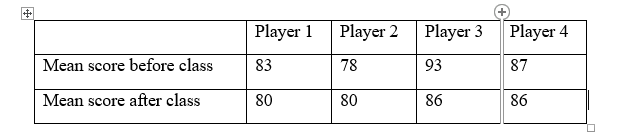
120. A golf instructor is interested in determining if her new technique for improving players' golf scores is effective. She takes four new students. She records their 18-hole scores before learning the technique and then after having taken her class. She conducts a hypothesis test. The data are as follows.Is the correct decision to Reject the Null Hypothesis or Not Reject the Null Hypothesis? Test the hypothesis, assuming a 5% significance level. Solve using the following steps:
a. State the Null Hypothesis (Ho) and Alternate Hypothesis (Ha)
b. Find the random variable X.Consider we are testing "paired samples".
c. State the distribution you will use and why ?
d. What is the test statistic (t-value) ?Assume, the population mean of the differences = 0.
e. What is the P-value (probability) ?
f. Will you reject or not reject the Null Hypothesis and why ?
\f
Step by Step Solution
There are 3 Steps involved in it

Get step-by-step solutions from verified subject matter experts
 Study Help