







Question: need help with this assignment Cash Payback Method This method identifies how long it will take (in years) to recover the initial investment v .
need help with this assignment
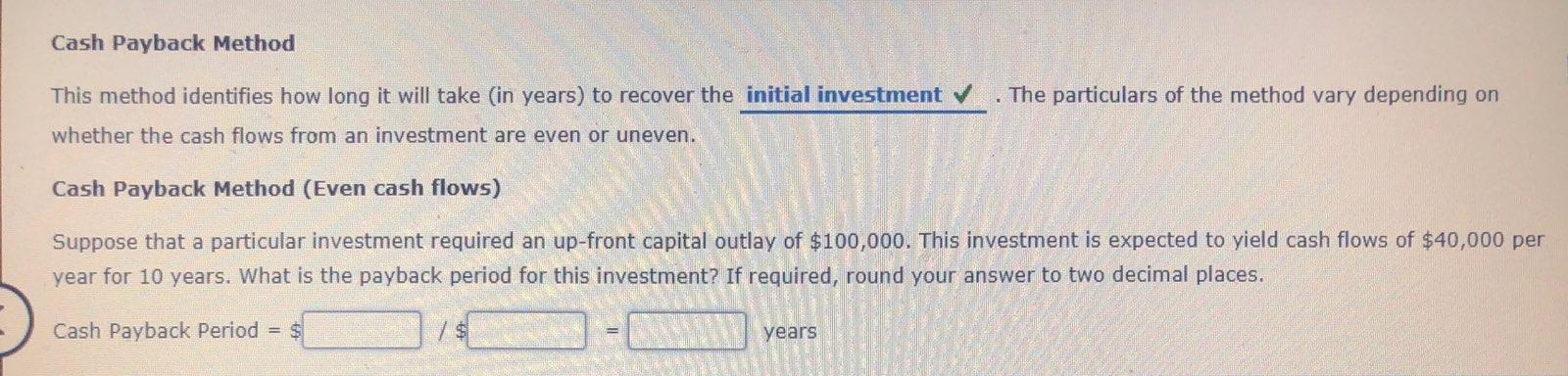
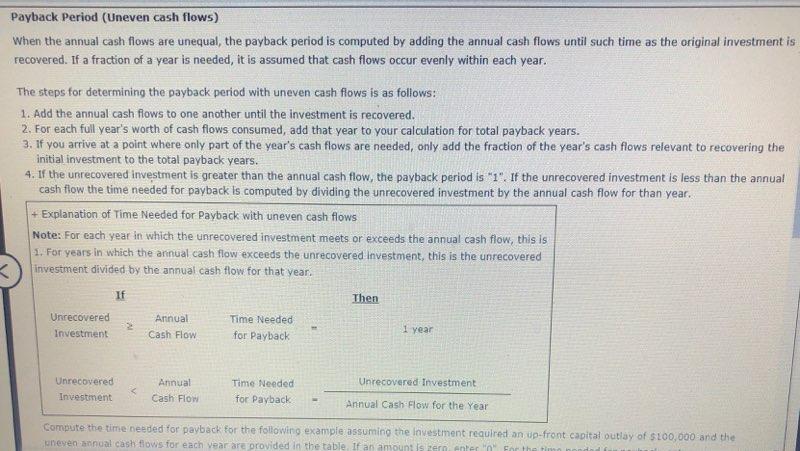
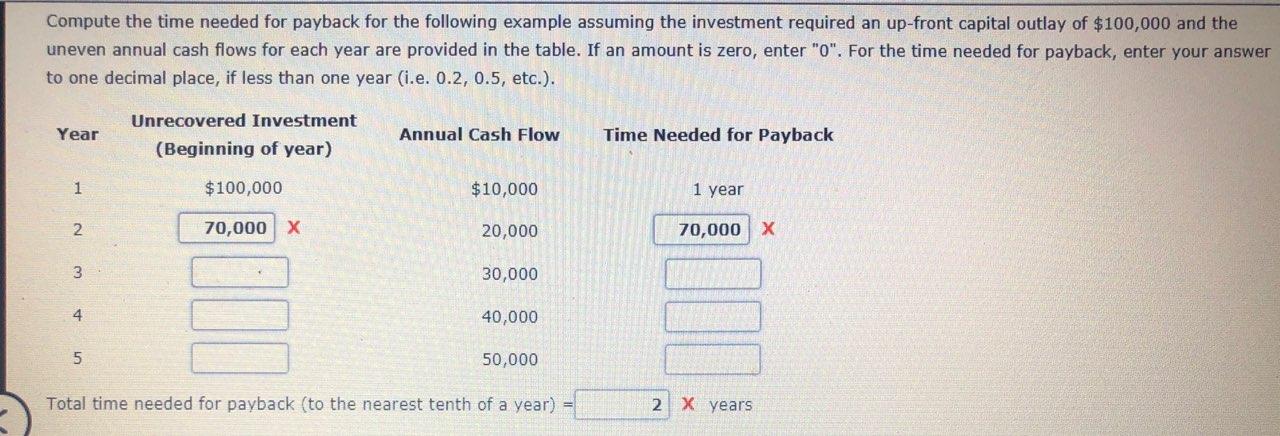
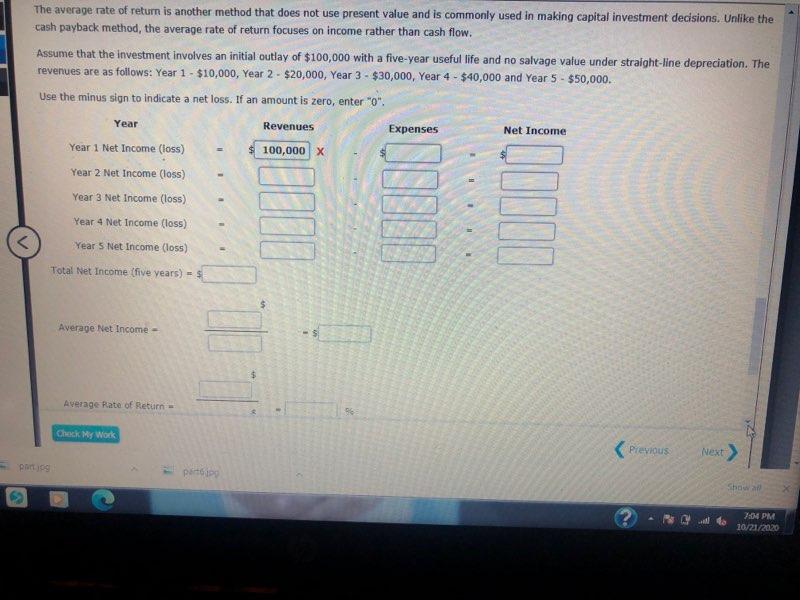
Cash Payback Method This method identifies how long it will take (in years) to recover the initial investment v . The particulars of the method vary depending on whether the cash flows from an investment are even or uneven. Cash Payback Method (Even cash flows) Suppose that a particular investment required an up-front capital outlay of $100,000. This investment is expected to yield cash flows of $40,000 per year for 10 years. What is the payback period for this investment? If required, round your answer to two decimal places. Cash Payback Period = $ yearsPayback Period (Uneven cash flows) When the annual cash flows are unequal, the payback period is computed by adding the annual cash flows until such time as the original investment is recovered. If a fraction of a year is needed, it is assumed that cash flows occur evenly within each year. The steps for determining the payback period with uneven cash flows is as follows: 1. Add the annual cash flows to one another until the investment is recovered. 2. For each full year's worth of cash flows consumed, add that year to your calculation for total payback years. 3. If you arrive at a point where only part of the year's cash flows are needed, only add the fraction of the year's cash flows relevant to recovering the initial investment to the total payback years. 4. If the unrecovered investment is greater than the annual cash flow, the payback period is "1". If the unrecovered investment is less than the annual cash flow the time needed for payback Is computed by dividing the unrecovered investment by the annual cash flow for than year. + Explanation of Time Needed for Payback with uneven cash flows Note: For each year in which the unrecovered investment meets or exceeds the annual cash flow, this is 1. For years in which the annual cash flow exceeds the unrecovered Investment, this is the unrecovered investment divided by the annual cash flow for that year. If Then Unrecovered Annual Investment 2 Time Needed Cash Flow for Payback 1 year Unrecovered Annual Time Needed Unrecovered Investment Investment Cash Flow for Payback Annual Cash Flow for the Year Compute the time needed for payback for the following example assuming the Investment required an up front capital outlay of $too, boo and the uneven annual cash flows for each vear are provided In the table, If an amount Is hernCompute the time needed for payback for the following example assuming the investment required an up-front capital outlay of $100,000 and the uneven annual cash flows for each year are provided in the table. If an amount is zero, enter "0". For the time needed for payback, enter your answer to one decimal place, if less than one year (i.e. 0.2, 0.5, etc.). Year Unrecovered Investment (Beginning of year) Annual Cash Flow Time Needed for Payback 1 $100,000 $10,000 1 year 2 70,000 X 20,000 70,000 X W 30,000 40,000 50,000 Total time needed for payback (to the nearest tenth of a year) 2 X yearsThe average rate of return is another method that does not use present value and is commonly used in making capital investment decisions. Unlike the cash payback method, the average rate of return focuses on income rather than cash flow. Assume that the investment involves an initial outlay of $100,000 with a five-year useful life and no salvage value under straight-line depreciation. The revenues are as follows: Year 1 - $10,000, Year 2 - $20,000, Year 3 - $30,000, Year 4 - $40,000 and Year 5 - $50,000. Use the minus sign to indicate a net loss. If an amount is zero, enter "0". Year Revenues Expenses Net Income Year 1 Net Income (loss) 100,000 X Year 2 Net Income (loss) Year 3 Net Income (loss) Year 4 Net Income (loss) Year 5 Net Income (loss) Total Net Income (five years) = $ Average Net Income = Average Rate of Return = Check My Work ( Previous Next Show and 7AM PM 10/21/2020
Step by Step Solution
There are 3 Steps involved in it

Get step-by-step solutions from verified subject matter experts
 Study Help