







Question: need help with this Fields in the dataset: Name: Name of cereal mfr: Manufacturer of cereal o A = American Home Food Products; o G
need help with this
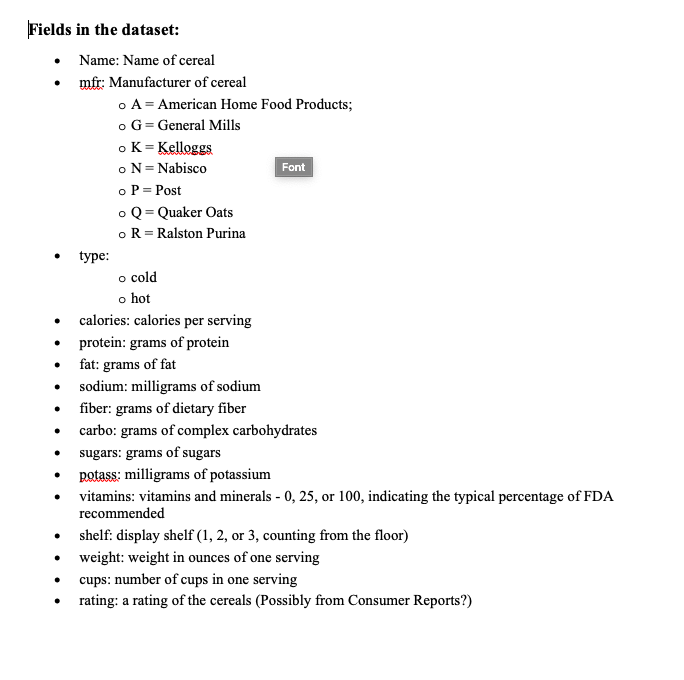
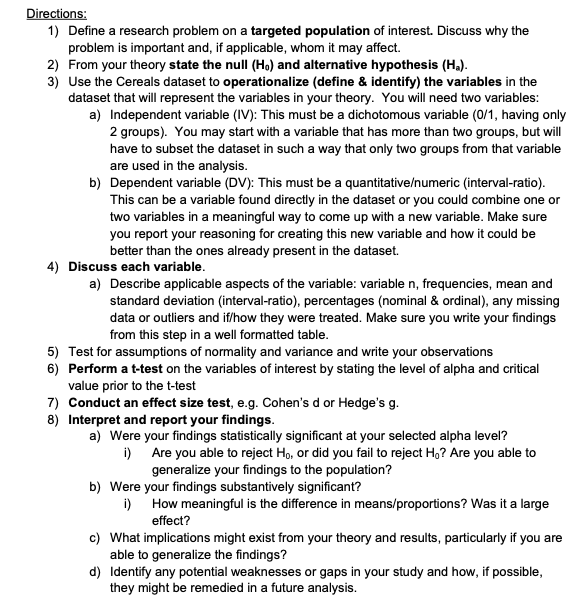
Fields in the dataset: Name: Name of cereal mfr: Manufacturer of cereal o A = American Home Food Products; o G = General Mills o K = Kelloggs o N = Nabisco Font o P = Post o Q = Quaker Oats o R = Ralston Purina type: o cold o hot calories: calories per serving protein: grams of protein fat: grams of fat . sodium: milligrams of sodium fiber: grams of dietary fiber carbo: grams of complex carbohydrates sugars: grams of sugars . potass: milligrams of potassium vitamins: vitamins and minerals - 0, 25, or 100, indicating the typical percentage of FDA recommended shelf: display shelf (1, 2, or 3, counting from the floor) weight: weight in ounces of one serving cups: number of cups in one serving rating: a rating of the cereals (Possibly from Consumer Reports?)Directions: 1) Define a research problem on a targeted population of interest. Discuss why the problem is important and, if applicable, whom it may affect. 2) From your theory state the null (H.) and alternative hypothesis (H.). 3) Use the Cereals dataset to operationalize (define & identify) the variables in the dataset that will represent the variables in your theory. You will need two variables: a) Independent variable (IV): This must be a dichotomous variable (0/1, having only 2 groups). You may start with a variable that has more than two groups, but will have to subset the dataset in such a way that only two groups from that variable are used in the analysis. b) Dependent variable (DV): This must be a quantitativeumeric (interval-ratio). This can be a variable found directly in the dataset or you could combine one or two variables in a meaningful way to come up with a new variable. Make sure you report your reasoning for creating this new variable and how it could be better than the ones already present in the dataset. 4) Discuss each variable. a) Describe applicable aspects of the variable: variable n, frequencies, mean and standard deviation (interval-ratio), percentages (nominal & ordinal), any missing data or outliers and if/how they were treated. Make sure you write your findings from this step in a well formatted table. 5) Test for assumptions of normality and variance and write your observations 6) Perform a t-test on the variables of interest by stating the level of alpha and critical value prior to the t-test 7) Conduct an effect size test, e.g. Cohen's d or Hedge's g. 8) Interpret and report your findings. a) Were your findings statistically significant at your selected alpha level? i) Are you able to reject Ho, or did you fail to reject Ho? Are you able to generalize your findings to the population? b) Were your findings substantively significant? i) How meaningful is the difference in means/proportions? Was it a large effect? c) What implications might exist from your theory and results, particularly if you are able to generalize the findings? d) Identify any potential weaknesses or gaps in your study and how, if possible, they might be remedied in a future analysis
Step by Step Solution
There are 3 Steps involved in it

Get step-by-step solutions from verified subject matter experts
 Study Help