



Question: Need help with this question Problem 5. Social Welfare Consider an exchange economy in which there are two agents, Alice and Bob, and two goods,
Need help with this question
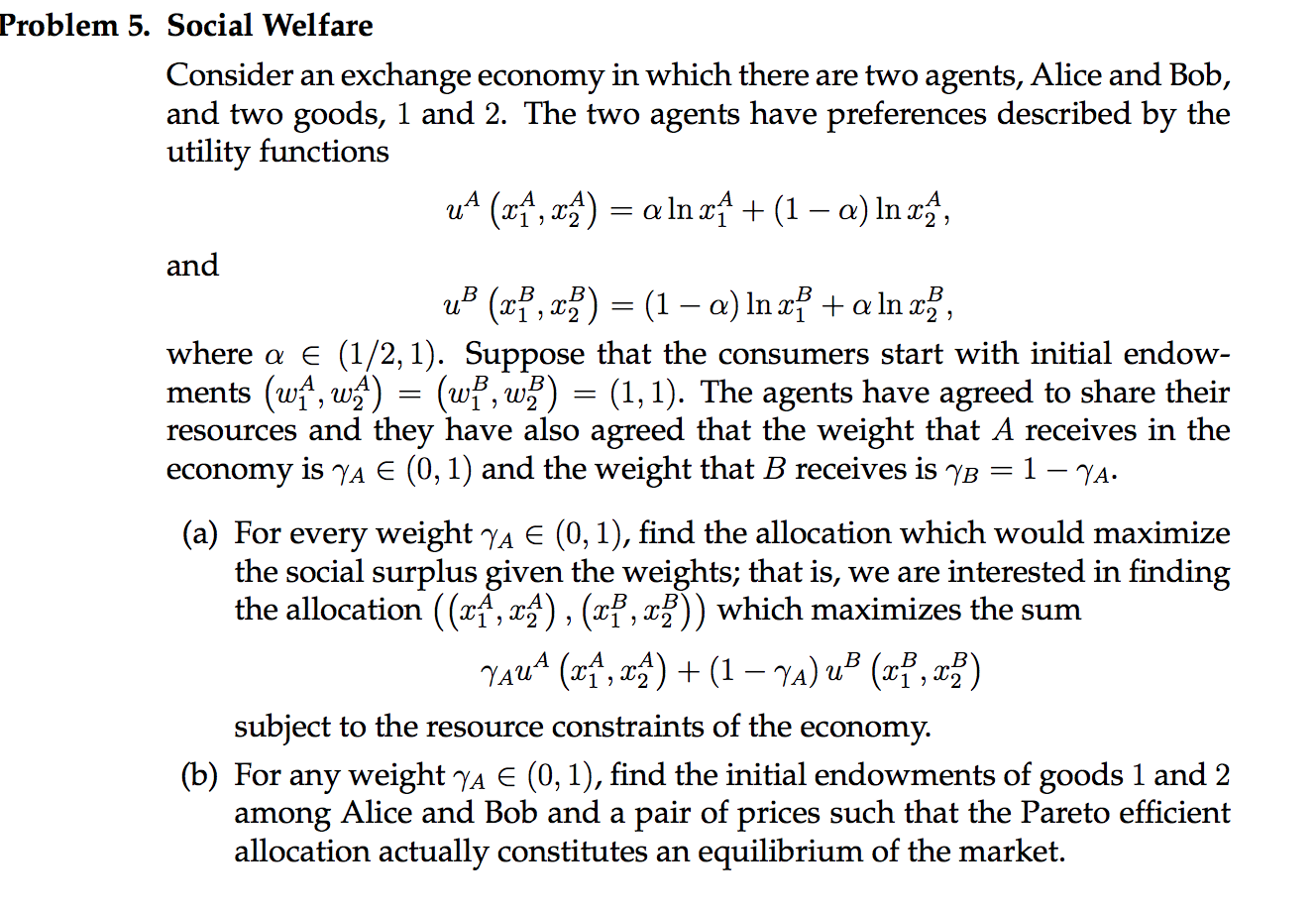
Problem 5. Social Welfare Consider an exchange economy in which there are two agents, Alice and Bob, and two goods, 1 and 2. The two agents have preferences described by the utility functions of\" (3314,3313) = 051113314 + (l 0011135, and HB (33?,3323) = (1 a) 1113:? + alnsz, where a e (1 / 2, 1). Suppose that the consumers start with initial endow- ments (1014,1154) = (1019,1053) = (1, 1). The agents have agreed to share their resources and they have also agreed that the weight that A receives in the economy is 7,4 6 (0, 1) and the weight that B receives is '73 = 1 7,4. (a) For every weight 7,; e (0, 1), nd the allocation which would maximize the social surplus given the weights; that is, we are interested in finding the allocation ((3:14, $124) , (3:19, 3:23)) which maximizes the sum m (we as) +
Step by Step Solution
There are 3 Steps involved in it

Get step-by-step solutions from verified subject matter experts