







Question: Need help with this question. Thank you :) Question 4. Toying with tetrahedronarks) The three-dimensional counterpart of a triangle is a tetrahedron, which is a
Need help with this question. Thank you :)
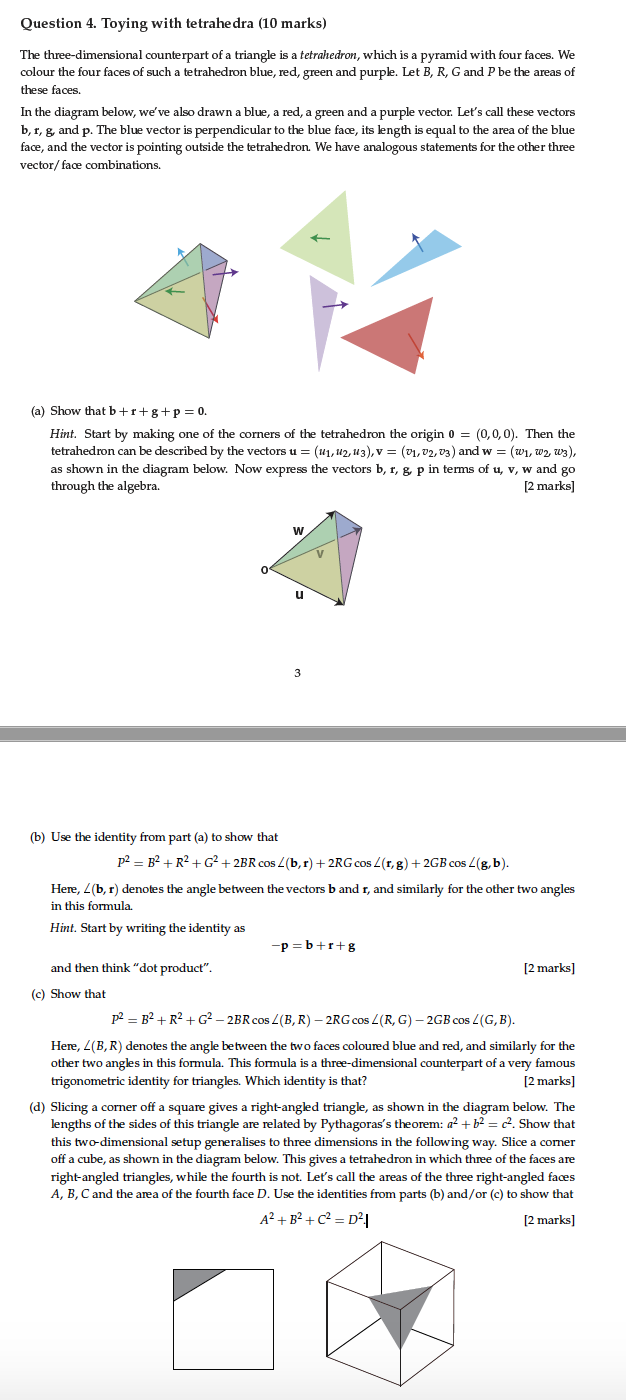
Question 4. Toying with tetrahedronarks) The three-dimensional counterpart of a triangle is a tetrahedron, which is a pyramid with four faces. We colour the four faces of such a tetrahedron blue, red, green and purple. Let B, R, G and P be the areas of these faces. In the diagram below, we've also drawn a blue, a red, a green and a purple vector. Let's call these vectors b, r, g and p. The blue vector is perpendicular to the blue face, its length is equal to the area of the blue face, and the vector is pointing outside the tetrahedron. We have analogous statements for the other three vector/ face combinations. + (a) Show that bor+g+p =0. Hint. Start by making one of the corners of the tetrahedron the origin 0 = (0,0,0). Then the tetrahedron can be described by the vectors u = (#1, 12, 13), V = (01, 72, 03) and w = (w1, w2. w3), as shown in the diagram below. Now express the vectors b, r, g p in terms of u, v, w and go through the algebra. [2 marks] 3 (b) Use the identity from part (a) to show that p2 = B2 + R2 + G2 + 2BR cos Z(b, r) + 2RGcos Z(r, g) + 2GB cos Z(g, b). Here, Z(b, r) denotes the angle between the vectors b and r, and similarly for the other two angles in this formula. Hint. Start by writing the identity as -p=b+r+g and then think "dot product". [2 marks] (c) Show that p2 = B2 + R2 + G2 - 2BR cos _(B, R) - 2RG cos Z(R, G) - 2GB cos Z(G, B). Here, Z(B, R) denotes the angle between the two faces coloured blue and red, and similarly for the other two angles in this formula. This formula is a three-dimensional counterpart of a very famous trigonometric identity for triangles. Which identity is that? [2 marks] (d) Slicing a corner off a square gives a right-angled triangle, as shown in the diagram below. The lengths of the sides of this triangle are related by Pythagoras's theorem: a2 + b2 = c2. Show that this two-dimensional setup generalises to three dimensions in the following way. Slice a comer off a cube, as shown in the diagram below. This gives a tetrahedron in which three of the faces are right-angled triangles, while the fourth is not. Let's call the areas of the three right-angled faces A, B, C and the area of the fourth face D. Use the identities from parts (b) and/ or (c) to show that A2 + B2 + C2 = D21 [2 marks]
Step by Step Solution
There are 3 Steps involved in it

Get step-by-step solutions from verified subject matter experts
 Study Help