







Question: need only conclusions equal importance between the two elements, while the rank 9 indicates the absolute importance of one element over another against which it
need only conclusions
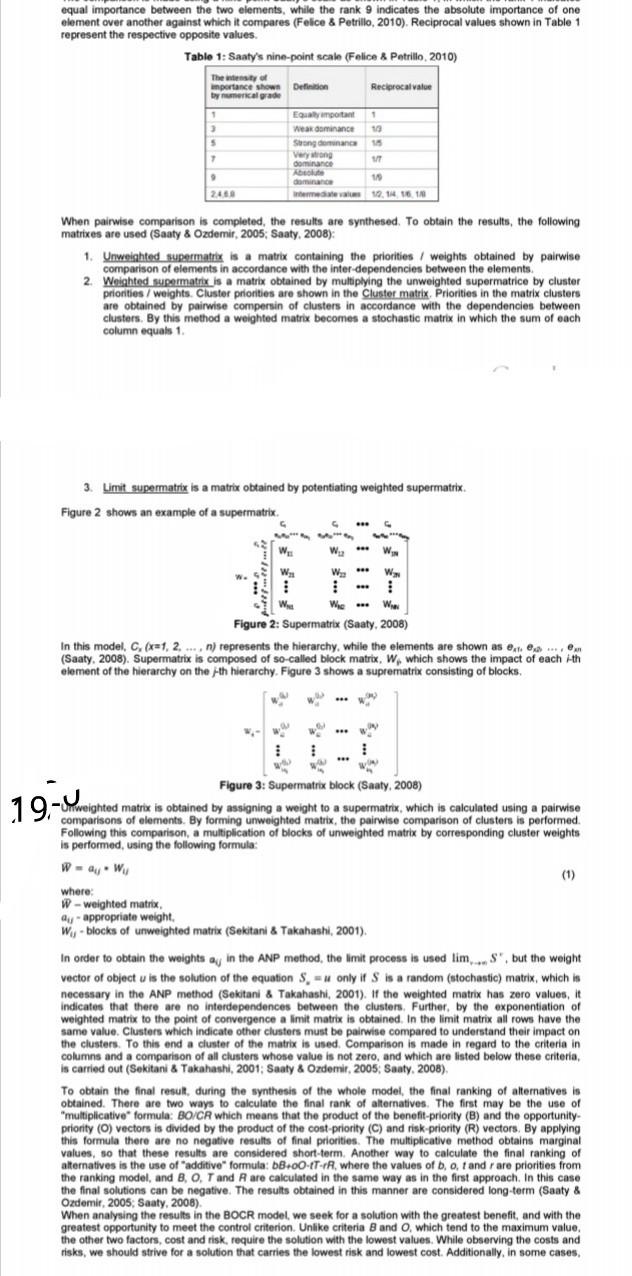
equal importance between the two elements, while the rank 9 indicates the absolute importance of one element over another against which it compares (Felice & Petrillo, 2010). Reciprocal values shown in Table 1 represent the respective opposite values Table 1: Santy's nine-point scale (Felice & Petrillo 2010) Theeya mportance shown Definition Reciprocal value by numerical grade 1 Emportant 3 Weak dominance 15 5 Strong dan 7 Very wrong UT cominards . Absolute 19 dominance 2468 Intermediate 19,14 16.18 1 When pairwise comparison is completed, the results are synthesed. To obtain the results, the following matrixes are used (Saaty & Ozdemir, 2005, Saaty, 2008): 1. Unweighted supermatrix is a matrix containing the priorities / weights obtained by pairwise comparison of elements in accordance with the inter-dependencies between the elements 2. Weighted supermatrix_is a matrix obtained by multiplying the unweighted supermatrice by cluster priorities / weights. Cluster priorities are shown in the Cluster matrix Priorities in the matrix clusters are obtained by pairwise compersin of clusters in accordance with the dependencies between clusters. By this method a weighted matrix becomes a stochastic matrix in which the sum of each column equals 1. 3. Limit supermatrix is a matrix obtained by potentiating weighted supermatrix Figure 2 shows an example of a supermatrix 5 . W W W.2*** Wy". W. SW W W, We W. Figure 2: Supermatrix (Saaty, 2008) In this model, C. (x=1,2,..., n) represents the hierarchy, while the elements are shown as ext. ..., (Saaty, 2008). Supermatrix is composed of so-called block matrix, W, which shows the impact of each ith element of the hierarchy on the th hierarchy. Figure 3 shows a suprematrix consisting of blocks w w : w Figure 3: Supermatrix block (Saaty, 2008) -weighted matrix is obtained by assigning a weight to a supermatrix, which is calculated using a pairwise comparisons of elements. By forming unweighted matrix, the pairwise comparison of clusters is performed Following this comparison, a multiplication of blocks of unweighted matrix by corresponding cluster weights is performed, using the following formula: Way. W (1) where: W-weighted matrix ay - appropriate weight, Wy-blocks of unweighted matrix (Sekitani & Takahashi, 2001). . In order to obtain the weights ay in the ANP method, the limit process is used lim...S', but the weight vector of object is the solution of the equation $. = only if S is a random (stochastic) matrix, which is necessary in the ANP method (Sekitani & Takahashi, 2001). If the weighted matrix has zero values, it indicates that there are no interdependences between the clusters. Further, by the exponentiation of weighted matrix to the point of convergence a limit matrix is obtained. In the limit matrix all rows have the same value. Clusters which indicate other clusters must be pairwise compared to understand their impact on the clusters. To this end a cluster of the matrix is used. Comparison is made in regard to the criteria in columns and a comparison of all clusters whose value is not zero, and which are listed below these criteria, carried out (Sekitani & Takahashi, 2001: Saaty & Ozdemir, 2005Saaty, 2008) To obtain the final resul, during the synthesis of the whole model, the final ranking of alternatives is obtained. There are two ways to calculate the final rank of alternatives. The first may be the use of "multiplicative formula: BO/CR which means that the product of the benefit-priority (B) and the opportunity priority (O) vectors is divided by the product of the cost-priority (C) and risk-priority (R) vectors. By applying this formula there are no negative results of final priorities. The multiplicative method obtains marginal values, so that these results are considered short-term Another way to calculate the final ranking of alternatives is the use of "additive formula: bB00-T-R, where the values of b, of and rare priorities from the ranking model, and B, O, T and R are calculated in the same way as in the first approach. In this case the final solutions can be negative. The results obtained in this manner are considered long-term (Saaty & Ozdemir, 2005, Saaty, 2008) When analysing the results in the BOCR model, we seek for a solution with the greatest benefit, and with the greatest opportunity to meet the control criterion. Unlike criteria 8 and 0, which tend to the maximum value, the other two factors, cost and risk, require the solution with the lowest values. While observing the costs and risks, we should strive for a solution that carries the lowest risk and lowest cost. Additionally, in some casesStep by Step Solution
There are 3 Steps involved in it
1 Expert Approved Answer
Step: 1 Unlock

Question Has Been Solved by an Expert!
Get step-by-step solutions from verified subject matter experts
Step: 2 Unlock
Step: 3 Unlock
 Study Help