







Question: need only part b..handwritten Data Warehousing and Data Mining 1. Note: Only Hand-written solutions are acceptable. Consider the following transaction database. Each row represents a
need only part b..handwritten
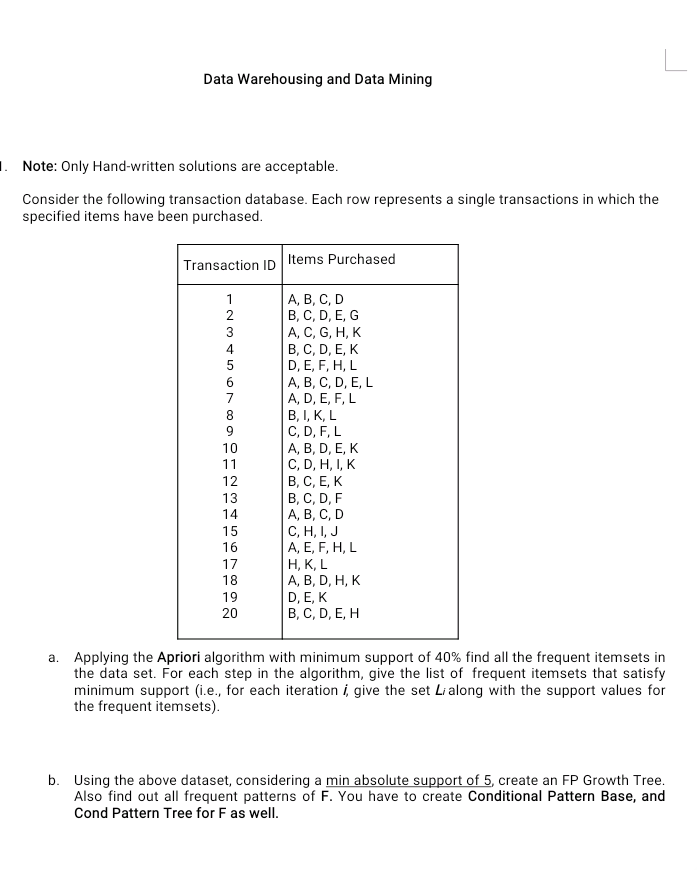
Data Warehousing and Data Mining 1. Note: Only Hand-written solutions are acceptable. Consider the following transaction database. Each row represents a single transactions in which the specified items have been purchased. Transaction ID Items Purchased 1 2 3 4 5 6 7 8 9 10 A, B, C, D B, C, D, E, G A, C, G, H, K B, C, D, E, K D, E, F, H, L A, B, C, D, E, L A, D, E, F, L B, I, K, L C, D, F, L A, B, D, E, K C, D, H, I,K B, C, E, K B, C, D, F A, B, C, D C, H, I, J A, E, F, H, L H, K, L A, B, D, HK D, E, K B, C, D, E,H 11 12 13 14 15 16 17 18 19 20 a. Applying the Apriori algorithm with minimum support of 40% find all the frequent itemsets in the data set. For each step in the algorithm, give the list of frequent itemsets that satisfy minimum support (i.e., for each iteration i give the set Li along with the support values for the frequent itemsets). b. Using the above dataset, considering a min absolute support of 5, create an FP Growth Tree. Also find out all frequent patterns of F. You have to create Conditional Pattern Base, and Cond Pattern Tree for F as well
Step by Step Solution
There are 3 Steps involved in it

Get step-by-step solutions from verified subject matter experts
 Study Help