







Question: * Need only Q5 QUESTION 1 Capital structure enables a better understanding on how a firm finances its assets using debt and equity combinations (Bakry,
* Need only Q5
QUESTION 1
Capital structure enables a better understanding on how a firm finances its assets using debt and equity combinations (Bakry, 2020).
By examining 2018 and 2019 financial statements for Zenith Energy Ltd, ZENs debt ratio was 53.8% in 2018 in comparison to 59.65% in 2019. This significant increase of 10.8% is primarily because of the increase in their short term and long term debt. Hence, demonstrating that the company is financing their assets through debt. On the other hand, the interest coverage ratio is a core method utilised to evaluate whether a company can meet its financial obligations. A company with a high coverage ratio means it will be able to make repayments on its debts (Bakry, 2020). In 2018, ZENs coverage ratio was 6.56, indicating the company is able to repay its debts. However, in 2019 the coverage ratio decreased to 3.17. By analysing the P&L statement, we are able to see that ZEN has increased their expenses whilst the amount of sales has decreased. However, Zeniths EBIT has visibly decreased in 2019 resulting that ZENs main source of finance can be seen as their own debts.
Moving to Contact Energy Ltd, CENs debt ratio in 2018 was 48.7%, and in 2019 was 43.8%. Therefore, we can see their debt ratio has decreased by 10.1% indicating they are repaying their debts quicker which is evident in their substantial reduction of short-term debt by 74%. Again, their interest coverage ratio was 2.79 in 2018 and it increased to 4.08 in 2019 demonstrating an EBIT increase, proving their capability to repay their suppliers earlier than in the previous year. These ratios indicate that CEN is able to meet repayment deadlines. Hence from this we it is clear that CENs main source of finance is from the equity components.
QUESTION 2
To understand how Zenith Energy Limited (ZEN) and Contact Energy Limited (CEN) are managing their expenses it is important to critically evaluate changes to the profit margin ratios and the profit and loss statements from June 2018 to June 2019.
The gross profit margins have remained steady from year to year, 0.35 to 0.36 for Zenith and 0.21 to 0.21 for Contact. Zenith's Operating profit margin decreased from 0.27 to 0.23 while Contacts ratio improved from 0.11 to 0.12. Zenith is generating higher operating profits than Contact, but its financial performance has decreased, while Contacts performance has improved. Zenith's net profit margin decreased from 0.16 to 0.11 while Contacts improved from 0.05 to 0.07. Again, these numbers demonstrate Zenith's financial position is deteriorating while Contact's is improving. The differences in these ratios will be explained below.
Positively, Zeniths revenue has grown by seven percent while Operating Expenses increased by only five percent. However, ZEN is 31% less profitable, after interest and tax expenses, than in the previous year. This is because the value of assets has almost doubled which has resulted in current liabilities increasing three-fold and Net Interest more than two-fold. A significant depreciation increase of $3.5m demonstrates that Zenith has been spending money on Power Generation assets that are depreciating. Other expenses have also increased by 53%. This demonstrates Zeniths poor control of expenses is significantly impacting their Gross Profit and Net Profit figures.
In contrast, Contacts financial position has improved as their Net Profit figures have increased by 50 million. However, changes in labelling of expenses between 2018 and 2019 makes it difficult to analyse the mix of expenses from one year to the next. Nevertheless, it is important to note, Carbon Emissions expenses increased by 47%. Similar to ZEN, CEN had a proportionate increase in total revenue and operating expenses over the two years. In contrast to ZEN, depreciation expenses decreased, so the EBIT (Operating Profit) increased 33%, even greater than the 19% revenue growth. Furthermore, because of positive changes to Interest Revenue and Interest Expenses, profit before tax improved by 58%, an increase of $81,426,573 to $221,754,922. Although CENs tax expenses have increased by approximately $30m because of the profit increase, this just demonstrates the company has made a healthy profit.
In conclusion, the three-profit margin ratios are very informative, indicating a deterioration of Zeniths financial performance while providing insight into the improvement of Contacts financial performance. Detailed examination of the profit and loss statement demonstrates Contact is controlling expenses better than Zenith.
QUESTION 3
A comparison of Contact Energy Limiteds and Zenith Energy Limiteds asset management efficiency ratios for 2018 and 2019 will demonstrate the difference between the capability of managing assets.
In 2019, Contacts total asset turnover was 0.51 in comparison to 0.43 in 2018. This steady increase of $0.08 in sales per $1 is highlighted by its 2019 sales of $2,519,000, a 10% increase in revenue from 2018s revenue of $2,275,000. Additionally, CENs total assets has seen a 7% decrease. Furthermore, CENs fixed asset turnover ratio increased from 0.53 to 0.61 displaying an increase in efficiency in 2019 comparatively to 2018. This increase is due to the 3% decrease in investments of property, plant and equipment from the 2018 year of $4,253,000 to the 2019 year of $4,126,000. These figures demonstrate that Contact has liquidated its obsolete assets in order to generate revenue which has proven to be highly successful for the entity.
On the other hand, Zeniths total asset turnover in 2019 was 0.31 compared to its total asset turnover of 0.53 in 2018. Interestingly, the $0.12 loss is not because of the change in revenue as was with CEN, as it saw a 7% increase from 2018s revenue. However, because the total asset value increased by 86% in 2019 and the inventory increased from $2,686,000 in 2018 to $6,962,000 the following year it demonstrates ZEN's lack of efficient asset management and its repercussions on the entity.. In addition ZEN is unable to purchase excess inventory to be sold as a result of this. In comparison, CENs 20% decrease has allowed them to efficiently utilise their assets to generate profit. ZENs fixed total asset turnover decreased to 0.37 in 2019 from 0.68. This is a result of the 106% increase of the investment of liabilities. Hence, emphasising Zeniths poor management of assets in comparison to Contact.
To conclude, an analysis of both Contact Energy Limited and Zenith Energy Limiteds asset management demonstrate CENs increase in efficiency to generate revenue and highlights ZENs poor management of assets.
QUESTION 4
Zenith Energy's return on invested capital (ROIC) had high profitability ratios of 12.16 in 2018, indicating that cash invested from shareholders was durable and effective. However in 2019 it is seen that Zenith Energys ROIC dropped substantially to 5.30. In comparison, Contact Energy had a steady increase in their ROIC ratio from 5.12 to 6.96 indicating a more sustainable and effective profitability than Zenith Energy.
Changes that reinforce Zenith Energys poor profitability ratio is the changes in their net operating profits. It is seen in 2018 that their net operating profits were 19.08 which is considered to be high. However continuing to 2019, there was a significant depreciation of operating profits to 15.51 which translated to their poor ROIC in the same year. This shows that Zenith Energys conversion from invested capital to net operating capital was not as efficient in 2019 than 2018. This is due to Zeniths poor management of expenses and profitability. Zeniths increase in current liabilities and depreciating expenses such as Power Generation costed 3.5 Million AUD for Zenith as well as other inefficient expenses, highlighted their poor management of expenses which depreciated their net operating profits. This resulted in a poor ROIC conversion ultimately making Zenith less profitable in 2019.
Furthermore Zenith Energy had effective investment capital turnover ratios of 0.64 in 2018 which depreciated to 0.34 in 2019, in addition Zenith Energy had almost double more stockholder equity of 48.43 to utilise in 2019 than 26.11 in 2018. Despite the increase in resources obtained from stockholders equity, Zenith was ineffective in managing the equity invested to produce revenue which can be seen with large volumes of investing in depreciating assets from 96.42 in 2018 to 179.40 in 2019. Zeniths unsustainable ROIC and profitability derives from ineffective management of assets, equity and expenses.
Contrastingly, changes that reinforce Contact Energys effective profitability of invested capital are the changes in their net operating profit. It is seen that Contacts profit before tax improved by 58% , an increase of 81,426573 to 221,754,922 from 2018 to 2019. The increase in net profit shows that there are increases in effectiveness and ratio of their invested capital turnover as invested capital stayed relatively similar from 0.69 in 2018 to 0.60 in 2019. This shows that Contact is much more effective in generating profit from investor funds. Contact Energys sustainable ROIC and high profitability derives from their ability to use invested capital effectively.
** You have to answer the question 5.
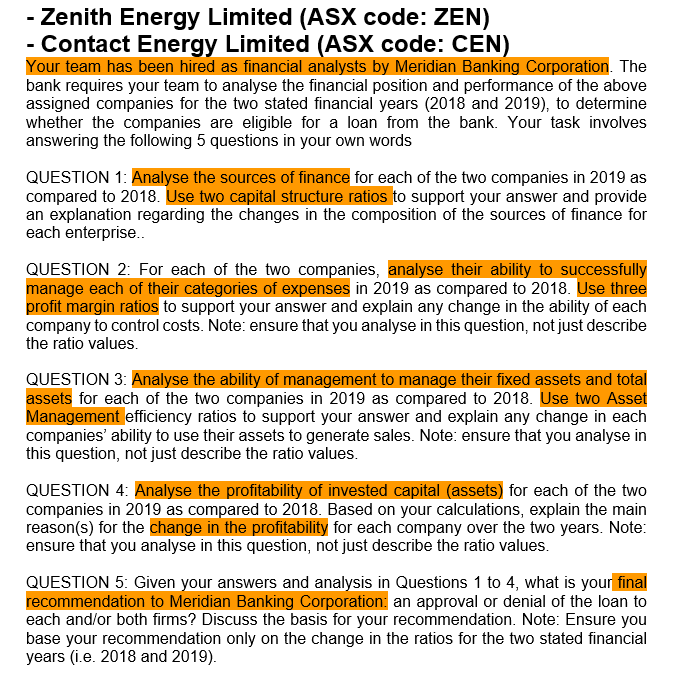
- Zenith Energy Limited (ASX code: ZEN) - Contact Energy Limited (ASX code: CEN) Your team has been hired as financial analysts by Meridian Banking Corporation. The bank requires your team to analyse the financial position and performance of the above assigned companies for the two stated financial years (2018 and 2019), to determine whether the companies are eligible for a loan from the bank. Your task involves answering the following 5 questions in your own words QUESTION 1: Analyse the sources of finance for each of the two companies in 2019 as compared to 2018. Use two capital structure ratios to support your answer and provide an explanation regarding the changes in the composition of the sources of finance for each enterprise. QUESTION 2: For each of the two companies, analyse their ability to successfully manage each of their categories of expenses in 2019 as compared to 2018. Use three profit margin ratios to support your answer and explain any change in the ability of each company to control costs. Note: ensure that you analyse in this question, not just describe the ratio values. QUESTION 3: Analyse the ability of management to manage their fixed assets and total assets for each of the two companies in 2019 as compared to 2018. Use two Asset Management efficiency ratios to support your answer and explain any change in each companies' ability to use their assets to generate sales. Note: ensure that you analyse in this question, not just describe the ratio values. QUESTION 4: Analyse the profitability of invested capital (assets) for each of the two companies in 2019 as compared to 2018. Based on your calculations, explain the main reason(s) for the change in the profitability for each company over the two years. Note: ensure that you analyse in this question, not just describe the ratio values. QUESTION 5: Given your answers and analysis in Questions 1 to 4, what is your final recommendation to Meridian Banking Corporation: an approval or denial of the loan to each and/or both firms? Discuss the basis for your recommendation. Note: Ensure you base your recommendation only on the change in the ratios for the two stated financial years (i.e. 2018 and 2019)
Step by Step Solution
There are 3 Steps involved in it

Get step-by-step solutions from verified subject matter experts
 Study Help