







Question: Need Question 4 answered with explanation please Example 3. Using these notions of security, we now have a very firm and clear basis to show
Need Question 4 answered with explanation please
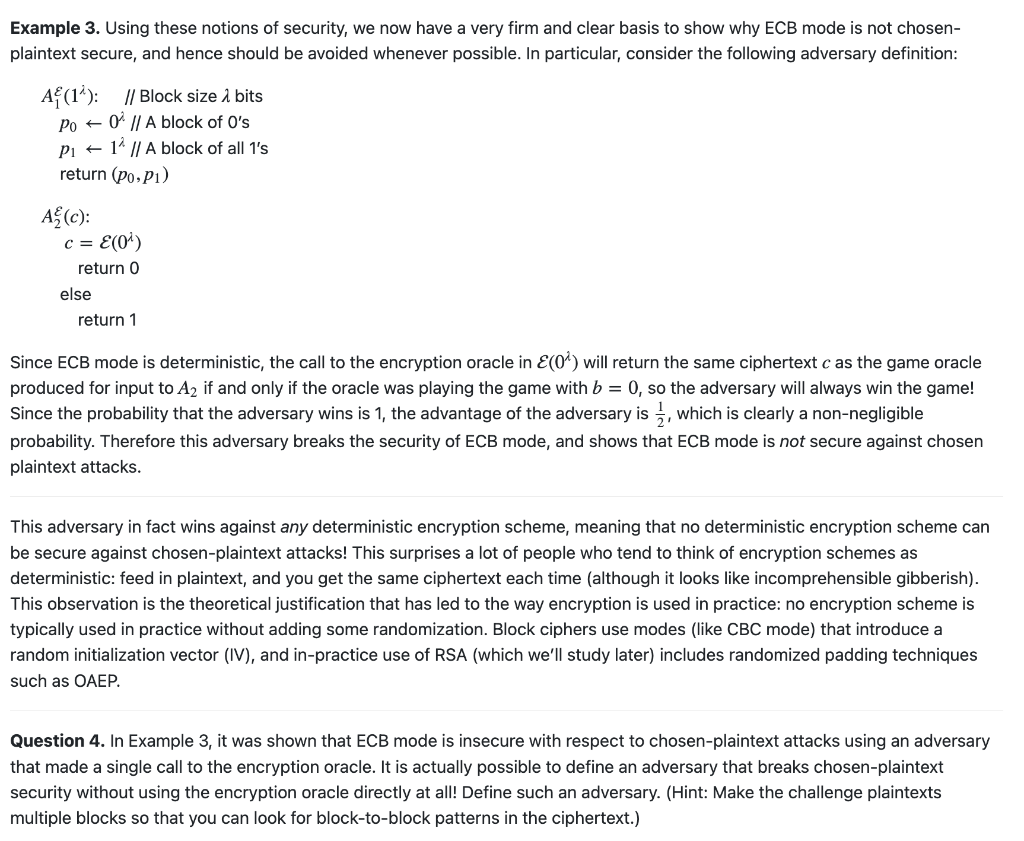
Example 3. Using these notions of security, we now have a very firm and clear basis to show why ECB mode is not chosenplaintext secure, and hence should be avoided whenever possible. In particular, consider the following adversary definition: A1E(1):// Block size bits p00// A block of 0 's p11// A block of all 1's return (p0,p1) A2E(c): c=E(0) return 0 else return 1 Since ECB mode is deterministic, the call to the encryption oracle in E(0) will return the same ciphertext c as the game oracle produced for input to A2 if and only if the oracle was playing the game with b=0, so the adversary will always win the game! Since the probability that the adversary wins is 1 , the advantage of the adversary is 21, which is clearly a non-negligible probability. Therefore this adversary breaks the security of ECB mode, and shows that ECB mode is not secure against chosen plaintext attacks. This adversary in fact wins against any deterministic encryption scheme, meaning that no deterministic encryption scheme can be secure against chosen-plaintext attacks! This surprises a lot of people who tend to think of encryption schemes as deterministic: feed in plaintext, and you get the same ciphertext each time (although it looks like incomprehensible gibberish). This observation is the theoretical justification that has led to the way encryption is used in practice: no encryption scheme is typically used in practice without adding some randomization. Block ciphers use modes (like CBC mode) that introduce a random initialization vector (IV), and in-practice use of RSA (which we'll study later) includes randomized padding techniques such as OAEP. Question 4. In Example 3, it was shown that ECB mode is insecure with respect to chosen-plaintext attacks using an adversary that made a single call to the encryption oracle. It is actually possible to define an adversary that breaks chosen-plaintext security without using the encryption oracle directly at all! Define such an adversary. (Hint: Make the challenge plaintexts multiple blocks so that you can look for block-to-block patterns in the ciphertext.)
Step by Step Solution
There are 3 Steps involved in it

Get step-by-step solutions from verified subject matter experts
 Study Help