







Question: Need questions 4-6 from Exercise 1. Exercise 1 (A Negative Supply Shock). Consider a two-period sticky-price economy populated by identical households with preferences defined over
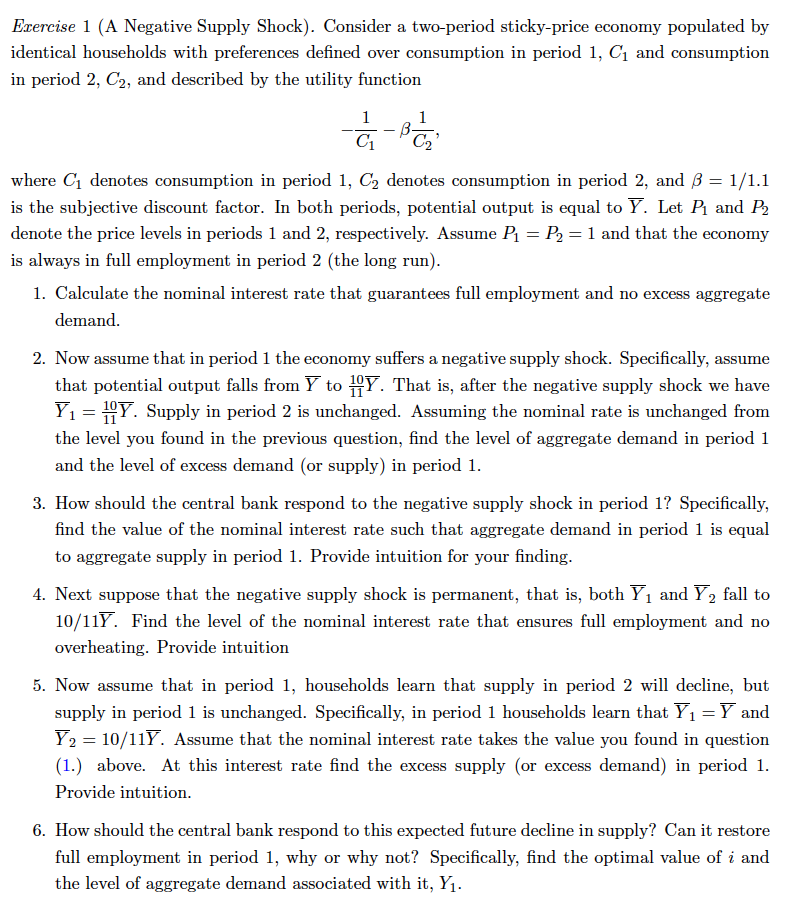
Need questions 4-6 from Exercise 1.
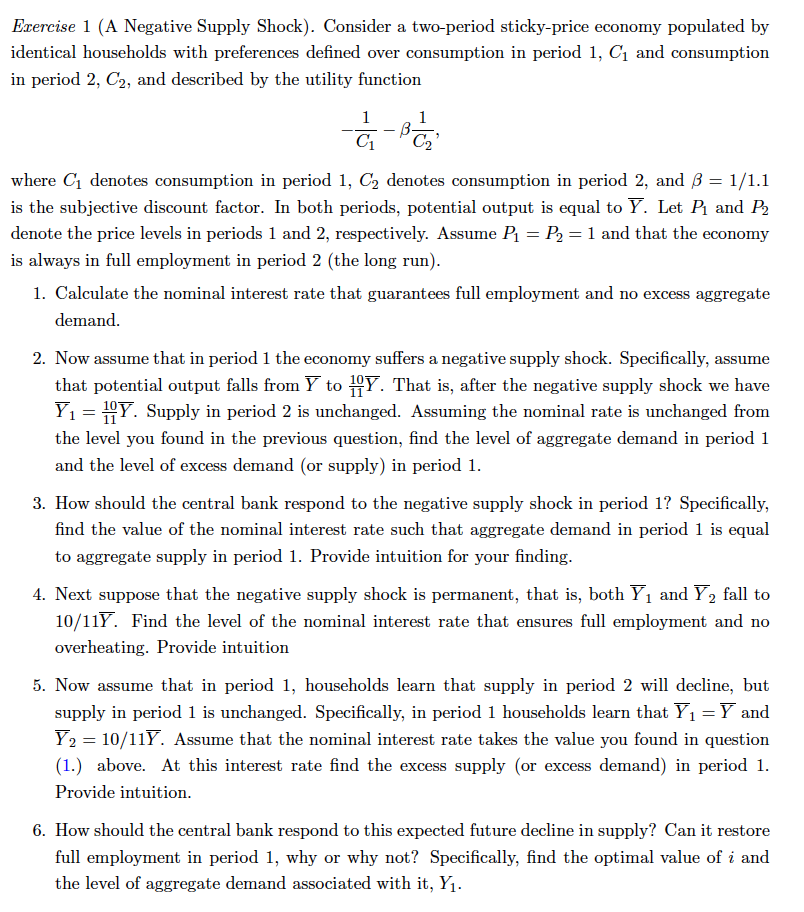
Exercise 1 (A Negative Supply Shock). Consider a two-period sticky-price economy populated by identical households with preferences defined over consumption in period 1, C1 and consumption in period 2, C2, and described by the utility function CI where C1 denotes consumption in period 1, C2 denotes consumption in period 2, and B = 1/1.1 is the subjective discount factor. In both periods, potential output is equal to Y. Let Pi and P2 denote the price levels in periods 1 and 2, respectively. Assume P1 = P2 = 1 and that the economy is always in full employment in period 2 (the long run). 1. Calculate the nominal interest rate that guarantees full employment and no excess aggregate demand. 2. Now assume that in period 1 the economy suffers a negative supply shock. Specifically, assume that potential output falls from Y to # Y. That is, after the negative supply shock we have HY. Supply in period 2 is unchanged. Assuming the nominal rate is unchanged from the level you found in the previous question, find the level of aggregate demand in period 1 and the level of excess demand (or supply) in period 1. 3. How should the central bank respond to the negative supply shock in period 1? Specifically, find the value of the nominal interest rate such that aggregate demand in period 1 is equal to aggregate supply in period 1. Provide intuition for your finding. 4. Next suppose that the negative supply shock is permanent, that is, both Y, and Y2 fall to 10/11Y. Find the level of the nominal interest rate that ensures full employment and no overheating. Provide intuition 5. Now assume that in period 1, households learn that supply in period 2 will decline, but supply in period 1 is unchanged. Specifically, in period 1 households learn that Y1 = Y and Y2 = 10/11Y. Assume that the nominal interest rate takes the value you found in question (1.) above. At this interest rate find the excess supply (or excess demand) in period 1. Provide intuition. 6. How should the central bank respond to this expected future decline in supply? Can it restore full employment in period 1, why or why not? Specifically, find the optimal value of i and the level of aggregate demand associated with it, Y1
Step by Step Solution
There are 3 Steps involved in it

Get step-by-step solutions from verified subject matter experts
 Study Help