







Question: Need quick answer for those questions 1) Facts and Assumptions. What are the central facts of the case and the assumptions you are making on
Need quick answer for those questions
1) Facts and Assumptions. What are the central facts of the case and the assumptions you are making on the basis of these facts?
2. Major Overriding Issues/Problems. What are the major overriding issues in this case? (What major questions/issues does this case address that merit(s) their/its study in this course and in connection with the chapter/material you are now covering?)
3. Sub-issues and Related Issues. What sub-issues or related issues are present in the case that merit consideration, discussion, and action?
4. Stakeholder Analysis. Who are the stakeholders in this case, and what are their stakes? (Create a stakeholder map to depict relationships.) What challenges/ threats/opportunities are posed by these stakeholders? What stakeholder characteristics are at work (legitimacy, power, urgency)?
5. CSR Analysis. What Corporate Social Responsibilities (CSR) economic/legal/ethical/ philanthropic does the company have, and what exactly are the nature and extent of these responsibilities to the various stakeholders?
6. Evaluations. If the case involves a companys or managers actions, evaluate what the company or manager did or did not do correctly in handling the issue affecting it. How should actions have been handled?
7. Recommendations and Implementation. What recommendations would you make in this case? If a companys or a managers strategies or actions are involved, should they have acted the way they did? What actions should they have taken? What actions should the company or manager take now, and why? Be specific and include a discussion of alternatives (right now, short-term and long-term). Identify and discuss any important implementation considerations.
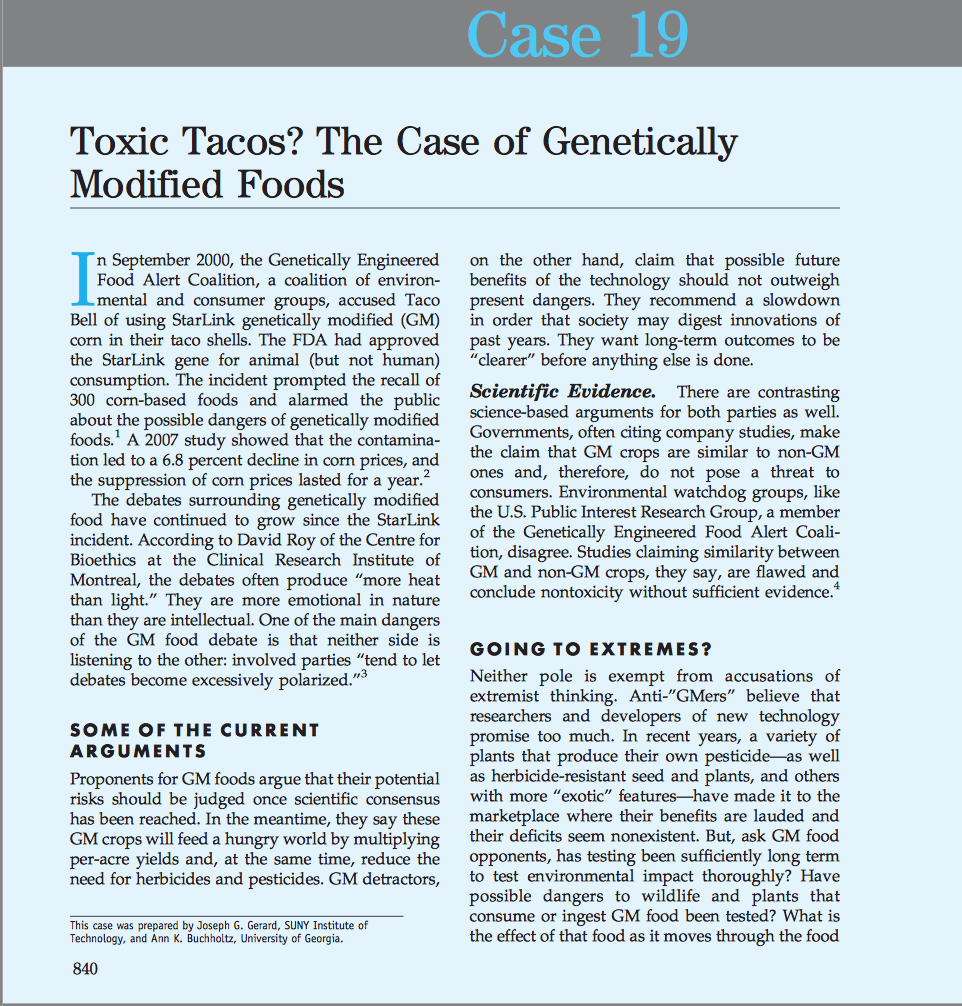
Case 19 Toxic Tacos? The Case of Genetically Modified Foods n September 2000, the Genetically Engineered on the other hand, claim that possible future Food Alert Coalition, a coalition of environ- benefits of the technology should not outweigh present dangers. They recommend a slowdown mental and consumer groups, accused Taco Bell of using StarLink genetically modified (GM) in order that society may digest innovations of corn in their taco shells. The FDA had approved the StarLink gene for animal (but not human) consumption. The incident prompted the recall of 300 corn-based foods and alarmedthe public about the possible dangers of genetically modified foods. A 2007 study showed that the contamina tion led to a 6.8 percen the suppression of corn prices lasted for a year past years. They want long-term outcomes to be "clearer" before anything else is done. Scientific Evidence. There are contrasting science-based arguments for both parties as well. Governments, often citing company studies, make the claim that GM ones and, therefore, do not pose a threat to consumers. Environmental watchdog groups, like t decline in corn prices, and crops are similar to non-GM 2 The debates surrounding genetically modified food have continued to grow since the StarLink incident. According to David Roy of the Centre for Bioethics at the Clinical Research Institute of Montreal, the debates often produce "more heat than light." They are more emotional in nature than they are intellectual. One of the main dangers of the GM food debate is that neither side is listening to the other: involved parties "tend to let debates become excessively polarized the U.S. Public Interest Research Group, a member of the Genetically Engineered Food Alert Coali tion, disagree. Studies claiming similarity between GM and non-GM crops, they say, are flawed and conclude nontoxicity without sufficient evidence GOING TO EXTREMES? Neither pole is exempt from accusations of extremist thinking. Anti-"GMers" believe that researchers and developers of new technology promise too much. In recent years, a variety of plants that produce their own pesticide-as well as herbicide-resistant seed and plants, and others with more "exotic" features-have made it to the marketplace where their benefits are lauded and their deficits seem nonexistent. But, ask GM opponents, has testing been sufficiently long term to test environmental impact thoroughly? Have possible dangers to wildlife and plants that consume or ingest GM food been tested? What is the effect of that food as it moves through the food SOME OF THE CURRENT ARGUMENTS Proponents for GM foods argue that their potential risks should be judged once scientific consensus has been reached. In the meantime, they say these GM crops will feed a hungry world by multiplying per-acre yields and, at the same time, reduce the need for herbicides and pesticides. GM detractors, food This case was prepared by Joseph G. Gerard, SUNY Institute of Technology, and Ann K. Buchholtz, University of Georgia. 840
Step by Step Solution
There are 3 Steps involved in it

Get step-by-step solutions from verified subject matter experts
 Study Help