







Question: Need #'s 1&2 procedure pictured here for any additional info Prelab: Bromination of Acetanilide 1. Draw the 2 isomers expected for the reaction of Br2
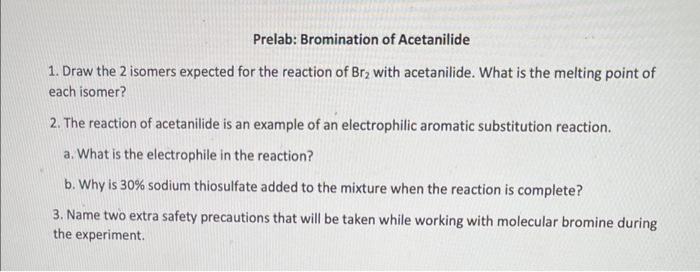
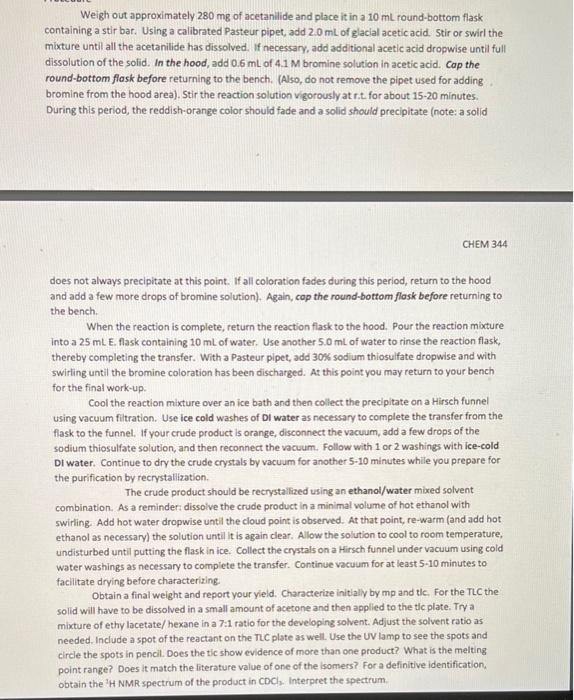
Prelab: Bromination of Acetanilide 1. Draw the 2 isomers expected for the reaction of Br2 with acetanilide. What is the melting point of each isomer? 2. The reaction of acetanilide is an example of an electrophilic aromatic substitution reaction. a. What is the electrophile in the reaction? b. Why is 30% sodium thiosulfate added to the mixture when the reaction is complete? 3. Name two extra safety precautions that will be taken while working with molecular bromine during the experiment. Weigh out approximately 280mg of acetanilide and place it in a 10mL round-bottom flask containing a stir bar. Using a calibrated Pasteur pipet, add 2.0mL of glacial acetic acid. 5 tir or swirl the mixture until all the acetanilide has dissolved. If necessary, add additional acetic acid dropwise until full dissolution of the solid. In the hood, add 0.6mL of 4.1M bromine solution in acetic acid. Cap the round-bottom flask before returning to the bench. (Also, do not remove the pipet used for adding bromine from the hood area). Stir the reaction solution vigorously at r.t. for about 1520 minutes. During this period, the reddish-orange color should fade and a solid should precipitate (note: a solid does not always precipitate at this point. If all coloration fades during this period, return to the hood and add a few more drops of bromine solution). Again, cop the round-bottom flask before returning to the bench. When the reaction is complete, return the reaction flask to the hood. Pour the reaction macture into a 25mL. flask containing 10mL of water. Use another 5.0mL of water to rinse the reaction flask, thereby completing the transfer. With a Pasteur pipet, add 30% sodium thiosulfate dropwise and with swirling until the bromine coloration has been discharged. At this point you may return to your bench for the final work-up. Cool the reaction mixture over an ice bath and then collect the precipitate on a Hirsch funnel using vacuum filtration. Use ice cold washes of DI water as necessary to complete the transfer from the flask to the funnel. If your crude product is orange, disconnect the vacuum, add a few drops of the sodium thiosulfate solution, and then reconnect the vacuum. Follow with 1 or 2 washings with ice-cold Di water. Continue to dry the crude crystals by vacuum for another 5-10 minutes while you prepare for the purification by recrystallization. The crude product should be recrystalized using an ethanol/water mixed solvent combination. As a reminder dissolve the crude product in a minimal volume of hot ethanol with swirling. Add hot water dropwise untll the cloud point is observed. At that point, re-warm (and add hot ethanol as necessary) the solution until it is again clear. Allow the solution to cool to room temperature, undisturbed until putting the flask in ice. Collect the crystals on a Hirsch funnel under vacuum using cold water washings as necessary to complete the transfer. Continue vacuum for at least 5-10 minutes to facilitate drying before characterizing. Obtain a finai weight and report your yield. Characterize initially by mp and tlc. for the TLC the solid will have to be dissolved in a small amount of acetone and then applied to the tic plate. Try a mixture of ethy lacetate/ hexane in a 7:1 ratio for the developing solvent. Adjust the solvent ratio as needed. Include a spot of the reactant on the niC plate as well. Use the UV lamp to see the spots and circle the spots in pencil. Does the tic show evidence of more than one product? What is the melting point range? Does it match the literature value of one of the isomers? For a definitive identification, obtain the ' H NMR spectrum of the product in CDC2. Interpret the spectrum
Step by Step Solution
There are 3 Steps involved in it

Get step-by-step solutions from verified subject matter experts
 Study Help