







Question: Need short and good case synopsis and Problem statement for java j's company's case study At their regular weekly meeting on 29th March, 2020, Judi
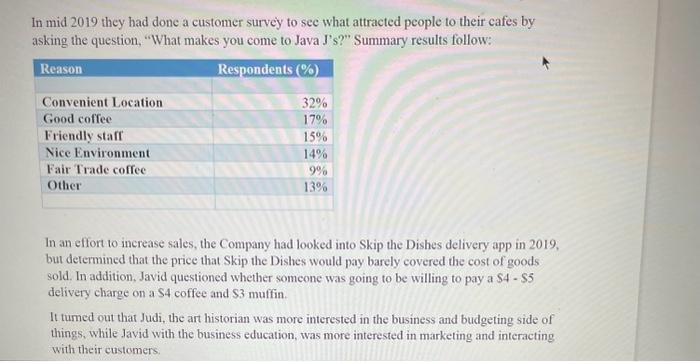
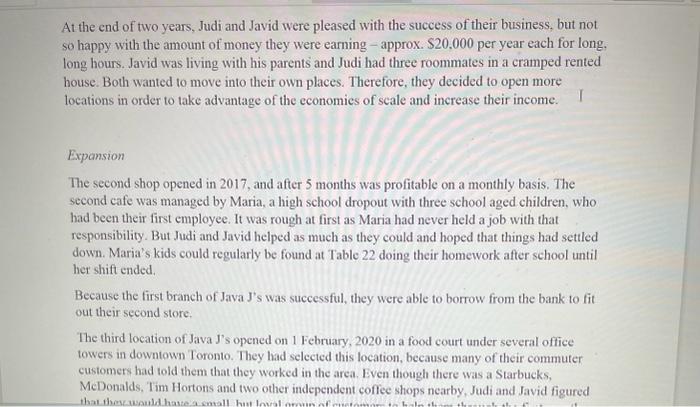
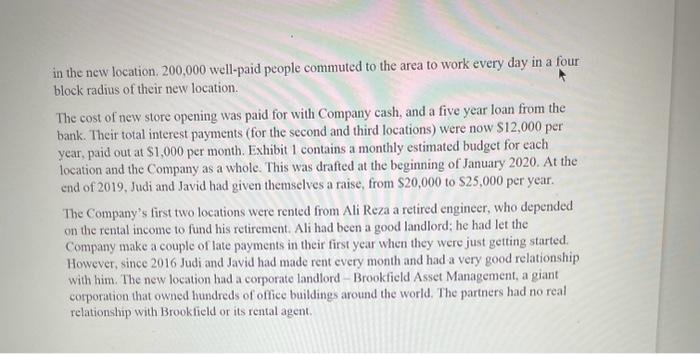
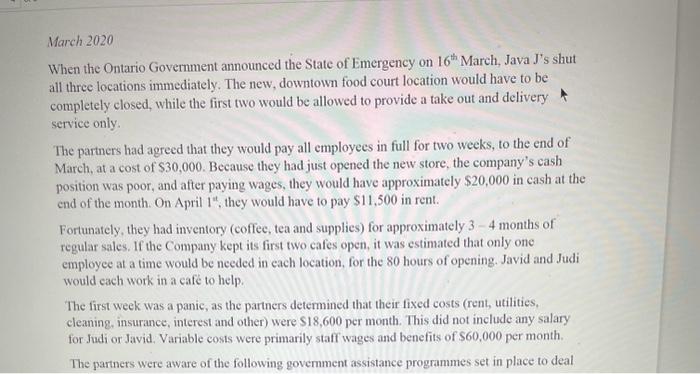
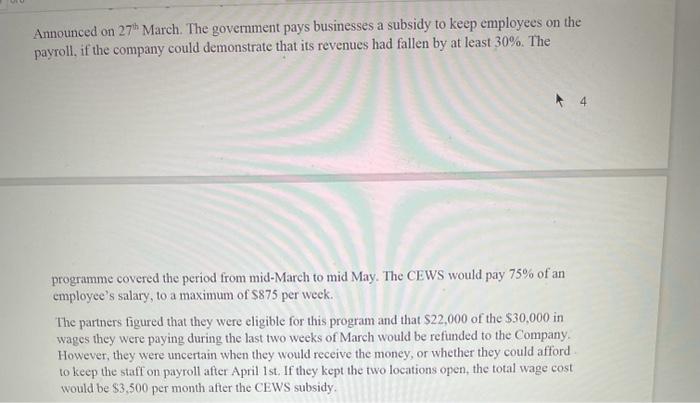
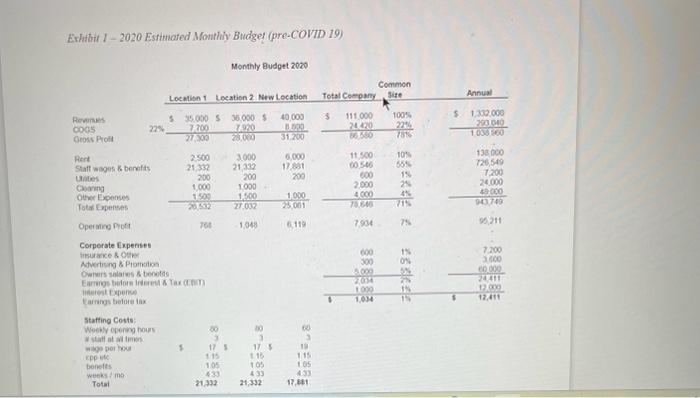
At their regular weekly meeting on 29th March, 2020, Judi Turcotte and Javid Jeyasundra the owners of three Java J's coffee and tea cafes in Toronto were contemplating a dismal future. Two weeks previously, the Government of Ontario had declared a State of Emergency to deal with the Covid 19 pandemic. Under this legislation, all non-essential services (including coffee shops and restaurants) were ordered closed indefinitely. Since January, Judi and Javid had been watching the spread of the COVID-19 coronavirus from China, to Italy and Iran, then to the rest of Europe. As successive countries went into lockdown and ordered businesses closed, the partners and staff became increasingly concerned abut what would happen in Canada and how it would affect their business. History Judi and Javid had met in university in 2013, where Judi was studying art history and Javid was in a business programme. Judi had become interested in coffee, good coffee, in her first year of university, while Javid much preferred tea. Sometime during their fourth year, they began talking about how much fun it would be to open a high quality, ethically-based coffec shop. Although coffee sales were dominated by the big chains, Starbucks, Tim Horton's and McDonald's, Judi and Javid were aware of numerous successful independent coffee and tea cafes throughout the city. After discussing the idea for more that a year, and unable to find interesting full time jobs, they decided to take the plunge and open their first shop in the Junction area of Toronto in late 2015 , They formed a company with 50% of the shares owned by each of Javid and Judi. The Company took over a shuttered Coffee Time (a generally downmarket coffee chain) location and renamed it Java J's Cafe. With friends (and professional help where required), they renovated the shop and fumished it with casts offs and used tables and chairs from charity shops. The total cost of opening was $120,000, which was spent on a coffee roaster; two commercial espresso machines; refrigerators; changing the signage, point of sale computer system and opening inventory and supplics: Each of the owners contributed $5,000 in sivings to the Company. The balance of the required funds came from government grants and loans for young entrepreneurs, friends and family, and a small operating loan from a bank. All coffee and teas were sourced from Fair Trade certified producers'. Their selection of baked goods came from local artisan bakers, some of whose entire business was in supplying Java J's. Because of the location, Java J's was able to attract customers from its opening. Most of the Coffee Time regulars never came back as the average price of a cup of coffee had gone from $1.50 to $4.50 - more for specialty coffees. 'Tea sold for $2.00 to $3.50 depending on the blend. The main local competition (within one mile) was two Tim Horton's and one McDonalds. However, the neighbourhood was changing - with more and more new residents being willihg to pay the higher prices for a good cup of coffec or tea and artisanal baked goods. The Fair Trade affiliation also attracted some customers. Operations Judi and Javid were committed to high levels of corporate social responsibility - both in purchases of Fair Trade coffee and tea and in their treatment of their employees. Their staff of nearly 30 people (seven of whom were part-time students) were well paid for the industry, and earned benefits much better than the industry average. Staff were paid at least $17.00 per hour three dollars per hour more than minimum wage. After three months of employment, all employees were eligible for the company's health care insurance which covered the cost of prescriptions, eyeglasses, dentist visits, and other items. This cost the Company $96 per month per employee. In addition, they provided workers schedules two weeks in advance which was deeply appreciated by those with family responsibilities. As a result, staff turnover was very low. Staff knew most regular customers and their orders which helped to speed service and made customers feel special and loyal to the location. After the first year of operations, the Company had identified three types of customers: - stay at home moms who met friends at the cafe; home workers who took breaks in the cafe or settled in to work for a few houts; and, passing traffic-(commuters) who bought a drink on their way to work. Sales were split roughly 45% dine in (the first two types of customer), 45% take out, and 10% sales of bagged coffee and tea. The caf was open 80 hours a week - 7 am to 7pm on weekdays and 8 am to 6pm on weekends. Java J's bought all its coffee and tea from one of six Fair Trade organisations. The coffee beans were then roasted in a back room at the Cafe. Fair Trade coffee and teas were more expensive than regular commercial coffee, but Java J's was able to charge a premium price for it. Baked goods were purchased from a number of small local artisanal bakers, several of whom made their products in a home kitchen. Other supplies - cups, lids, milk, cream, water, juice, ete. were purchased from one of the many restaurant supply companies operating in Canada. The company had a minimal website presence with its menu, opening hours, and information on their underlying philosophy of serving high quality Fair Trade coffee and teas, while giving back to the community. They were more active on social media. Javid was responsible for their presence on social, posting several times a month on each of Instagram, Twitter, and Facebook. Each channel had approximately 500 followers, with about 300 individuals following on all three channels. In mid 2019 they had done a customer survey to see what attracted people to their cafes by asking the question, "What makes you come to Java J's?" Summary results follow: In an effort to increase sales, the Company had looked into Skip the Dishes delivery app in 2019 , but determined that the price that Skip the Dishes would pay barely covered the cost of goods sold. In addition. Javid questioned whether someone was going to be willing to pay a $4 - $5 delivery charge on a $4 coffee and $3 muffin. It tumed out that Judi, the art historian was more interested in the business and budgeting side of things, while Javid with the business education, was more interested in marketing and interacting with their customers. At the end of two years, Judi and Javid were pleased with the success of their business, but not so happy with the amount of money they were earning - approx. $20.000 per year each for long. long hours. Javid was living with his parent' and Judi had three roommates in a cramped rented house. Both wanted to move into their own places. Therefore, they decided to open more locations in order to take advantage of the economies of scale and increase their income. Expansion The second shop opened in 2017 , and after 5 months was profitable on a monthly basis. The second cafe was managed by Maria, a high school dropout with three school aged children, who had been their first employee. It was rough at first as Maria had never held a job with that responsibility. But Judi and Javid helped as much as they could and hoped that things had settled down. Maria's kids could regularly be found at Table 22 doing their homework after school until her shift ended. Because the first branch of Java J's was successful, they were able to borrow from the bank to fit out their second store. The third location of Java J's opened on 1 February, 2020 in a food court under several office towers in downtown Toronto. They had selected this location, because many of their commuter customers had told them that they worked in the area. Even though there was a Starbucks, MeDonalds, Tim Hortons and two other independent coffee shops nearby, Judi and Javid figured in the new location. 200,000 well-paid people commuted to the area to work every day in a four block radius of their new location. The cost of new store opening was paid for with Company cash, and a five year loan from the bank. Their total interest payments (for the second and third locations) were now $12,000 per year, paid out at $1,000 per month. Exhibit 1 contains a monthly estimated budget for each location and the Company as a whole. This was drafted at the beginning of January 2020 . At the end of 2019 , Judi and Javid had given themselves a raise, from $20,000 to $25,000 per year. The Company's first two locations were rented from Ali Reza a retired engineer, who depended on the rental income to fund his retirement. Ali had been a good landlord; he had let the Company make a couple of late payments in their first year when they were just getting started. However, since 2016 Judi and Javid had made rent every month and had a very good relationship with him. The new location had a corporate landlord - Brookficld Asset Management, a giant corporation that owned hundreds of office buildings around the world. The partners had no real relationship with Brookfield or its rental agent. March 2020 When the Ontario Government announced the State of Emergency on 16th March, Java J's shut all three locations immediately. The new, downtown food court location would have to be completely closed, while the first two would be allowed to provide a take out and delivery service only. The partners had agreed that they would pay all employees in full for two weeks, to the end of March, at a cost of $30,000. Because they had just opened the new store, the company's cash position was poor, and after paying wages, they would have approximately $20,000 in cash at the end of the month. On April 1", they would have to pay $11,500 in rent. Fortunately, they had inventory (coffec, tea and supplies) for approximately 34 months of regular sales. If the Company kept its first two cafes open, it was estimated that only one employee at a time would be needed in each location, for the 80 hours of opening. Javid and Judi would cach work in a cafe to help. The first week was a panic, as the partners determined that their fixed costs (rent, utilities, cleaning, insurance, interest and other) were $18,600 per month. This did not include any salary for Judi or Javid. Variable costs were primarily staff wages and benefits of $60,000 per month. The parmers were aware of the following government assistance programmes set in place to deal Announced on 27h March. The government pays businesses a subsidy to keep employees on the payroll, if the company could demonstrate that its revenues had fallen by at least 30%. The programme covered the period from mid-March to mid May. The CEWS would pay 75% of an employee's salary, to a maximum of $875 per week. The partners figured that they were eligible for this program and that $22,000 of the $30,000 in wages they were paying during the last two weeks of March would be refunded to the Company. However, they were uncertain when they would receive the money, or whether they could afford to keep the staff on payroll after April 1st. If they kept the two locations open, the total wage cost would be $3,500 per month after the CEWS subsidy. Exhithit I - 2020 Estmated Monthy Budget (pre-COVID 19) Montify Budeet zobe
Step by Step Solution
There are 3 Steps involved in it

Get step-by-step solutions from verified subject matter experts
 Study Help